Cloudflare Just Named the Role That Doesn't Survive AI: Measurers
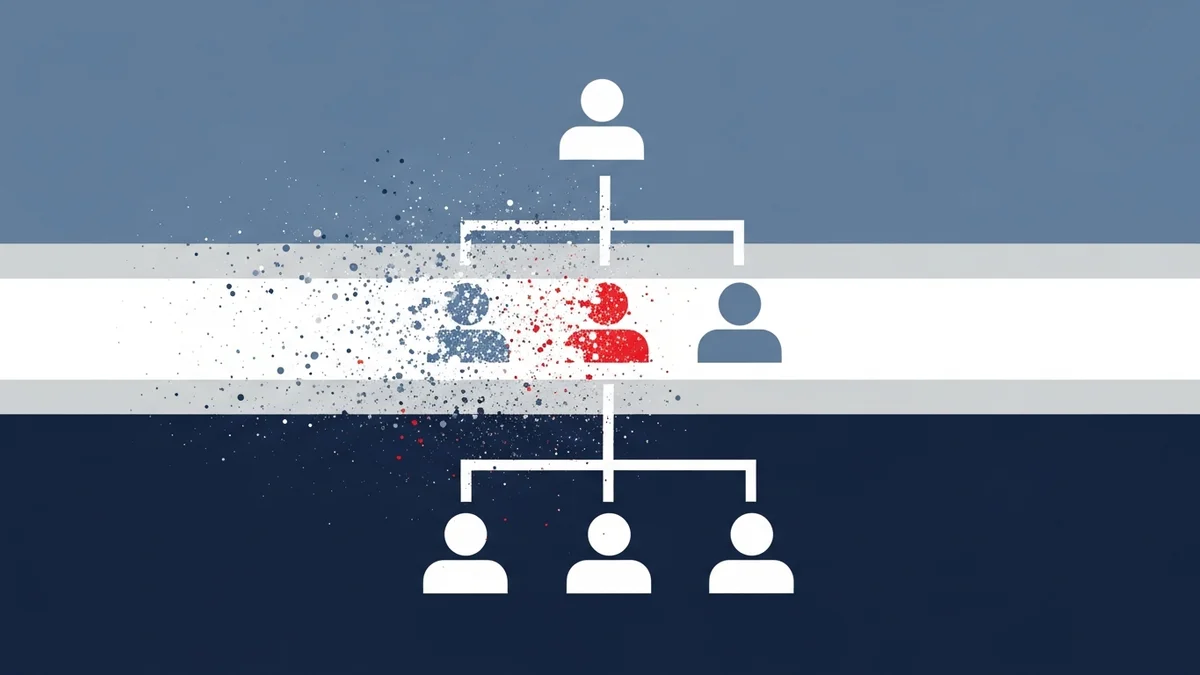
In May 2026, Cloudflare cut 1,100 employees. First mass layoff in the company’s 16-year history. The headline number is not what matters. The label Matthew Prince hung on the people being cut is.
He called them “measurers.” Middle management. Finance. Legal. Internal auditing. Revenue recognition. The functions whose work product is verification of someone else’s work product.
This is the first time a major-tech CEO has named coordination as the cuttable layer when AI absorbs execution. The framing matters more than the layoff. Every board deck for the next two quarters will borrow the word. Every CFO will ask which of their cost centers fall under the new taxonomy. The question worth fighting over is not whether measurers should be cut. It is what replaces them, because AI execution without measurer-equivalent oversight is the failure mode nobody is pricing in yet.
What Prince actually said
The author at Hackyexperiments captured the rhetoric clearly: “A founder cutting 20% writes an op-ed in the Wall Street Journal and gets called brave.” The same author argues that “a 5-to-10 person company starting today can credibly take on incumbents with thousands.” And the technical claim underneath the philosophy: variance in engineer productivity is now “directly measurable via token usage.”
Three moves nested in those sentences. Each one is a thesis we have been circling for a year.
First move: the cost of running a company has fallen far enough that the measurement layer is the most expensive layer that remains. Engineers ship more code per hour. Designers iterate faster. Customer support handles more tickets per agent. The bottleneck shifted to the people whose job was to confirm those things happened correctly.
Second move: AI made the execution layer auditable in machine-readable form. Token usage. Commit-level traceability. Automated review passes. The “measurer” function was a workaround for not having that telemetry. Once the telemetry exists, the headcount built to compensate for its absence becomes optional.
Third move: cutting that layer is now a brag, not a confession. The cultural frame shifted from “we had to lay people off” to “we restructured around AI.” Prince is the first major-tech CEO to publish the new vocabulary out loud.
Why this taxonomy will spread
CIOs and CFOs have wanted this language for two years. They could see the cost. They could not see the cohort. The org chart did not have a row labeled “people who measure other people.” Prince just drew the row. Once a row exists, it can be reorganized, reduced, or replaced. That is how language operationalizes change.
Expect the term in earnings calls within a quarter. Expect McKinsey to repackage it into a deck within two. Expect a Harvard Business Review piece with a 2x2 matrix by Q4.
The risk is not the language. The risk is the underlying assumption. The assumption is that measurement is overhead. That assumption is wrong by half.
What measurers actually did
Strip the org-chart politics and look at the functions. Internal audit catches material misstatements before regulators do. Revenue recognition keeps a company off restatement watch. Legal review keeps the agreements you sign from costing you ten times the contract value when something breaks. Finance approvals are the difference between a clean SOX 404 and a Section 302 nightmare.
These were never coordination overhead. They were liability suppression. The measurer function was the human firewall between the company and the consequences of unchecked execution. AI does not eliminate that firewall. It changes what the firewall is made of.
This is the part of the Prince framing that gets lost in translation. He did not say “we no longer need oversight.” He said “we no longer need that many humans doing this oversight.” Those are not the same sentence. The first is a strategy. The second is a workforce reallocation. Boards that read them as identical are buying the second risk in size.
What replaces the measurer headcount
Three pieces of machinery, in order. Each one corresponds to a function the laid-off layer was doing manually.
Continuous control verification. What internal audit used to sample quarterly, instrumentation now reads every transaction. Controls assert. Anomalies escalate. The audit committee gets a dashboard with a freshness timestamp, not a binder six weeks after quarter close. Tools like AuditBoard, Workiva, and the SAP GRC suite all moved this direction in 2025. The remaining work is not capability; it is implementation discipline.
Policy-as-code at the agent layer. Every AI agent acting on company systems carries the rule that authorizes the action. The rule is versioned, tested, and citable when the auditor asks. This is what Cloudflare’s internal stack rollout demonstrated at engineering scale. The same architecture has to extend into finance, legal, and ops, which is the gap we wrote about in the cross-domain governance tooling deficit.
Signal review at human pace. Whatever the machine flags has to land on a human desk with enough context to act on within hours, not weeks. This is not coordination overhead. This is the new measurer role. Fewer people, doing the deliberation the automation cannot do, on cases the automation correctly escalates. The math is roughly one human reviewer for every fifteen to twenty that the manual function required, based on the financial-services SOX automation benchmarks already in circulation.
A company that cuts the headcount without building the three pieces is not running leaner. It is running with the smoke detector unplugged.
The two-clock problem this exposes
We wrote about the two-clock CEO workforce problem earlier this year. Cloudflare’s announcement collapses the two clocks into one decision moment.
Clock one is the quarterly cost clock. Headcount is the biggest line item. Cutting measurers shows up in the next earnings cycle. The pressure to act on clock one is immediate and visible to every board.
Clock two is the liability accrual clock. Controls that erode silently produce material weaknesses that surface eighteen to thirty-six months later. The cost is enormous and the attribution is fuzzy. The pressure to act on clock two is invisible until the auditor finds the issue.
CEOs who only price clock one will get a quarter of margin and three years of restatement risk. CEOs who price both will reduce headcount and ship the control instrumentation in the same quarter. The second path is the one Prince’s framing was supposed to invite. Most companies will hear only the first half of the sentence.
What to do in the next 90 days
The Prince framing will be in every board meeting before July. Get ahead of it.
First, map your measurer surface. For each business function (finance, legal, audit, compliance, revenue ops, sales ops, marketing ops), list the work products whose purpose is verification rather than production. That list is the cohort the new vocabulary is going to target. Knowing it before the board asks is the cheap win.
Second, draw the replacement architecture function by function. Where does continuous control verification need to live. Where does policy-as-code need to extend. Where does the human reviewer queue sit and who staffs it. Do this in two weeks. Not a year. The cost of having no answer when the question lands is a forced answer that ignores clock two.
Third, choose your sequence. Cut headcount only after the instrumentation that replaces it is in production. Companies that invert the sequence will pay the audit penalty in 2027 and the restatement penalty in 2028.
Cloudflare named the role. The replacement work is what the next twelve months are about. Do not confuse the announcement with the strategy.
This analysis synthesizes The Revenge of The Measurers (Hackyexperiments, May 2026).
Victorino Group helps leadership teams redesign the oversight machinery that survives the measurer cut, replacing coordination headcount with governance instrumentation that scales. Let’s talk.
All articles on The Thinking Wire are written with the assistance of Anthropic's Opus LLM. Each piece goes through multi-agent research to verify facts and surface contradictions, followed by human review and approval before publication. If you find any inaccurate information or wish to contact our editorial team, please reach out at editorial@victorinollc.com . About The Thinking Wire →
If this resonates, let's talk
We help companies implement AI without losing control.
Schedule a Conversation