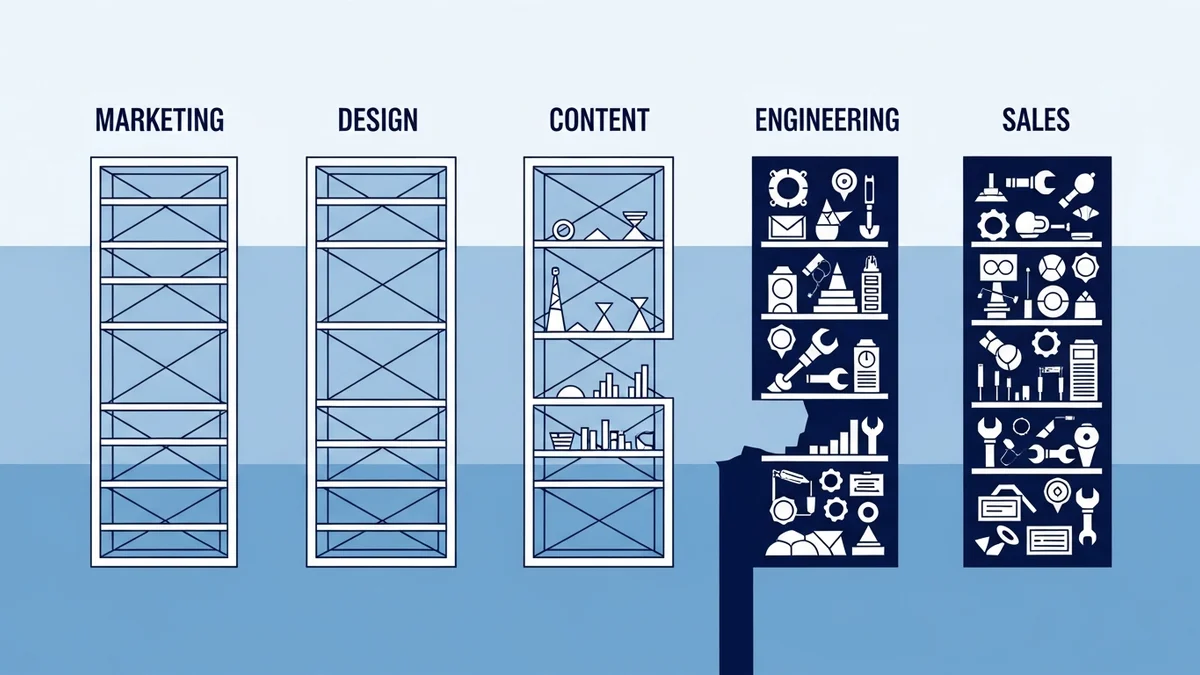
Engineering has Cloudflare. Marketing has nothing.
That is the shortest way to describe the state of AI governance tooling in April 2026. On one side of the building, engineering teams now have a real control stack: identity for agents, network policies for MCP servers, cost ceilings per tool call, monitoring for drift, coordination protocols for multi-agent work. On the other side of the building, marketing is shipping autonomous campaigns with nothing between the model and the brand.
Twelve months of quiet plumbing
In the last year, engineering got serious. Cloudflare turned agent identity, tool permissions, and rate limits into table stakes. Datadog started treating agent runs as first-class telemetry. A dozen MCP-native products emerged to handle coordination between agents. None of this was glamorous. All of it was governance.
We wrote about the shape of that shift in When Infrastructure Ships Governance, and about the broader pattern in AI Governance Is Leaving the Engineering Silo. The short version: engineering answered four questions about its agents. Who can act. What they can reach. How they consume resources. How they coordinate with each other.
Now walk across the building. Ask the same four questions in marketing, design, content, and sales. The silence is the story.
Marketing: campaigns without a brand layer
Klaviyo is shipping agents that write, segment, and send. Adobe Summit opens in Las Vegas next week with a keynote built entirely around AI reshaping marketing and creative software. The capability is real and it is already in production inboxes.
What is not real is the governance layer. When an agent writes your campaign at 2am, who approves the tone? Not “who gets the Slack notification” — who owns the constraint that the agent hit before it sent? Brand guidelines today are PDFs, not policies an agent can be evaluated against at runtime. The question marketing leaders are not yet asking out loud: what is the brand equivalent of a firewall rule?
Design: the canvas is agentic, the system is not
AI is on the canvas now. Abduzeedo called “AI agent orchestration” the new design skill this month, and they are right. One designer can ship three apps a year by treating the model as a collaborator instead of a tool.
Design systems exist. Most teams treat them as style guides. A style guide is a suggestion. A constraint layer is enforcement. We argued the distinction in Design Systems Just Became AI Governance Infrastructure, and the gap has only widened since. The teams that convert their design systems into constraint layers this year will be the ones whose agentic output still looks like their brand in December. The teams that do not will be cleaning up.
Content ops: the missing middle
Julia Porter wrote the best diagnosis of the content gap I have read this month. She calls it the mid-level generalist problem. Senior strategy at the top. AI and juniors at the bottom. Nothing in the middle to catch quality drift, convert a brief into a deliverable, and push back on a bad draft before it ships.
This is a governance gap wearing an org chart. We wrote about the role version of it in The Most Valuable Hire You’re Not Making. The tooling version is simpler and nastier: there is no product today that sits between a content strategist and an AI writer and says “this draft is off-thesis, do not ship.” Content ops is running production without a pre-commit hook.
Sales: proposals without offer governance
Sales is generating proposals, pricing pages, and outbound sequences from models. The offer — the actual commercial commitment the company is willing to make — is not governed. Discounting rules live in a sales playbook nobody reads. Contract boundaries live in legal’s head. An agent does not know any of that, which means the agent will cheerfully offer terms the company cannot honor.
Engineering calls this a permissions problem. Sales still calls it “we should probably review those.”
One pattern, four empty rooms
Look at those four domains together and the pattern is exactly the one engineering answered. Who can act. What they can reach. How they consume. How they coordinate. Four layers. Four domains. Sixteen governance questions. Somewhere close to zero vendor answers aimed at the people who actually own those domains.
That is the gap. It is not subtle and it will not last. Governance tooling always follows capability tooling; the only question is how many quarters behind.
Adobe Summit is the first test
Next week matters. Adobe Summit is the first major platform-vendor reveal of 2026 aimed squarely at marketing and creative. The test is not whether Adobe ships impressive AI features. They will. The test is whether Adobe ships governance for non-engineering domains by default — brand constraints, approval routing, audit trails, cost controls — or whether it ships capability and quietly hands the governance question back to the customer.
If Adobe ships it, the gap closes faster than anyone expects and a lot of agency work gets repriced. If Adobe punts, the gap stays open through the summer and the opportunity belongs to whoever is willing to build the control plane the platform vendors did not.
Either way, the question stops being theoretical on April 20.
This analysis synthesizes Adobe Summit 2026: How Adobe Hopes to Redesign Marketing and Creativity with AI (April 2026), AI Agent Orchestration: The New Design Skill (April 2026), Mid-Level Generalist > Senior Strategist by Julia Porter (April 2026), and Skills in Chrome by Google (April 2026).
Victorino Group helps leaders outside engineering identify the governance layer their domain is still missing. Let’s talk.
All articles on The Thinking Wire are written with the assistance of Anthropic's Opus LLM. Each piece goes through multi-agent research to verify facts and surface contradictions, followed by human review and approval before publication. If you find any inaccurate information or wish to contact our editorial team, please reach out at editorial@victorinollc.com . About The Thinking Wire →
If this resonates, let's talk
We help companies implement AI without losing control.
Schedule a Conversation