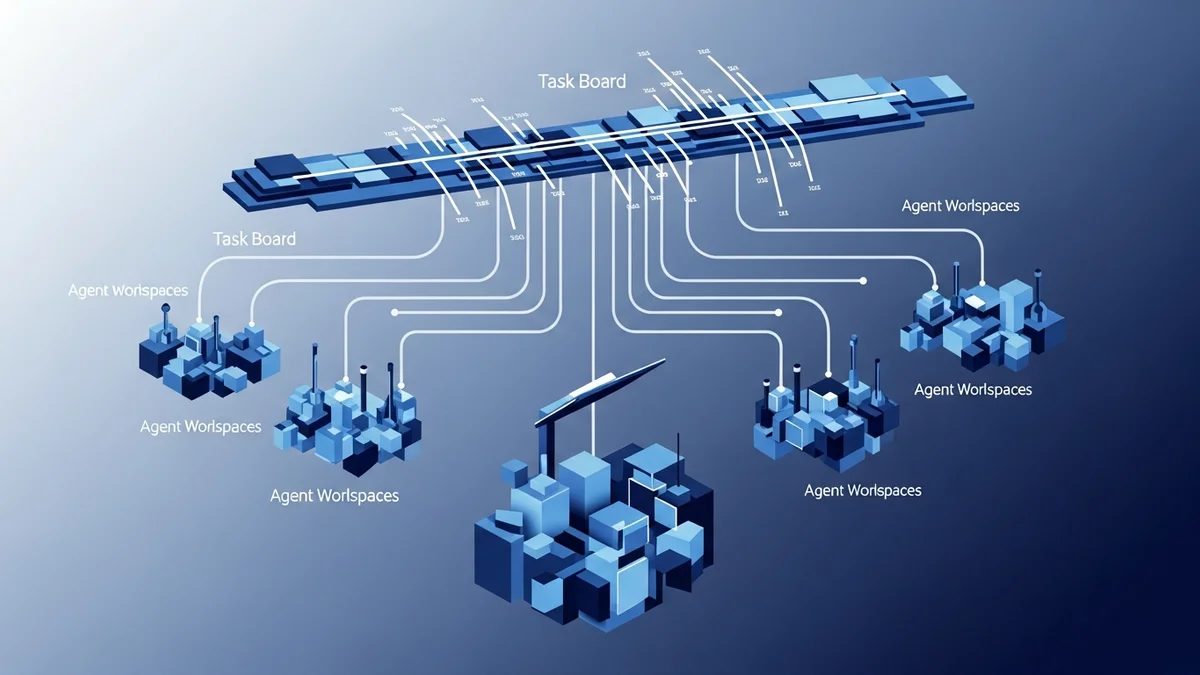
OpenAI published Symphony this week: an open-source specification for coding-agent orchestration. The page is short. The framing is not. Symphony calls Linear-class issue trackers the control plane for coding-agent fleets. Tasks on the board are continuously assigned to agents in dedicated workspaces. Humans stop context-switching between tickets and code; the board is where the work lives, and the agents go to it. Per the announcement, teams running Symphony see up to a 5x increase in landed pull requests.
Set the throughput claim aside for a moment. The number is not the news.
The news is that OpenAI just tried to fix the vocabulary.
The Vocabulary Fight Is The Real Fight
We have written about agent orchestration in production. We have written about orchestration as the governance layer. We have written about the workspace as control plane. Three essays, one observation: the operating model for coding-agent fleets is not a feature. It is a layer. Whoever names it, owns it.
Symphony is the naming attempt. The choice to open-source is the giveaway. OpenAI is not trying to lock customers into a proprietary surface; it is trying to make Symphony’s vocabulary the default vocabulary. “Control plane” is now a published term with a reference implementation. Linear is the named example. Codex is the named agent. The pattern is no longer a blog post. It is a spec.
This is how standards form. Not by committee. By the first credible actor publishing the words other teams adopt because adopting them is cheaper than inventing rivals.
What Open-Sourcing A Spec Actually Does
Open-sourcing the spec changes the buy-build question. Three months ago, a platform team shipping coding agents in production had three options:
- Build the orchestration layer in-house, on top of whatever issue tracker the org already used.
- Buy a commercial coding-agent platform, accept its opinion of how the control plane works.
- Wait.
Symphony adds a fourth: adopt the spec, fork the reference implementation, run it on your own stack. The cost of (1) just dropped because the design work is published. The risk of (2) just changed because commercial vendors will either align to Symphony’s vocabulary or argue against it. Waiting (3) is now waiting on a moving target.
If you are running coding agents in production today, the buy-build-or-fork question is not abstract. It is on the table this quarter.
Throughput Is The Decoy
The 5x landed-pull-request claim, per the Symphony announcement, is the headline number. It will move budgets. It is also the part to be most careful with. Pull-request count is a process metric. Whether those PRs ship value, whether they survive review, whether they encode the right scope, whether they would have been written at all under a different operating model — those are different questions. We have spent enough time inside agent-instrumentation work to know that throughput numbers without scope and quality controls are exactly the kind of numbers that win pilots and lose deployments.
The deeper reason the number is the decoy: throughput claims are debatable. Vocabulary is harder to argue with. Once your engineers say “the board is the control plane” in standups, the architecture follows the words. The control plane gets dedicated tooling. Workspaces get isolation budgets. Task assignment gets a policy layer. Six months later, the platform looks like Symphony’s diagram regardless of whether the team formally adopted Symphony.
That is what naming does. The 5x number gets you to read the announcement. The vocabulary is what restructures the platform.
The Decision On Your Desk
If your platform team is shipping coding agents in production right now, you have three things to decide this quarter, in this order:
Read the spec. Treat it as architectural input, not as a vendor pitch. Note where Symphony’s model agrees with how your platform already works. Note where it disagrees. The disagreements are where the future debates will land.
Pick your vocabulary. If your team is going to use the words “control plane,” “workspace,” and “task assignment” the way Symphony defines them, decide that on purpose. If you are going to use different words, decide what those are and why. Ambiguity is the expensive option; in eighteen months, every coding-agent platform’s docs will reuse Symphony’s terms or argue against them, and your engineers will have to translate either way.
Position the buy-build-or-fork. Adopt the reference implementation, fork it for your stack, build alongside it, or wait one more quarter. Each is defensible. Drift is not. Drift is what happens when no one decides, the team uses Symphony’s words informally, and the platform starts shaping itself around a spec the team never formally adopted.
The Spec Is Now Public. The Decision Is Not Whether.
Open-source specs at this layer of the stack rarely lose. The cost of inventing rival vocabulary is high. The benefit, for OpenAI, is that the next generation of coding-agent platforms — including the ones built by their competitors — get built using Symphony’s words. That is a strong move. It is also not a unique move. Kubernetes did this for container orchestration. OpenTelemetry did this for observability. The lesson from both: the team that names the layer first does not win every customer, but they do define what every other player has to argue against.
Symphony just put the words on the table. Your platform’s vocabulary in eighteen months will either be Symphony’s, or yours, or a translation layer between the two. The decision is not whether to adopt. The decision is whose vocabulary your team will be speaking when the rest of the industry has already moved on.
This analysis synthesizes Symphony: An Open-Source Spec for Codex Orchestration (OpenAI, April 2026).
Victorino Group helps platform leaders evaluate the trade-offs of adopting, forking, or building around emerging agent-orchestration specs like Symphony. Let’s talk.
All articles on The Thinking Wire are written with the assistance of Anthropic's Opus LLM. Each piece goes through multi-agent research to verify facts and surface contradictions, followed by human review and approval before publication. If you find any inaccurate information or wish to contact our editorial team, please reach out at editorial@victorinollc.com . About The Thinking Wire →
If this resonates, let's talk
We help companies implement AI without losing control.
Schedule a Conversation