Marketing's Governance Stack Is Real. It's Also Asymmetric.
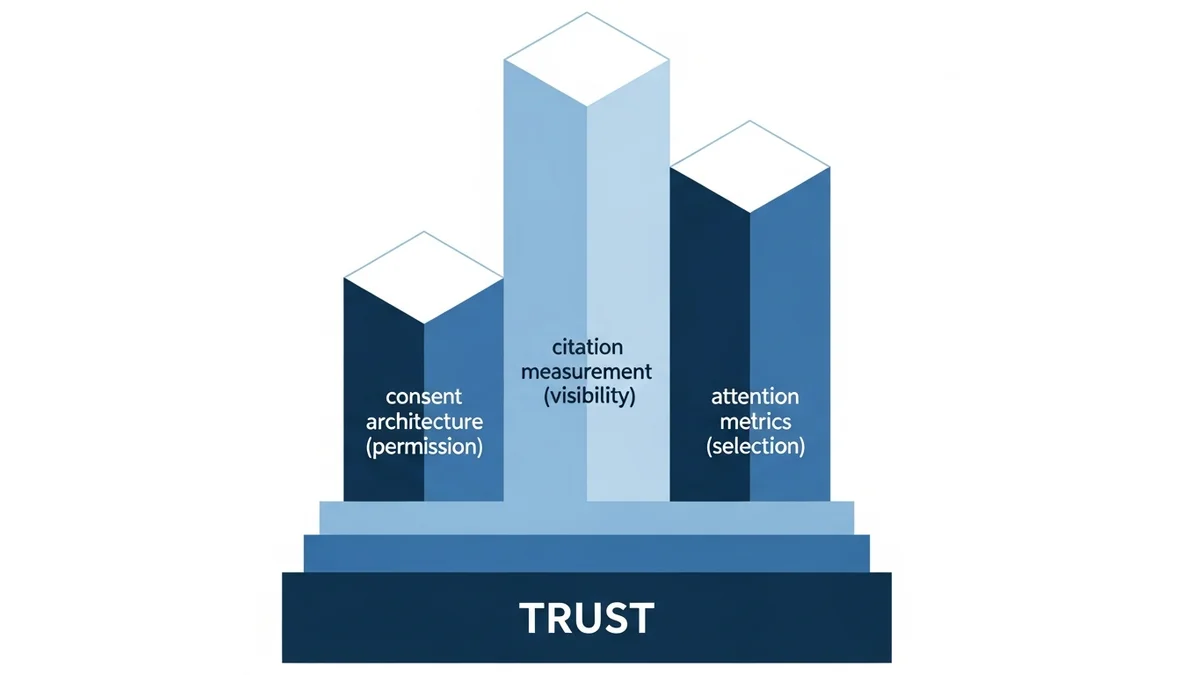
Three separate sources surfaced something that looks like a marketing governance stack this month.
A Usercentrics-sponsored MIT Technology Review Insights report on consent architecture. Kevin Indig’s “Ghost Citation Problem” on brand visibility inside AI search. Ann Handley’s “Email Is Dead, Long Live Email” on the shift from deliverability to chosenness. Read in sequence, they feel like the three layers of a marketing control plane landing in the same news cycle.
They are not.
Read carefully, only one of the three is a governance layer. The second is measurement. The third is craft. The piece that matters is not the tidy three-column diagram. It is the asymmetry.
The load-bearing column: consent architecture
The Usercentrics-sponsored MIT Technology Review Insights report, Building trust in the AI era with privacy-led UX, carries the disclosure “In partnership with Usercentrics.” It is custom content, not newsroom research. The TRUST framework it introduces (Translate, Reduce, Unify, Secure, Track) is almost certainly Usercentrics product positioning. That is not a reason to dismiss it. It is a reason to read it for what it is: a vendor laying out the shape of a category it intends to own.
The category is real, and the shape is worth naming.
In January 2026, Usercentrics acquired MCP Manager, a policy layer for the Model Context Protocol. Founder Michael Yaroshefsky became VP of AI. Three months later, the sponsored MIT Insights report surfaces MCP (per PPC Land’s extended coverage) as the emerging privacy primitive for agentic AI. The report’s most load-bearing sentence:
“Where automated systems can make data-sharing decisions before a user is ever aware, the permission architecture must be in place before the agent acts.” — MIT Technology Review Insights (sponsored by Usercentrics), April 2026
That is a governance statement. It has the three things governance requires. A measurable surface (consent events, preference state, data-sharing decisions). An enforcement mechanism (the policy layer fires before the agent calls the tool). An audit trail (every decision is logged).
This is the first column of a marketing control plane that a practitioner actually owns. Not rents from a platform. Owns.
The supporting numbers in the report are softer than the architecture. The much-quoted 82% abandoned-a-brand-over-privacy figure from the Thales 2025 Consumer Digital Trust Index is self-reported past-twelve-month behavior across 14 countries. Privacy is where the gap between what people say and what people do is widest. Treat the number as an attitudinal high-water mark, not behavioral truth. The architecture argument does not depend on it.
The middle column: measurement, not governance
Kevin Indig’s Ghost Citation Problem gives us the second marketing surface: how brands appear inside AI search answers. His methodology is transparent. 115 prompts, 14 countries, 4 engines, 3,981 domain appearances, Semrush’s AI Toolkit as the instrument. The headline: 61.7% of the domains that appear are “ghosts” — linked as sources but never named in the answer text.
The headline number is less interesting than the per-engine split Indig surfaces. On ChatGPT, domains are cited 87% of the time and mentioned 20.7% of the time. On Gemini, mentioned 83.7% and cited 21.4%. Near-mirror-image behavior from two engines whose outputs sit on the same screen.
Read the caveats. The “citation vs. mention” split is Semrush’s operational definition, not an industry standard. Eight prompts per country is a thin cell. The per-engine inversion is inferred from a commercial crawl, not disclosed by the engines themselves. Indig treats it as directional, and so should we. The direction is the signal: brand visibility now bifurcates by engine, and optimizing for one is not optimization for the other.
We argued last year that your docs have two audiences: the human reader and the agent reader. Indig quantifies per-engine divergence inside that second audience. The reading machine is not one machine. It is four, with inverse incentives.
Here is the thing people get wrong about this data. Measurement is not governance. It is observability with nowhere to push a lever. The marketer running this dashboard learns where the brand is invisible. The marketer cannot then adjust a policy and force visibility. The control plane belongs to OpenAI, Google, Anthropic, and whatever Semrush can see from the outside. Calling this a “governance layer” flatters the function. It is a monitoring layer, and it is valuable, and it is not the same thing.
The third column: craft, not layer
Ann Handley’s “Email Is Dead, Long Live Email” names the third surface. When Gmail Gemini and Apple Intelligence Mail decide what is worth surfacing, deliverability becomes table stakes and “chosenness” becomes the new conversion. Her operational test is one question the writer asks during drafting: “Would it flag this for my reader?”
That is a craft discipline. It is the right discipline. It is not a layer.
A layer needs a policy surface, an enforcement point, and an audit trail. Chosenness has none of the three. It is a heuristic for authors. Treating it as the peer of a consent-management API on an architectural diagram is a category error. We mistake intent (“write in a voice worth flagging”) for mechanism (“here is where the rule fires and what it logs”).
Handley is a better writer than most people writing about email, which is exactly why her frame is dangerous if you promote it to the wrong tier. Her piece is a standard for taste, not a component in a stack.
The asymmetry is the argument
Here is the map.
| Surface | What landed this month | What it actually is |
|---|---|---|
| Consent | Usercentrics + MCP Manager + TRUST framework | Governance layer. Policy, enforcement, audit. Owned by the marketer. |
| Citation / mention | Indig’s Ghost Citation data + Semrush AI Toolkit | Monitoring layer. Observability without enforcement. Control plane is the engines. |
| Attention | Handley’s “chosen, not delivered” | Craft discipline. Authorial standard. No control plane exists. |
We argued in March that marketing had just had engineering’s 2024 moment. This week the stack parts showed up. That is the good news. The better news is that the parts are asymmetric, and naming the asymmetry tells you where to invest.
Engineering has Cloudflare. A full governance stack with policy, logs, enforcement, and reversibility. Marketing, as of April 2026, has one column of that. The other two are a dashboard and a writing prompt. The gap between them is where 2026 marketing maturity gets earned.
The pattern is not new. Engineering went through the same shape around 2020. Observability tools appeared before governance tools. People confused them, because both showed charts. Then runtime enforcement layers arrived, and the category sorted itself out. Marketing is three to four years behind that curve. The sorting is beginning.
What this means for the investment question
If you run a marketing function right now, you get three decisions, not one, because the surfaces require different kinds of spend.
On consent: this is where you buy a platform. Usercentrics, OneTrust, Cookiebot, or the equivalent. You are buying runtime enforcement, not a banner. The question is not “which consent UI looks cleanest” but “can this system stop an agent from reading user data before it reads it, and can I audit what it decided.” If the platform cannot answer that question with logs, it is not the platform for the agentic era.
On citation and mention: this is where you buy visibility into what the engines are doing, not a way to change it. Budget like observability, not like SEO. Expect the tooling to move fast and the definitions to wobble. Do not overpay for a number whose operational definition is one vendor’s choice.
On attention: you do not buy this. You hire for it, or you write it yourself, or you outsource it to people whose voice can survive an AI triage layer. The standard is editorial. Handley gives you the right question to ask in the room.
The honest version of the stack
The three-column diagram is the version that fits on a slide. It is also the version that leads to misallocated budget, because it invites you to treat unequal things as equal.
The honest version is a sketch with one solid column, one translucent column, and one column that is a person holding a pen. Consent architecture is the column marketers will own for the next decade. Citation measurement is the column platforms own and marketers watch. Chosenness is the column nobody owns. It is built one sentence at a time.
This is the shape marketing governance will have in 2026 and probably 2027. It is not symmetric. It is not tidy. It is defensible, and it tells you what to spend money on.
The mistake to avoid is the one vendors will push hardest for: treating all three surfaces as peer governance layers and selling you a “platform” that covers all of them. The platform does not exist. What exists is one real product category (consent), one real measurement category (citation), and one editorial discipline (chosenness) that is older than email itself.
Buy the first. Subscribe to the second. Hire for the third.
This analysis draws from MIT Technology Review Insights “Building trust in the AI era with privacy-led UX” (April 2026, sponsored by Usercentrics), Usercentrics’ acquisition of MCP Manager (January 2026), Kevin Indig’s “The Ghost Citation Problem” (Growth Memo, April 2026), Ann Handley’s “Email Is Dead, Long Live Email”, and the Thales 2025 Consumer Digital Trust Index.
Victorino Group helps teams build the control layer behind their marketing AI — consent, citation, and attention on a shared scoreboard. Let’s talk.
All articles on The Thinking Wire are written with the assistance of Anthropic's Opus LLM. Each piece goes through multi-agent research to verify facts and surface contradictions, followed by human review and approval before publication. If you find any inaccurate information or wish to contact our editorial team, please reach out at editorial@victorinollc.com . About The Thinking Wire →
If this resonates, let's talk
We help companies implement AI without losing control.
Schedule a Conversation