In one week, six people from six different communities arrived at the same conclusion. They did not coordinate. Most of them do not read each other. A Columbia/Yale working paper, a Google engineer, a growth marketer in San Francisco, a zero-click-marketing strategist, an SEO operator on LinkedIn, and a Google Ads product manager all described the same gap in the same seven days of April 2026.
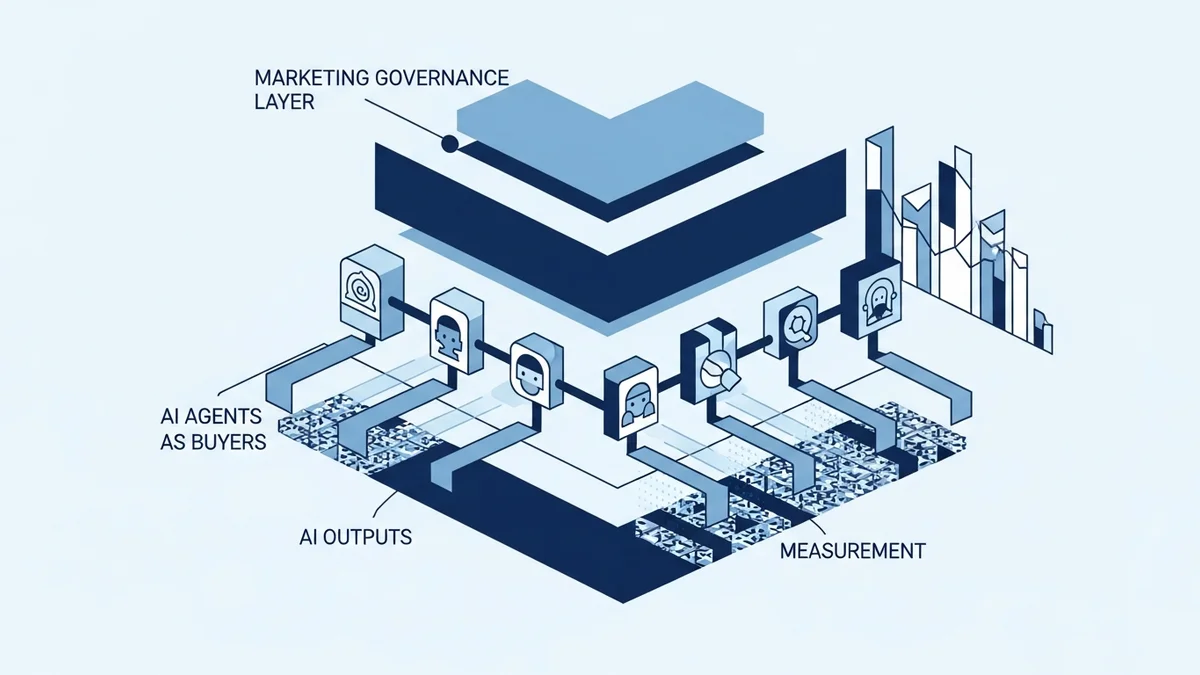
The gap is this: every external surface where your brand is represented is now an input to a model you do not control. The model’s output is what your customer sees. Nobody at your company owns the consistency of that representation. Engineering has spent a year building governance for AI. Marketing has not started.
That is the story. Not the numbers. The density.
What happened between April 11 and April 15
On April 11, Addy Osmani at Google published an essay titled Agentic Engine Optimization. His argument: agents read your documentation in a single HTTP GET. No scroll, no clicks, no tutorials. A Cisco API reference at 193,217 tokens is invisible to them. He proposed token budgets as a design constraint: quick-starts under 15,000 tokens, API references under 25,000. These are his recommendations, not industry standards. They are also the first serious attempt to size what an agent-readable surface looks like. We covered the reader-shift in AEO: Your Docs Have Two Audiences Now. Osmani gave it numbers.
On April 14, Mark Spera published a case study on GrowthMarketingPro about Dutch, a pet telemedicine company. His agency reports that Dutch’s LLM mention rate moved from 57.9% to 82.5% in two months. AI-search visibility moved from 23.8% to 45.5%. Conversion rose 50%. This is a single self-reported case from an agency that sells the service. Treat the outcome numbers as illustration, not forecast. What matters is the tactic list: Wikipedia entry, schema markup, guest placements on vet listicles, Reddit-aware bottom-of-funnel content, hundreds of pages pruned. The tactics are defensible independent of the numbers.
On the same day, Amanda Natividad wrote on her substack that “your public record is being written without you.” She told two stories. Seer Interactive had one negative review from early in its 24-year history that kept surfacing in LLM summaries until the firm published enough replacement facts to displace it. Natividad became a Formspree customer through Claude without ever visiting Formspree’s homepage. Both anecdotes point at the same thing: the conversion and the reputation impression happen on surfaces the brand does not own.
Around the same week, Ross Hudgens posted on LinkedIn that most companies have 8 to 12 third-party profiles they have forgotten about: LinkedIn Company, G2, Capterra, Clutch, Crunchbase, a Twitter bio, an Instagram bio, a DesignRush listing. No data supports the 8-to-12 figure; it is a practitioner’s estimate. Treat it that way. The useful point is not the count. The useful point is that inconsistent copy across those surfaces confuses LLMs, and nobody has a dashboard for it.
On April 15, Google announced that Dynamic Search Ads will auto-upgrade to AI Max in September 2026. No new DSA campaigns will be creatable after that through the UI, Editor, or API. “Automatically upgrade” is Google’s phrasing. Advertisers keep account-level controls (brand and location rules, negative keywords, text guidelines), but dynamic site matching, AI query expansion, text optimization, and final-URL expansion are now handled by Google’s model. Call it an automatic migration, not a forced one. The direction is the same: where the platform takes more control, the only remaining lever is the quality of the inputs.
Underneath all of this sits a working paper from Columbia, Yale, and MyCustomAI, revised December 17, 2025 and sitting on arXiv as 2508.02630. Allouah and co-authors built a controlled sandbox called ACES and ran 1,000 experiments in each of 8 product categories. Renaming “SUNMORY Floor Lamps for Living Room” to “SUNMORY Office Floor Lamp” in the office-lamp category moved GPT-5.1’s selection by up to 80.4 percentage points. Gemini 2.5 Flash moved by up to 52 points. Claude Opus 4.5 moved by up to 41. Badges like “Overall Pick” and “Bestseller,” review counts, star ratings, and the presence of a “Sponsored” label all shifted outcomes at causally identified magnitudes.
One sentence of honesty. This paper is a preprint. It is not peer-reviewed. The code is open on GitHub and the experimental design is replicable, which is stronger ground than most marketing research we see. But the number is specific to one category and one stimulus. Read it as “small semantic changes can produce disproportionate shifts in concentrated-choice regimes.” Do not read it as “rename your product and get 80 points of market share.” The mechanism is the point.
Why the density is the argument
Any one of those six is a think-piece. Together, in one week, they describe a phase change that has already happened and is finally visible to the people it affects. As we wrote in Engineering Has Cloudflare. Marketing Has Nothing., governance infrastructure exists in engineering and does not exist anywhere else. This week is what that absence looks like when the bill comes due.
The six pieces did not coordinate. Some of the authors read each other; most do not. The fact that six non-overlapping communities arrived at the same diagnosis in seven days does not tell us the gap is new. It tells us the rate of consensus formation just changed. When independent observers describe the same thing in the same week, the thing is no longer early.
The job that has no owner
The governance pattern is not new. Engineering already lived through this. Multi-surface consistency, deterministic outputs from probabilistic systems, hard-coded guardrails, continuous verification, lineage, audit, evals, linters, CI. All of it, ported to brand representation:
- Product titles and descriptions are structured data assets. They need a source of truth.
- Third-party profiles (G2, Capterra, LinkedIn, Crunchbase) are content replicas. They need sync and drift detection.
- Schema.org markup is an API contract with Google and every LLM that crawls you. It needs tests.
- Wikipedia entries are write-once surfaces with long half-lives. They need monitoring.
- Ad copy inside AI Max is an input to a model. It needs input-side guardrails because there are no longer output-side controls.
llms.txt,AGENTS.md, and the markdown mirrors of your HTML pages are a new deployment target. They need a pipeline.
This is a governance job. It is neither traditional marketing nor traditional engineering. It sits between them. It is closer in spirit to what the style guide has become than to what content teams were hired for five years ago.
We already sketched the advertising variant of this problem in Advertising Governance Is the Brand-Safety Frontier. Google’s AI Max announcement makes it operational. The ad platform will rewrite your text, expand your URLs, and match queries you never named. Your brand guidelines are now the guardrail. If your brand guidelines live in a Notion page nobody reads, you do not have guardrails.
And we argued earlier this quarter, in Governance Is Leaving the Engineering Silo, that the same discipline would eventually arrive in design, legal, marketing, and HR. April 2026 is when marketing’s turn started in public.
The counter-argument, acknowledged
Some marketers will read this and say: “We have always had third-party profiles. G2 existed in 2015. Schema.org existed in 2011. The gap is not new; it is ignored.”
That is fair. What changed is the consequence. An out-of-sync LinkedIn bio used to cost you an introduction. Now it costs you a purchase decision that a model made on your customer’s behalf, without your customer visiting your site. This is the same shift we described in Growth Is Now a Trust Problem and in AI Search Governance Is About Hard Signals. Governance used to be insurance. Now it is the acquisition channel.
The work is not glamorous. It is spreadsheets, permission systems, review cycles, profile inventories, schema validators, ad-copy linters, and weekly diffs. That is what engineering governance looked like in its first year, too. The unglamorous version is the one that compounds.
What to do on Monday
Do not restructure. Do not hire a VP of AI Brand Representation. Do three things.
First, take inventory. List every public surface where your brand’s name, description, category, URL, or product list appears. Start with the obvious (homepage, LinkedIn Company, G2) and keep going until you hit diminishing returns. Hudgens’s 8-to-12 estimate is a rough target; your number will be different.
Second, pick one source of truth. Your homepage, your pricing page, your primary product-category page. Write down the canonical name, the one-sentence description, the category taxonomy, the URL structure. Every other surface is a replica; replicas need sync.
Third, assign an owner. One person. Not a committee. The owner’s job in April is to measure drift. The owner’s job in Q3 is to close it. This work is not going to feel like marketing. It is going to feel like what DevOps felt like in 2014 when teams first realized somebody had to own deploys. That is the right instinct.
The question to sit with
Who, at your firm today, owns the consistency of your brand across every output an LLM will produce about you next Tuesday?
If the answer is “nobody,” the next answer is the job description you need to write. If the answer is “marketing,” the next answer is whether that team has the tools, the mandate, and the engineering partnership to do the work that title now implies. If the answer is “engineering,” you have a different problem, which is that your engineers are about to be asked to govern your brand.
Six independent observers named the gap in one week. That is how these things go. The firms that name the role first, staff it, and give it real authority will have a measurable advantage for the next twenty-four months. After that, everyone will have one, and the advantage will move somewhere else. That is also how these things go.
This analysis synthesizes What Is Your AI Agent Buying? (Allouah, Besbes, Figueroa, Kanoria, Kumar; arXiv preprint 2508.02630, revised December 2025), Agentic Engine Optimization (Addy Osmani, April 2026), the GrowthMarketingPro Dutch case study (Mark Spera, April 2026), Your Public Record Is Being Written Without You (Amanda Natividad, April 2026), Ross Hudgens on third-party profile drift (LinkedIn, April 2026), the Google Ads & Commerce announcement on DSA to AI Max (April 2026), and McKinsey’s New Front Door to the Internet (October 2025).
Victorino Group helps firms design marketing-governance layers for the AI-agent buyer era. Let’s talk.
All articles on The Thinking Wire are written with the assistance of Anthropic's Opus LLM. Each piece goes through multi-agent research to verify facts and surface contradictions, followed by human review and approval before publication. If you find any inaccurate information or wish to contact our editorial team, please reach out at editorial@victorinollc.com . About The Thinking Wire →
If this resonates, let's talk
We help companies implement AI without losing control.
Schedule a Conversation