Anthropic Just Shipped Ten Finance Agents. Each One Drafts a Regulated Artifact.
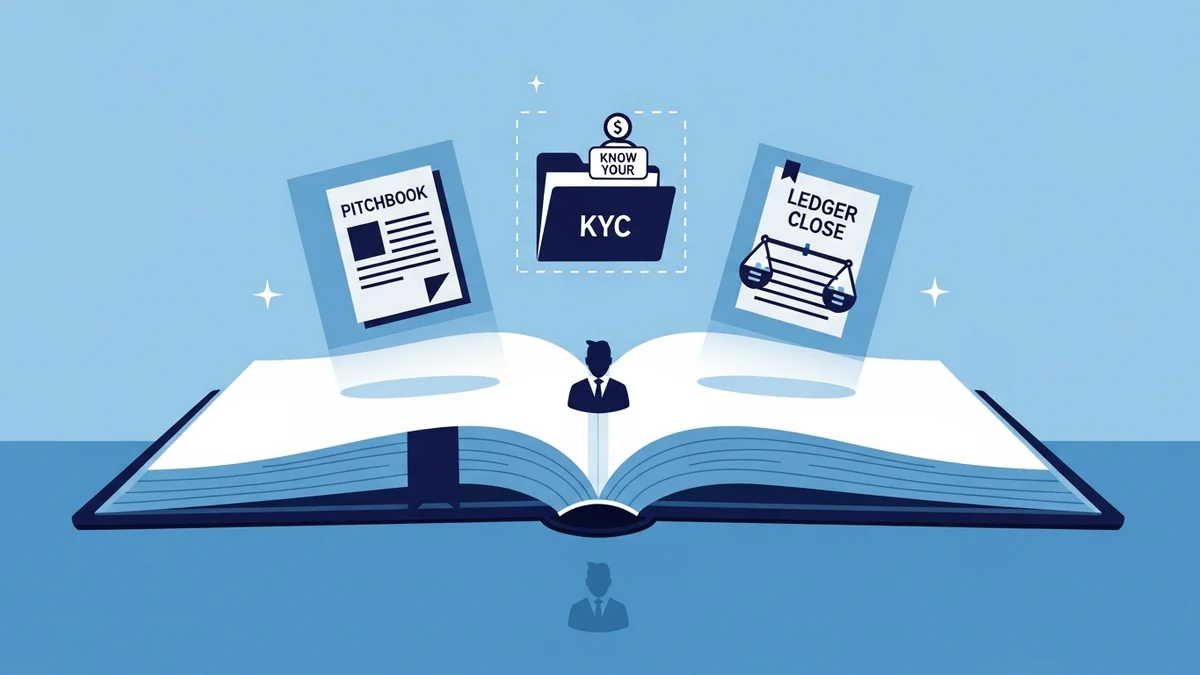
The vendor announcement is short. Anthropic shipped ten ready-to-run agent templates for the most time-consuming work in financial services. Pitchbook drafting. KYC file screening. Month-end close. The templates ship as building blocks for banks, asset managers, and insurers to deploy against their own data and policy. Read on the surface, it is a productization story. A frontier-model lab leaning into vertical playbooks because the horizontal “build your own agent” pitch has a long tail of integration work that most regulated buyers will not finish.
Read one layer down, it is a governance story we have not seen before in this arc.
Each template named in the announcement corresponds to a regulated artifact. A pitchbook is not a slide deck; it carries due-diligence representations, fairness opinions in some contexts, and disclosures that hit FINRA Rule 2241 and SEC Regulation Best Interest. A KYC file is not an internal note; it feeds the audit trail an examiner will ask for under BSA, AML, and OFAC obligations, plus the Customer Due Diligence Final Rule. Month-end close is not a spreadsheet; it ties to SOX Section 404 controls and external auditor signoff. The artifact is the regulated thing, and the template is now drafting it.
That is the new question. Not “can the agent do the work” but “whose name is on the artifact when the regulator asks.”
What Anthropic Actually Released
We are working from a single source: Anthropic’s announcement post, “Anthropic Releases Agents for Financial Services,” dated May 2026. Single-source vendor announcements deserve skeptical reading, and the regulated-artifact framing in this piece is editorial extrapolation, not language Anthropic itself uses. Anthropic’s positioning is operational. Save analyst time. Compress weeks of pitchbook prep. Reduce KYC backlog. Close the books faster. None of those phrases mention regulation.
The artifacts they target do.
Pitchbooks circulating outside the firm carry written representations about valuation methodology, comparable-company selection, and risk disclosure. KYC files land inside an audit folder that examiners pull during routine and for-cause exams. Month-end close drives the trial balance that flows into 10-Q and 10-K filings. Three of ten templates, and we have not finished the list yet, sit on top of regulated outputs with named external reviewers.
We do not know yet which of the ten templates land in the most regulated zones. The announcement names categories, not the full template manifest. The pattern, though, is already legible: when a vendor productizes finance work, the productization surface and the regulation surface overlap by default.
The Companion Industry Signal
A separate data point landed in the same window. Reporting on Salesforce, ServiceNow, and Google’s enterprise-AI metrics noted that 75% of Google Cloud customers are now using AI products and that 330 of those customers process more than one trillion tokens. Financial-services workloads sit inside that 330. We do not have a clean breakdown of which fraction. We do have the order of magnitude.
The implication: the underlying compute and orchestration capacity to run agents like Anthropic’s finance templates is not the constraint. Customer concentration is real, model capability is real, but the infrastructure is no longer the binding limit for a regulated buyer who wants to put one of these templates into production. The binding limit is approval. Whose review desk says yes, and on what evidence.
That shifts where the work lives. It does not shift whether the work exists.
The Productized Template Caveat
Here is where the engineering-side governance literature, the one that produced agent factories, evals harnesses, and policy-as-code, runs out of road. That literature assumes the buyer wrote or deeply customized the agent. Code review, deployment gates, model-card review, prompt versioning. All of those instruments presume internal authorship.
A productized template inverts the relationship. The buyer adopts a third-party drafter for a regulated artifact. The drafter is a vendor template, instantiated against the buyer’s data, prompted by the buyer’s analyst, but authored by Anthropic’s content and prompt engineering teams. Compliance signoff in that world has to cover three things the engineering literature did not require:
Due diligence on the template itself. Not just the model card for Claude, but the template’s prompt structure, retrieval scaffolding, output schema, and the reasoning patterns it was tuned to follow. Anthropic ships those choices. The buyer inherits them.
Change control across vendor releases. When Anthropic updates the pitchbook template, the buyer’s compliance posture changes. Versioning of the template is now part of the buyer’s audit trail in the same way model-version pinning became part of LLM operations.
Joint liability framing. The contract layer where the vendor’s terms of use, indemnification, and warranty disclaimers meet the buyer’s regulatory obligations. Most existing AI vendor contracts disclaim fitness for specific regulated purposes. Pitchbook, KYC, and close work are specific regulated purposes.
This is not a critique of the templates. The templates are likely well-built. It is a description of where the governance work moves when the artifact’s drafter is a vendor product rather than an internal tool.
The Six Surfaces a Finance Buyer Has to Instrument
| Surface | What to instrument | Cadence | Owner |
|---|---|---|---|
| Template version registry | Which Anthropic template version is in production for which workflow | Per release | Vendor management + IT |
| Output review log | Human-in-the-loop signoff record per artifact, with reviewer identity | Per artifact | Compliance + line owner |
| Data-class boundary | What the template is permitted to read; what it is forbidden to send out | Quarterly | CISO + Legal |
| Prompt and policy diff | Changes between template versions; impact on output content | Per release | Compliance + Internal Audit |
| Auditor evidence pack | Artifact, reviewer, template version, timestamp, source data references | Per artifact | Internal Audit |
| Vendor change notification | Anthropic’s release notes ingested and routed to the right reviewers | Real time | Vendor management |
Each row is a claim, an instrument, a cadence, and an owner. Six rows, four owners, and a hard requirement that they share a single registry. The buyers who already run this for their core banking platform, their general ledger, and their trading systems will recognize the shape. What is new is the speed and frequency. A core banking release lands every few months. A frontier-model template can ship updates much faster, and the artifact downstream is regulated.
The Honest Caveat on Our Framing
Three disclosures the argument requires.
One. Anthropic does not call these “regulated artifact drafters.” That language is ours. The company describes them as productivity tools for analyst workflows. The regulation lens is editorial. We think it is the right lens because the artifacts named are, in fact, regulated. Readers should know we are extrapolating.
Two. Single-source announcements compress the picture. Anthropic’s framing about time saved and analyst leverage is the only public framing right now. We do not have buyer testimonials, regulator commentary, or independent evals. We are reasoning from the artifact list outward.
Three. The “due diligence on the template” claim is a posture, not a contractual reality today. Most vendor agreements do not give buyers deep visibility into prompt internals or training data. The posture says: that opacity is now a regulated-buyer problem, not an engineering preference. Whether it becomes a contractual reality depends on how OCC, FINRA, and SEC examiners react when one of these artifacts comes up in an exam.
What the Engineering-Governance Narrative Was Missing
The governance-beyond-engineering arc has now extended into HR, advertising, and design. Finance is the next domain, and it carries a different texture. HR and design surface internal cultural and operational signals; advertising touches brand safety and creative review; finance touches statutory artifacts. The signoff chain is named in regulation, not in policy.
That is what the engineering-side literature was not built to address. A policy-as-code repo can encode controls. It cannot, by itself, satisfy a SOX auditor that the agent that drafted the close package was operating under a tested control. It can support the case. The case still requires a named human reviewer, an artifact, a timestamp, and a reproducible reasoning trail. Productized templates make that case harder to assemble unless the buyer treats the template as a regulated component from day one.
Do This Now
If your firm is piloting one of these templates, or any productized agent that drafts a regulated artifact, do three things this quarter.
First, name the artifact. Map every template you are evaluating to the specific regulated output it will draft, the regulator that supervises that output, and the named reviewer in your firm who already signs off on that output today. If the answer is “no one signs off today,” you have a deeper problem than the template.
Second, freeze a template version per workflow. Pin the Anthropic template version for the pitchbook workflow, separately from the KYC workflow. Treat version updates as change-management events that route through your existing model-risk or vendor-management process, not as silent vendor updates.
Third, write the evidence pack. For each artifact the template produces, the audit trail must include source data references, prompt and template version, output, reviewer identity, reviewer comments, and timestamp. If your existing GRC platform cannot capture all six fields, fix that before the first artifact leaves the desk.
The templates are real, the artifacts are regulated, and the signoff perimeter just extended. The work to extend it is concrete, not philosophical.
This analysis synthesizes Anthropic Releases Agents for Financial Services (Anthropic, May 2026).
Victorino Group helps CFOs and risk leaders extend their compliance signoff perimeter when vendor templates draft regulated artifacts. Let’s talk.
All articles on The Thinking Wire are written with the assistance of Anthropic's Opus LLM. Each piece goes through multi-agent research to verify facts and surface contradictions, followed by human review and approval before publication. If you find any inaccurate information or wish to contact our editorial team, please reach out at editorial@victorinollc.com . About The Thinking Wire →
If this resonates, let's talk
We help companies implement AI without losing control.
Schedule a Conversation