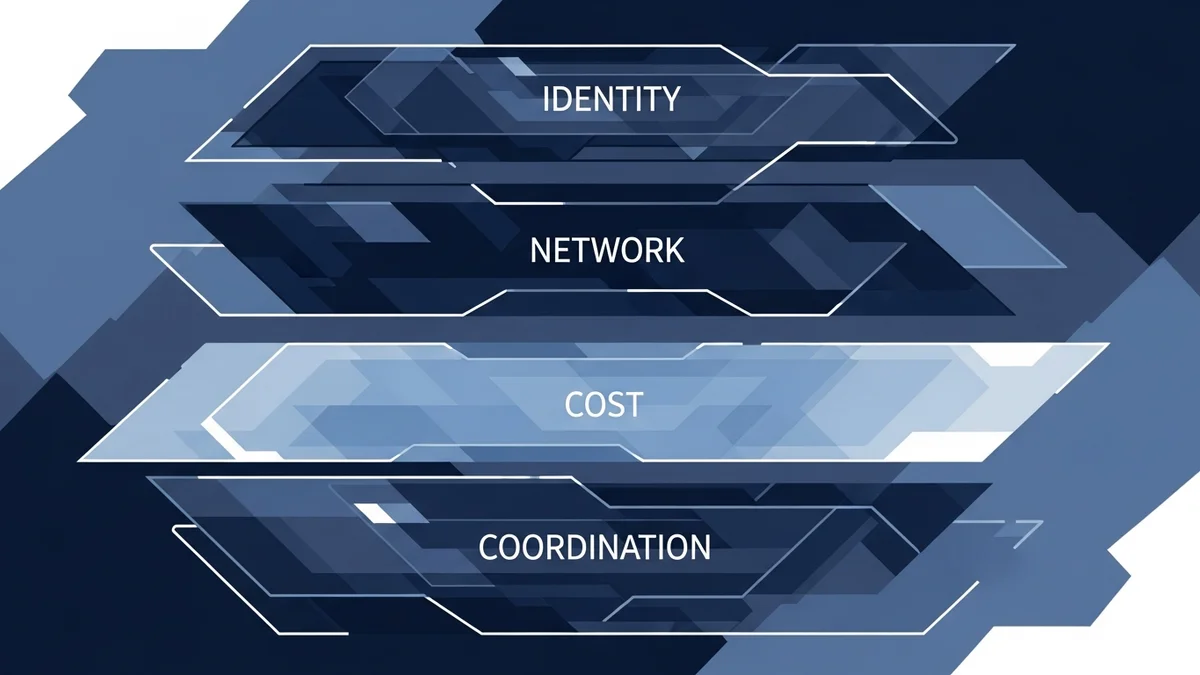
Four launches. One week. One vendor.
That is what Cloudflare shipped in April 2026. Not four features of the same product. Four separate product announcements, each addressing a different failure mode of running AI agents in production. Read together, they form something the industry has been talking around for a year: a complete control taxonomy for agent workloads, delivered as product instead of policy.
When we wrote last year that Cloudflare was quietly making AI governance table stakes, the argument was directional. One free tier here, one managed service there. The thesis was that governance would eventually arrive as infrastructure, not as a slide deck from your CISO. This week is the thesis accumulating evidence faster than the market can absorb it.
Let me show you the four pieces, in the order a CIO should think about them.
Who can act: identity
The first launch is Scoped Permissions. Scannable API tokens so leaked credentials can be detected at the edge. OAuth visibility so you can actually see which principals are acting inside your account. Resource-scoped RBAC so an agent given a key to one bucket cannot decide, at 3 a.m., to write to another.
This is the identity surface. “Who can act?” is the first question of any governance regime, and Cloudflare is answering it with default narrowness. The token is no longer a blunt instrument. It is a named principal with a scope.
What they can reach: network
The second launch is Dynamic, Identity-Aware Sandbox Auth. Outbound Workers sit between an agent’s sandbox and the internet, injecting credentials at the egress point so the LLM workload itself never sees the secret. You get programmable egress. You get zero-trust between the model and the APIs it calls. You get audit logs on every outbound request.
This is the network surface. “What can they reach?” used to be answered by a VPC diagram and a prayer. Now it is answered by a proxy you can configure. The credential never enters the context window. An agent cannot exfiltrate what it never possessed.
How they consume: cost and traffic
The third launch is AI-aware Cache. Cloudflare’s own data shows AI crawlers generating high-volume, diverse traffic that blows past cache hit rates designed for human browsers. Origin load rises. Costs rise. Performance degrades for everyone. Their response is to separate AI traffic from human traffic at the cache layer and invent new algorithms for it.
This is the cost surface, which most governance frameworks ignore because “cost” does not sound like risk. It is risk. The most common AI incident in production right now is not a security breach. It is a bill. An agent in a retry loop, a caching layer that cannot tell it from a browser, an origin that melts. “How do they consume?” is a governance question, and Cloudflare is turning it into a cache policy.
How they coordinate: protocol
The fourth launch is Enterprise MCP. Unified deployment patterns for Model Context Protocol servers inside a large organization, with the security controls that make MCP deployable past a single team.
This is the coordination surface. MCP is how agents will talk to tools and to each other. If every team rolls its own MCP server with its own auth story, the enterprise ends up with a coordination mess that nobody owns. Cloudflare is offering the boring answer: one deployment pattern, one security model, one place to look.
Four surfaces, one baseline
Identity. Network. Cost. Coordination. That is the taxonomy. A single vendor shipped all four in one week.
You could argue this is a roadmap backlog clearing. Maybe it is. But the effect on the market is the same whether it was planned as a trilogy or assembled from unrelated sprints: the baseline just moved. “We will figure out agent governance later” is a statement that had a half-life of about twelve months. This week shortened it.
We saw a version of this pattern recently with Datadog turning governance into a product roadmap. Different vendor, different surface, same move. The observability layer is racing the infrastructure layer to own the control plane. That is a good race for customers. It is a harder race to ignore.
The skeptical read is real and worth naming. A vendor that ships all four control surfaces is also a vendor that owns all four control surfaces. Governance-as-product can calcify into governance-as-lock-in. The answer is not to refuse the product. It is to know which surfaces you are buying, from whom, and what the exit looks like if you change your mind. Taxonomies help with that. Vague commitments to “responsible AI” do not.
The decision
Here is the question every CIO now has to answer, and it is more concrete than it was last week.
Does your current stack cover all four layers?
Not “do we have a governance strategy.” Not “are we thinking about AI risk.” Those are the wrong questions because they have no falsifiable answer. The right question is a checklist:
- Identity — can you name the principal behind every agent action, and is its permission scoped to the resources it needs?
- Network — is there a programmable layer between your agents and the outside world where you inject credentials and log every call?
- Cost — does your infrastructure distinguish agent traffic from human traffic, and is there a policy that fires when an agent behaves pathologically?
- Coordination — is there one answer to “how do our agents talk to tools and each other,” or does every team have its own?
If you have four answers, you are operating AI. If you have fewer than four, you are hoping. Hope was a defensible posture when governance lived in a PDF. It is a harder posture to defend when it ships as product on a Tuesday.
The vendors are not waiting. Neither should the decision.
This analysis synthesizes Cloudflare’s April 2026 launches: Scoped Permissions, Dynamic, Identity-Aware Sandbox Auth, Why We’re Rethinking Cache for the AI Era, and Scaling MCP Adoption.
Victorino Group helps enterprises map their current stack onto the four governance control layers before the baseline moves past them. Let’s talk.
All articles on The Thinking Wire are written with the assistance of Anthropic's Opus LLM. Each piece goes through multi-agent research to verify facts and surface contradictions, followed by human review and approval before publication. If you find any inaccurate information or wish to contact our editorial team, please reach out at editorial@victorinollc.com . About The Thinking Wire →
If this resonates, let's talk
We help companies implement AI without losing control.
Schedule a Conversation