The Labs Became Consulting Firms. The Hottest Role Is Forward Deployed Engineer.
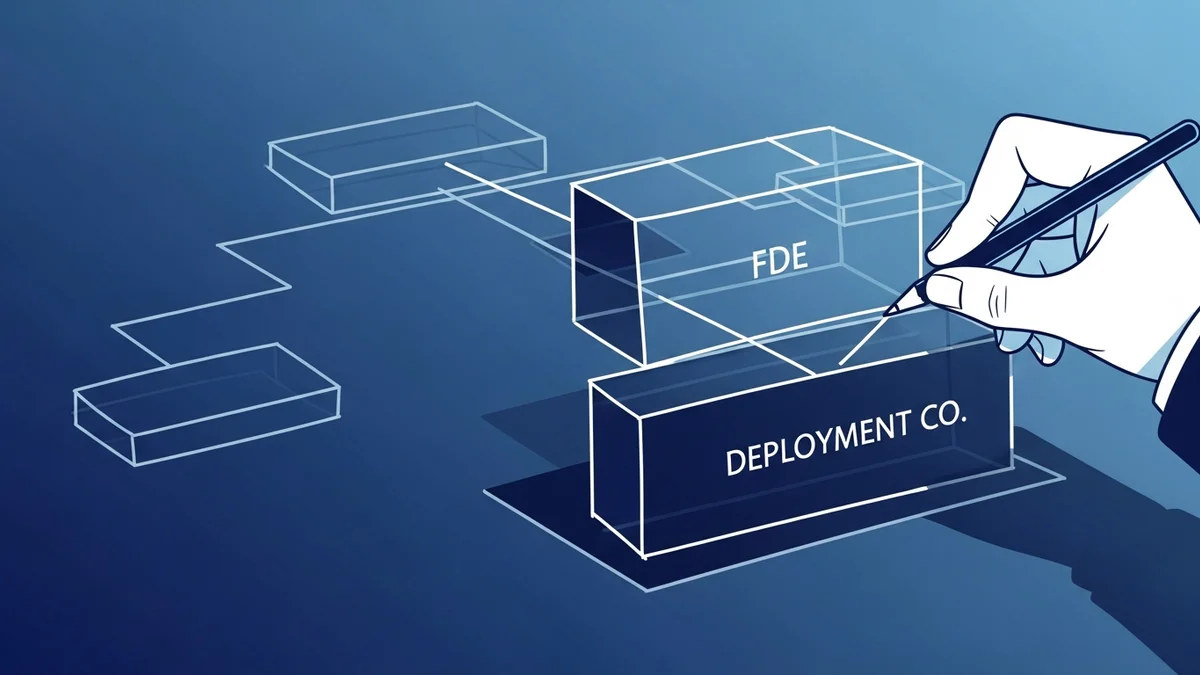
In four weeks, the three frontier labs all admitted the same thing. The product is not the model. The product is the engineer who installs the model.
Anthropic announced a forward-deployed-engineer consulting subsidiary on May 4 2026, backed by Blackstone, Hellman and Friedman, and Goldman Sachs. OpenAI capitalized its Deployment Company on May 11 with $4B from TPG and Advent at a $14B valuation, then bought Tomoro UK and absorbed 150 forward-deployed engineers across the UK, Asia, and Australia. By late May, Gergely Orosz reported in The Pragmatic Engineer that Google Cloud had compressed its forward-deployed-engineer interview loop from four to six interviews over several weeks down to two interviews in two days.
Two days. From a frontier lab. For an engineering hire.
That is not a hiring policy. That is a structural admission. The labs need humans inside customer accounts faster than the labs can model them. Slow Ventures named the pattern the cleanest: AI Accenture, not Accenture for AI. The labs are not hiring consultants. They are becoming the consultancy, and they are pricing the role like it is on fire.
The labor-market signal
The corporate-development story is loud, but the labor-market story is louder, and harder to argue with.
Kyle Poyar’s May 2026 cut of Sumble data (Growth Unhinged, May 20) reads as the first clean snapshot of what AI is doing to GTM headcount. Overall go-to-market job postings are down 15% year over year in the first half of 2026. SDR and BDR roles are down 21% across the market. Customer support is down 37%, the largest decline of any GTM function. Whole layers of the funnel are being depopulated in real time.
Now the counter-cut. Cursor, Decagon, and OpenAI all doubled their own SDR headcount in the same period. The AI-native vendors whose pitch is “automation replaces sales” are themselves hiring sales faster than anyone. GTM-engineering roles, the hybrid product-plus-pipeline function, doubled year over year to more than 400 open positions across the public market. Sales and solutions engineering combined now make up roughly 60% of all GTM openings.
The picture is not “AI eliminates sales jobs.” The picture is “AI eliminates the bottom of the funnel and pulls the rest of the funnel into engineering.” The work that survives is the work close to the customer’s system of record. The work that dies is the work that scripts a call.
This is the same shape as the FDE announcement. The labs and the AI-native vendors are not predicting a future in which software sells itself. They are building an organization in which engineers sell, install, and operate the software, and the rest of the funnel gets compressed into the model.
Why the apps need this shape
The structural answer for why this is happening sits in Neevash Ramdial’s Tech Bifurcation and the 0.5 Layer (May 2026). Ramdial argues that there is a new infrastructure tier emerging between the foundation model and the application, the layer where agent execution, retrieval, eval, and routing actually live. He points to companies like Turbopuffer ($100M ARR profitable on under $1M raised), Modal ($355M Series C at a $4.65B valuation), and Mintlify (where roughly half of documentation traffic now comes from AI agents reading docs on behalf of human users) as proof that the 0.5 layer is real, large, and capitalized.
The same post cites a Neevash demo in which Google’s Antigravity 2.0 built a working operating system in roughly 12 hours, orchestrating 93 sub-agents at a total cost of under $1,000. That is not a feature story. It is a delivery-cost story. The model is now cheap enough and capable enough that the bottleneck is the human work of pointing it at a real customer problem, structuring the agent graph, and operating the result.
That human work has a name. Forward deployed engineer.
We argued in Foundation Labs Are Absorbing Your Stack that the labs were collapsing model, runtime, dev tooling, and consulting into one balance sheet. The FDE buildout is the staffing model under that collapse. The 0.5-layer thesis explains why the staffing model has to look this way. You cannot ship a $1,000 OS-from-scratch demo through a quote-to-cash motion that takes nine months and four discovery calls. You need an engineer who can sit with the customer’s domain expert on Monday and ship the agent graph by Friday.
What “FDE” actually means now
The role itself is older than the lab restructuring. Palantir invented the modern version in the 2010s. The pattern was simple. Send a real engineer into the customer account. Let that engineer become a temporary employee of the customer’s operation. Build the workflow around the customer’s actual data and actual constraints. Leave the workflow installed when you pull the engineer out.
What changed in May 2026 is the volume and the asking price. Anthropic, OpenAI, and Google are now staffing FDE roles at scale, and the comp packages are pulling senior application engineers out of every other corner of the industry. The Google two-day interview loop is the tell. When a frontier lab compresses its hiring process by an order of magnitude, the lab is not relaxing its bar. The lab is admitting that the supply of qualified humans is the constraint, and that every week the loop takes is a week a competitor’s FDE shows up at the customer’s office first.
This is the operating system of the AI-Accenture model. Not a methodology. Not a deck. A bench of engineers, staffed by the lab, sent into customer accounts, paid out of model revenue. The labs do not need a new product to compete with McKinsey. They need a new org chart. They have built it.
What this changes for buyers
Three consequences will land in enterprise procurement and engineering org charts this quarter.
First, you will be sold to by an engineer. The AE will introduce the room and then leave. The work of scoping, demoing, and recommending will be done by someone whose pager rotates back to the lab’s product team. That person will be brilliant, fast, and structurally biased toward the lab’s stack. Plan for that bias the way you would plan for any vendor-staffed solution architect, except more so, because this one writes the code that goes into production.
Second, your own GTM org will hollow at the bottom and thicken in engineering. The Poyar data is not a forecast. It is a measurement. If your sales-development team is more than 20% of your GTM headcount, your peers are already cutting toward your number. If your GTM-engineering function does not exist yet, your peers are already staffing it. The roles that survive sit close to customer systems. The roles that disappear sit close to a script.
Third, your delivery model needs an FDE-shaped layer of its own, or you will outsource that layer to whichever lab gets to the customer first. This is the buy-side mirror of the lab consolidation. If you sell software that touches AI, the customer is going to expect a forward-deployed engineer in the room, because that is what every other vendor in their procurement queue is now offering. Build the role internally or rent it from a partner who is not also selling the underlying model. Both options work. “Neither” does not.
Do this now
Run three things on the books this quarter.
Count your FDE-shaped people. The job title does not matter. Count the engineers who can sit in a customer’s office on Monday and ship production code on Friday. If the number is less than 10% of your engineering org and you sell into the enterprise, you have a delivery shortfall that your vendor partners will fill for you within two quarters.
Audit your GTM-engineering function. If it does not exist as a named team with its own budget, name it now. The function lives between product, sales engineering, and pipeline operations. The people staffing it are usually full-stack engineers with a revenue line attached. Sumble’s data shows the role doubling year over year. The market is repricing this work in real time.
Stress-test your single-vendor stacks. If your AI vendor is sending you a forward-deployed engineer, ask the vendor for a written exit plan. What knowledge transfers when the FDE leaves? What runs on your infrastructure versus the lab’s? What does the workflow look like when you swap the model in 18 months? The labs are pricing the FDE role like it is on fire because they know the workflow installed today is the procurement decision locked in tomorrow. Plan the exit while you still have the negotiating leverage of being a new customer.
The AI-Accenture motion is not a prediction. It is an org chart that already exists, capitalized, staffed, and pricing aggressively. The buyers who notice in May 2026 keep their optionality. The buyers who notice in May 2027 are signing the SOW that the FDE wrote last quarter.
This analysis synthesizes The Pulse: Forward-Deployed Engineering Heats Up Again (The Pragmatic Engineer, May 2026), Who’s Actually Hiring in GTM Right Now (Growth Unhinged, May 2026), and Tech Bifurcation and the 0.5 Layer (Neevash Ramdial, May 2026).
Victorino Group helps enterprises build the FDE-shaped delivery layer their AI vendor contracts now assume exists. Let’s talk.
All articles on The Thinking Wire are written with the assistance of Anthropic's Opus LLM. Each piece goes through multi-agent research to verify facts and surface contradictions, followed by human review and approval before publication. If you find any inaccurate information or wish to contact our editorial team, please reach out at editorial@victorinollc.com . About The Thinking Wire →
If this resonates, let's talk
We help companies implement AI without losing control.
Schedule a Conversation