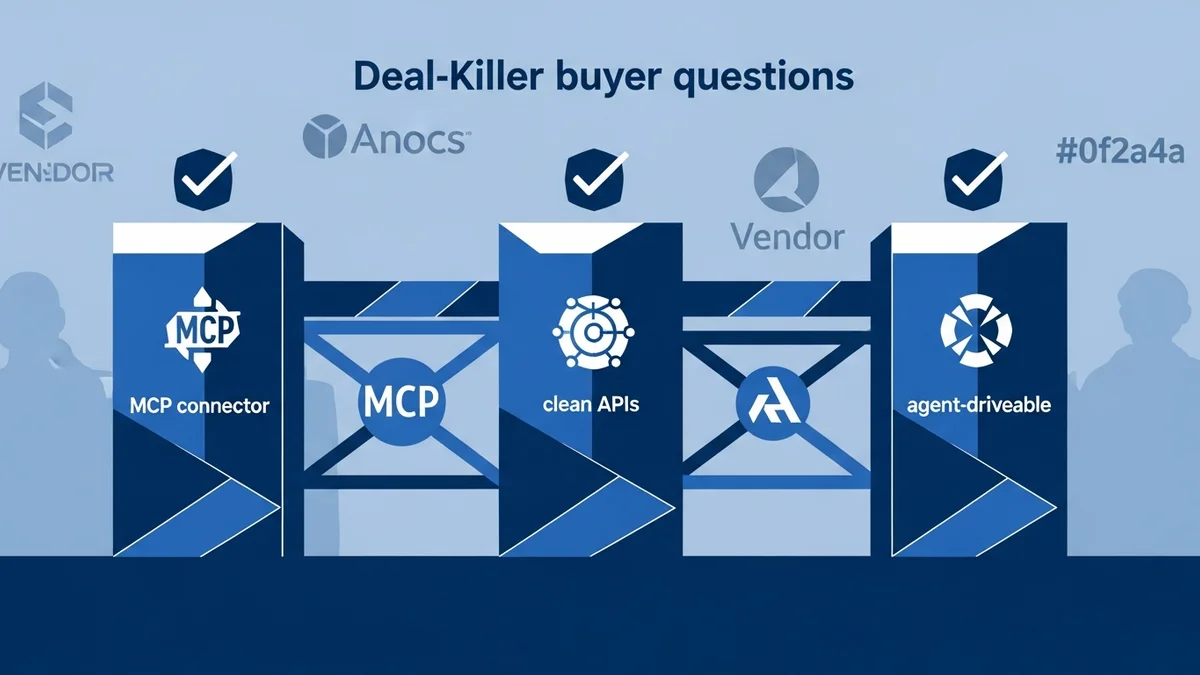
A SaaS renewal call used to start with usage stats. License count, active seats, feature adoption, the polite march toward the renewal number. This week, OnlyCFO published a buyer-side post that reframes the entire conversation: the questions that decide whether a vendor survives 2026 are no longer about adoption. They are about whether the product is operable by an agent.
Three questions. Each one is a deal-killer.
Does it have an MCP connector?
Are your APIs clean enough for an agent to drive?
Is your product designed as the best option for AI agents to operate independently?
OnlyCFO is a budget-holder. The post (2026: The Year of Churn) is not analyst speculation; it is a CFO writing about a vendor decision they personally made. A competing tool covered roughly 60% of an $80K-a-year tool’s functions. The CFO churned the $80K vendor, saved the $80K, and filled the remaining 40% with internal customization. That is the math that should land on every SaaS roadmap meeting this quarter.
The math is unforgiving
Pair the renewal-side reframing with the unit-economics floor. BenchSights’ median S&M payback period across public SaaS sits at roughly 20 months. Top-decile private companies, per ICONIQ, are not far off. That number was already long. It assumed a churn environment that no longer exists.
Higher churn pulls payback in two directions at once: it shortens the window in which a customer is contributing margin, and it raises the CAC required to refill the funnel. There is no algebraic version of “we’ll grow through it.” If renewal conversations are now decided by three questions and your product fails any of them, the math has already happened. The renewal call is just where the loss gets booked.
The SaaS rout post argued that operating discipline is the new premium. The Cursor margin post argued that the unit-economics inversion is real and structural. This is the third leg: the inversion has a buyer-side trigger now, and it is procedural.
Question 1: MCP connector
Six months ago, “does it have an API” was the integration question. Today it is “does it have an MCP connector.” The distinction matters. An API is something a developer integrates against. An MCP connector is something an agent uses without being integrated against — the agent discovers the surface, reasons about it, and operates the tool.
If the procurement conversation includes the phrase “we’d need to build a custom integration,” the buyer has the information they need. The vendor that ships an MCP connector becomes operable by every agent the buyer’s team configures. The vendor that does not stays a UI a human has to drive.
This is not a feature flag. It is a posture change about what your product is for.
Question 2: Clean APIs
Most SaaS products have APIs, technically. They are also gated behind UI patterns, hidden behind enterprise-tier paywalls, missing pagination, missing error semantics agents can recover from, missing idempotency keys, missing the schema documentation an agent needs to reason about what a request will do. The API exists. It does not work for an agent.
“Clean” here is a buyer-side term, not an engineering one. It means: an agent can call this without a human translator. The buyer is not asking whether your API is RESTful. The buyer is asking whether their agent can do useful work with it on the first attempt, and whether the next ten attempts will be safe. If your API requires a human to read the docs and a developer to wrap retries, it is not clean enough.
Question 3: Agent-driveable end-to-end
The third question is the hardest one. It asks whether the product, in its core flows, can be operated by an agent without the agent needing to fall back to a human or a UI shim. It asks whether the workflows your product is built around assume a human at the keyboard or assume a process that can be initiated, monitored, and completed without one.
This is the question that exposes architectural decisions made years ago. Products built with the UI as the first-class surface and the API as an afterthought fail this question even if they pass the first two. The MCP connector exists, the API is clean, but the moment the agent tries to drive a multi-step workflow, the workflow assumes a human is somewhere in the loop. The agent can read; it cannot operate.
The vendor that gets this right does not just retain renewals. The vendor that gets this right gets the new spend. The buyer’s agent stack will preferentially route work through the products that the agents can actually use.
The $80K-line-item question
The traditional renewal question is “is this used?” The new renewal question is “is this still needed if my agents already have access to a substitute?” The OnlyCFO example makes the answer concrete: 60% functional coverage from a tool the team already has, plus internal customization to cover the remaining 40%, beats an $80K renewal even when the $80K tool is the better product on its own merits.
That is the part vendors should sit with. The competing tool was not better. It was good enough, and it was already there. Functional adjacency from a tool the buyer already pays for is now a churn vector. The vendor selling the better-but-narrower product is the one that loses the line item.
If your product depends on its line item being defended on its own merits, your roadmap has a buyer-side problem the engineering team cannot fix by itself. The defense is operability. If two of the three buyer questions are “no,” the product is no longer competing on merits. It is competing against substitution.
What the buyer-side framing means for vendor roadmaps
The roadmap meeting a year ago argued about feature parity. Which competitor shipped what, which gap to close first, which integration to prioritize. That conversation is now downstream of three prior questions, and the prior questions are not on most roadmap docs.
Three concrete moves that reorder priorities:
- MCP connector before next feature. If the connector is not on the next two quarters’ roadmap, the product is shipping into a market that has changed its procurement question and has not been told.
- API audit through the agent’s eyes. Not “is this RESTful?” but “can a Claude or GPT agent, with no prior context, complete a real task using this API and the docs?” If the answer is no, the docs and the API both need work.
- End-to-end flow for headless operation. Pick the most-used flow. Walk through it as if the user were an agent. Mark every step that requires a human at a UI. Those steps are now technical debt with a renewal-cycle maturity date.
What the buyer-side framing means for buyers
If you are on the buyer side, the OnlyCFO post is permission to ask different questions. Not “are we using this enough to justify renewal” but “do we have a substitute on the agent surface, and is the gap small enough to close internally.”
The audit is fast. List the SaaS line items. Mark which ones have MCP connectors. Mark which ones an agent can operate end-to-end. The unmarked rows are renewal conversations now, not in nine months.
Three questions. Six weeks of due diligence collapsed into one renewal call. The bar moved while you were closing.
This analysis synthesizes 2026: The Year of Churn (OnlyCFO, April 2026), citing 20-month median S&M payback period from BenchSights.
Victorino Group helps software vendors and buyers map their portfolios against the three new buyer questions before the next renewal cycle. Let’s talk.
All articles on The Thinking Wire are written with the assistance of Anthropic's Opus LLM. Each piece goes through multi-agent research to verify facts and surface contradictions, followed by human review and approval before publication. If you find any inaccurate information or wish to contact our editorial team, please reach out at editorial@victorinollc.com . About The Thinking Wire →
If this resonates, let's talk
We help companies implement AI without losing control.
Schedule a Conversation