Cursor's Negative-23% Gross Margin Is the New SaaS Reality
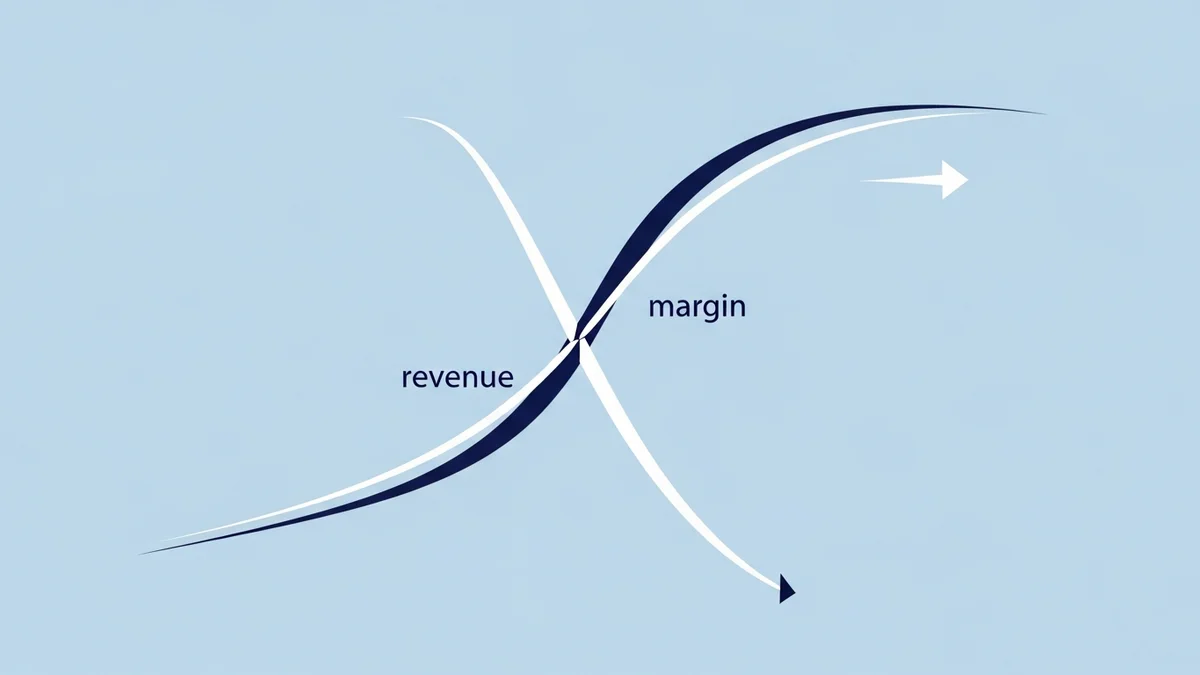
Cursor reportedly runs roughly $2.7 billion in annualized revenue at a gross margin of negative 23%. Read the second number again. The company loses money on every dollar of revenue before sales, marketing, R&D, or any line you would expect to see consume a SaaS P&L. The losses come from upstream API fees paid to Anthropic and OpenAI for the model calls that make the product work.
In the SaaS playbook, your best customer is the most profitable customer. In Cursor’s economics, your best customer is the most expensive one. The power user who lives in the IDE eight hours a day is the user whose tokens cost you the most. Every dollar of expansion is a dollar of widening loss. The 2014-vintage SaaS curve has been turned upside down inside a single product category.
The numbers and what they invert
Per Contrary Research’s April 2026 reconstruction, Cursor’s gross margin has been negative for most of its scale-up. The driver is structural, not cyclical: the underlying inference cost moves with usage, not with seat count. A traditional SaaS company with 80% gross margins amortizes a fixed cost base over a growing revenue line. Cursor amortizes a variable cost base — paid per token, per call, per model — that grows faster than the revenue line because power users use more tokens than light users pay for.
The cohort math compounds. Net revenue retention used to be the most flattering number on a SaaS deck because expansion came at near-zero marginal cost. In a token-cost world, expansion comes at strictly positive marginal cost, often higher than the marginal price the customer pays. NRR above 130% in this regime is a signal that the unit economics are deteriorating faster, not that the business is healthier.
This is the inversion. The shape of the cash flow that earned SaaS its multiple — recurring revenue, expanding cohorts, near-zero marginal cost — does not survive contact with foundation-model APIs as the cost of goods sold. We argued the broader market consequence of this shift in Post-SaaS Economics: The Premium Is Gone. Cursor is the most concrete example of what the new shape looks like on a single income statement.
The escape hatch: SpaceX
The standard exit from negative gross margins in software is to negotiate better cost-of-goods. You cannot negotiate your way out of frontier-model pricing when the providers themselves are losing money serving you. So Cursor reportedly went looking for a different kind of fix.
According to Contrary’s reporting, an attempted $50 billion round with Nvidia, Andreessen Horowitz, and Thrive did not close. The venture market that had been pricing Cursor as the clear category winner had already done the same arithmetic on the gross margin line and stepped back. The replacement option on the table is a $60 billion acquisition by SpaceX, or a roughly $10 billion payment for compute access through Colossus, the supercomputer cluster associated with the SpaceX orbit. Either way, the implicit thesis is the same: the only durable path out of negative gross margins for an AI-native application is to own, or lock up, the compute underneath it.
This is a remarkable claim if you sit with it. The “escape hatch” for one of the highest-revenue AI applications in the world is not pricing changes, model substitution, or efficiency gains. It is vertical integration into the compute layer at a price tag that is most of a small country’s GDP. That is not a normal venture-backed software story. It is closer to how telecom infrastructure or semiconductor fabs get financed.
For everyone else in the application layer who does not have a SpaceX-shaped patron in their cap table, the implication is sobering. If the category leader’s economics only work via vertical integration into compute, the category followers are running a business that has no margin floor and no obvious path to one.
What this means if you are buying
Three concrete moves for any board, CFO, or operator with AI tooling on the renewal calendar in the next six months.
Reprice your assumption about pricing. The seat-based, all-you-can-eat pricing model that AI-native vendors copied from SaaS is incompatible with token-based costs. It is being repriced in real time toward token-aware, compute-aware tiers. Plan for power users to cost meaningfully more in 2027 than they cost in 2026. The “freemium converts to enterprise” funnel is not just decelerating; it is inverted in any product where free tier usage drives losses faster than paid conversion drives revenue. We described how enterprises are already responding to this in The $7 Doritos Moment.
Treat negative-margin vendors as acquisition bets. If you are committing seats, data, or workflow to a vendor whose gross margin is structurally negative, you are implicitly betting on who acquires them. That is a governance question your board should know it is making. The acceptable answer is “we are comfortable being a customer of whichever compute-rich entity buys this company.” The unacceptable answer is “we did not realize that was the bet.” Every contract over a meaningful spend threshold should have a documented contingency for vendor acquisition, repricing, or wind-down — not because any of those is certain, but because at this margin profile a future repricing event is not a risk, it is a calendar item.
Watch the measurement layer get more important, not less. The vendors that survive the inevitable repricing will be the ones whose customers can prove the tool earned its money. The 5% of enterprises that can put a number on AI ROI today, as Cursor’s measurement work itself demonstrates in Cursor’s Multi-Agent Kernels, will negotiate from strength. The 95% that cannot will accept whatever pricing model the vendor’s new owner imposes. This is the same point we have been making across pillars: measurement is the moat for buyers as much as for sellers.
The deeper governance lesson is not about Cursor specifically. It is that AI tool selection in 2026 is no longer a feature-fit decision. It is a sustainability decision. A vendor with negative gross margins is a vendor whose pricing model has a future repricing event embedded in it. That repricing is a governance issue the same way a covenant breach in a loan agreement is a governance issue. You do not get to be surprised by it.
The honest reading of the Cursor numbers is not that the company is doomed. The product is excellent and the user love is real. The honest reading is that the SaaS economic template the application layer borrowed from is broken at the seam where token costs meet seat pricing. The vendors who figure out the new template — through compute integration, through usage-based tiers, through measurement that justifies premium pricing — will define what software economics look like for the next decade. The vendors who do not will be acquired or unwound.
If you are signing a renewal this quarter, that distinction is the one that matters.
This analysis synthesizes Contrary Research’s Cursor’s $60 Billion Escape Hatch (April 2026).
Victorino Group helps boards and CTOs evaluate AI tool sustainability beyond feature fit. Let’s talk.
All articles on The Thinking Wire are written with the assistance of Anthropic's Opus LLM. Each piece goes through multi-agent research to verify facts and surface contradictions, followed by human review and approval before publication. If you find any inaccurate information or wish to contact our editorial team, please reach out at editorial@victorinollc.com . About The Thinking Wire →
If this resonates, let's talk
We help companies implement AI without losing control.
Schedule a Conversation