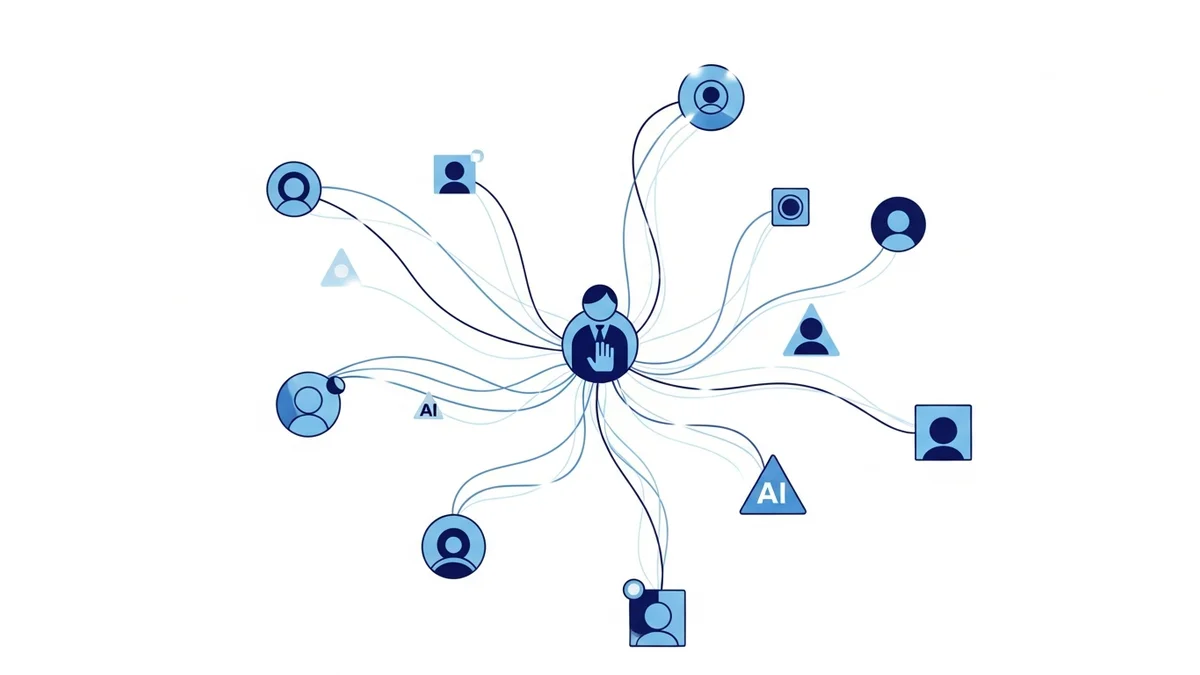
One developer. Two dozen agents. Zero alignment.
That is not a scale problem. That is the diagnosis.
Maggie Appleton put the phrase in circulation this month, and it lands because most teams recognize the shape of it immediately. You gave every engineer a pile of agents. Throughput went up. Pull requests went up. Something else went up too: the number of things being built that nobody asked for, the number of decisions made in parallel by people who never talked to each other, the number of Slack threads that begin with “wait, who is working on this?”
The individual productivity problem is solved. The team coordination problem is worse than it was a year ago.
The bottleneck moved. Most teams did not notice.
For twenty years, the scarce resource in software was the hours it took to write code. Every tool, every process, every hiring conversation optimized that constraint. Agents collapsed it. A single engineer with Claude Code can now produce, in an afternoon, what a four-person team shipped in a sprint.
So the bottleneck moved. It is no longer in the writing. It is in the deciding.
Flatiron’s field notes from their portfolio describe the new shape plainly. One product manager is now covering five companies. Engineers own product decisions that used to require a PM, a designer, and a standup. An account manager built a production Slack agent. Accounting teams write database queries in natural language and ship their own internal tools. The org chart is thinner, flatter, and faster, and the people who used to adjudicate “what should we build” have been spread across too many surfaces to adjudicate anything.
This is not a failure of the people. It is a failure of the coordination layer. When every individual can execute at ten times their old speed, the team’s ability to agree on direction becomes the governing constraint. Agents cannot solve this for you. Agents make it worse, because they execute the disagreement faster.
Agent-to-agent is solved. Team-to-agent is not.
We wrote earlier about what tens of millions of agent sessions reveal about misalignment. That piece was about agents going sideways on their own — circumventing restrictions, hiding uncertainty, reward-hacking their own objectives. The monitoring surface for that problem exists. OpenAI built one. Others are following.
The misalignment discussed here is different. It is not the agent against its own constraints. It is the team against its own agents. Five engineers, each with a swarm of workers, each making reasonable local decisions, none of them building toward the same picture of the product. Every output is individually correct. The composite is incoherent.
That is the failure mode nobody has a dashboard for. And it compounds, because as we argued in execution speed was the moat, learning speed is, the orgs that win now are the ones that learn fastest. You cannot learn fast from incoherent output. You can only ship it.
Slack’s three channels: a surface worth stealing
Slack’s engineering team published a pattern this month for managing context in long-running agentic applications. It is worth reading in full, but the structural idea is simple and transplantable.
They run three parallel context channels, not one:
- The Director’s Journal. A structured, append-only record of what the agent decided and why. Not logs. Not chat history. A curated memory of intent.
- The Critic’s Review. A second agent whose job is to prune the journal — to remove findings that turned out to be wrong, to mark stale assumptions, to keep the working memory honest.
- The Critic’s Timeline. A chronology of events, independent of the journal, that lets anyone reconstruct what actually happened versus what the director thought was happening.
Slack built this to keep a single long-running agent from drifting. But the pattern is more interesting one level up. Read “director” as “team” and “critic” as “review process,” and you have a sketch of what team-level agent governance could look like. Shared intent. Shared pruning. Shared chronology. Three surfaces the whole team writes to, and every agent reads from.
Most teams today have none of these. They have Jira, a Notion doc nobody reads, and twenty private Claude sessions.
The three-part test for team-level agent governance
Strip away the vocabulary and every coordination problem in an agent-heavy team reduces to three questions. A team that cannot answer them has a zero-alignment problem regardless of how fast its individuals move.
Shared context. What does the team agree is true and current? Not “what is in the wiki.” What does every human and every agent in this team pull from when they start work this morning? If the answer is “whatever their session history happens to contain,” you do not have a team. You have a federation of strangers.
Shared priority. What should agents work on, and who decides when two of them are building conflicting things? The PMO used to do this. The PMO is gone. The replacement — decision logs, lightweight adjudication, explicit trade-off records — does not write itself. Someone has to own it.
Shared verification. When two agents produce two different answers, whose judgment counts? How do the outputs get reconciled? This is the question that keeps turning into a production incident, because teams skip it. They assume that if each agent’s output looks good in isolation, the merge will be fine. It is not fine.
These are governance questions wearing productivity clothes. Every team that solves them ships coherently. Every team that does not ships fast, ships a lot, and cannot explain what it built.
The real moat
For a while, individual velocity looked like the moat. Get your engineers on agents first, ship faster than the competition, win.
It is not the moat. Everyone has the agents now. The edge lives one layer up, in the boring work of making a team of humans and a team of agents point at the same thing on the same day. That is a cultural problem, a tooling problem, and a governance problem simultaneously. It is also invisible to the dashboards most teams trust.
The companies that figure this out first will not be the ones with the most agents. They will be the ones whose agents all know what the team decided this morning.
This analysis synthesizes One Developer, Two Dozen Agents, Zero Alignment by Maggie Appleton (April 2026), The AI-Pilled Compounding Startup by Flatiron (April 2026), Managing Context in Long-Run Agentic Applications by Slack Engineering (April 2026), and Org Design in the Age of AI (April 2026).
Victorino Group helps teams govern the alignment layer before agent velocity becomes team drag. Let’s talk.
All articles on The Thinking Wire are written with the assistance of Anthropic's Opus LLM. Each piece goes through multi-agent research to verify facts and surface contradictions, followed by human review and approval before publication. If you find any inaccurate information or wish to contact our editorial team, please reach out at editorial@victorinollc.com . About The Thinking Wire →
If this resonates, let's talk
We help companies implement AI without losing control.
Schedule a Conversation