The Interlocks Live in the Spec: Anthropic's Model Hardware Standard as Physical Governance
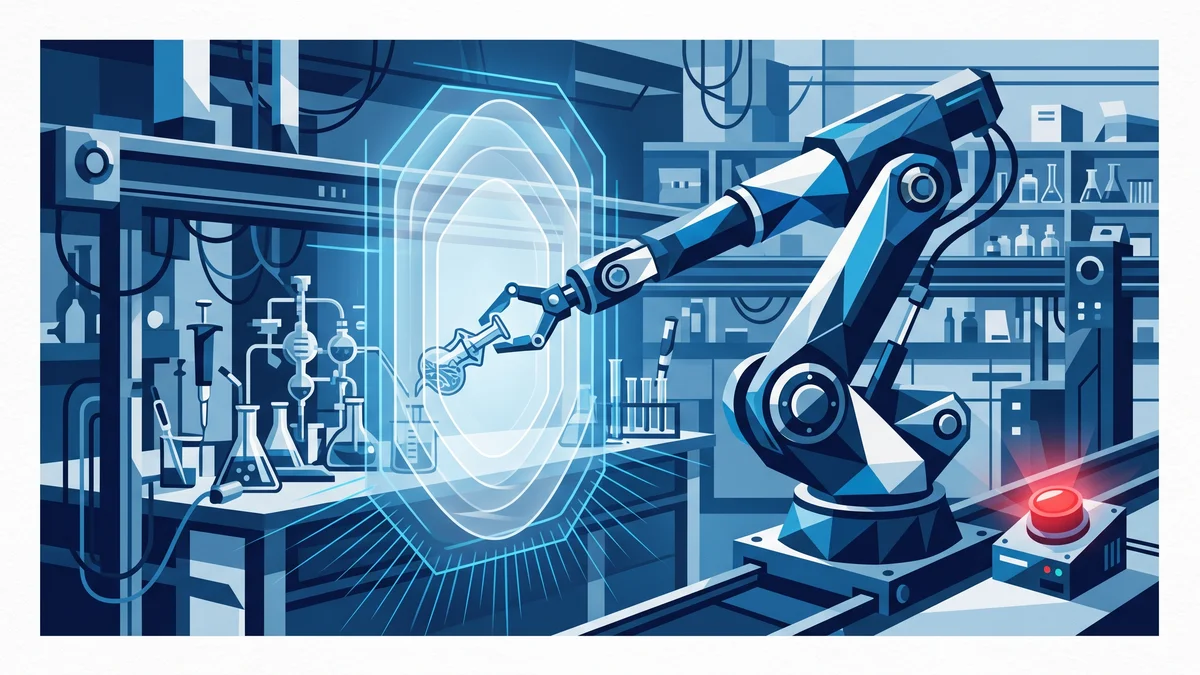
Six failure conditions, artificially induced: a missing plate, a rotated plate, a busy reader, a disconnected camera, an unreachable device, an active emergency stop. In Carnegie Mellon’s test of Anthropic’s Model Hardware Standard, the system blocked all six before any device moved.
That sentence carries more governance content than most AI policy documents published this year. On August 27, 2026, Anthropic’s Beneficial Deployments team released the Model Hardware Standard as a research preview: an MCP-based, model-agnostic interface that lets AI agents drive laboratory and factory equipment, with open sourcing planned. The partner list is unusually concrete for a research preview. Genentech, Carnegie Mellon, the Baker and Pinglay labs at the University of Washington, HHMI Janelia, QuEra, and Tetsuwan are running it. Vendors on board include Tecan, QIAGEN, Universal Robots, Danaher, Hugging Face’s LeRobot, and Raspberry Pi.
The capability story will get the headlines. The governance story is the one worth studying, because the controls do not sit in a prompt or a policy PDF. They sit in the interface specification itself: device-level limits, human approval gates for high-risk actions, auto-generated audit artifacts, and hardware interlocks the model cannot talk its way past. When the agent can move a robot arm, the containment question stops being rhetorical, and this spec answers it at the layer where an answer can actually be enforced.
What shipped, and where the governance lives
The integration problem MHS attacks is old. Connecting a new instrument to lab automation traditionally takes, in Anthropic’s words, “weeks, if not months.” The standard compresses that to hours or minutes. Carnegie Mellon wrote device drivers in about eight hours, against the several weeks a vendor-built setup typically takes, and reports experiments running about three times faster.
Speed alone would make this a productivity release. The design choice that makes it a governance release is where the constraints were placed. Four mechanisms ship inside the spec:
- Device-level limits. The interface bounds what an instrument will accept, independent of what the model asks for. A limit enforced at the device does not depend on the model’s compliance.
- Human approval gates. High-risk actions route to a person before execution, and the gate lives in the interface rather than in the model’s instructions.
- Auto-generated audit artifacts. The record of what the agent did to the hardware is produced by the system, as a side effect of operation. Nobody has to remember to log.
- Hardware interlocks. The physical layer can refuse. An active emergency stop is a circuit, and a circuit ignores arguments.
Prompt-layer governance fails in a characteristic way: the model is persuaded, confused, or jailbroken out of its instructions. Every one of these four mechanisms is indifferent to persuasion. The CMU six-condition test is a small demonstration of that indifference. The blocked conditions included states the model could plausibly have argued around in a text-only system (a busy reader, a rotated plate), and by the announcement’s account the block happened before any device moved.
The results, with the vendor label attached
The partner numbers deserve both attention and a disclaimer. Everything below comes from Anthropic’s own announcement. These are vendor-published partner accounts with no independent replication, and the safety result is one lab’s six-condition check, well short of a certification.
With that label attached, the numbers are specific enough to be useful.
QuEra used the system on laser recovery, a recalibration task. During development, recovery went from roughly 150 seconds per attempt at a 58% success rate to about six seconds at 96%. In a later blind test, the system succeeded on 695 of 700 attempts, a 99.3% rate. The two figures measure different things: 96% during development, 99.3% in the subsequent blind test. On a separate PID noise-tuning task, noise dropped from 15.7 mV to 1.55 mV across 363 experiments and 16 unattended hours.
Sixteen unattended hours is the phrase to sit with. Unattended physical operation is exactly the scenario that makes governance people reach for the shutdown argument, and it happened inside an interface where the interlocks, limits, and audit trail were present by construction rather than by operator discipline.
Tetsuwan’s result points somewhere else: the agent predicted multi-dispense precision roughly 12% more accurately than the manufacturer’s own spec, beating the spec on 31 of 45 runs, with a sign-test p-value around 0.001. An agent that models an instrument better than the instrument’s datasheet does is an agent whose relationship to the hardware has changed in kind.
The containment stack grows a physical tier
In April we mapped the four containment surfaces of the agent stack: compute, data, knowledge, identity. All four are digital. The worst case on each of those floors is a bad process, a bad query, a bad memory, a stolen credential. Recoverable, in principle, with backups and rotation.
A robot arm has no undo. Physical actuation breaks the recovery assumptions that digital containment quietly relies on, which is why the oversight economics we examined in the drone bench-test essay looked so uncomfortable: watching a physical agent closely enough to catch its mistakes can cost more than the automation saves.
MHS is interesting precisely because it responds to that economics problem structurally. The four mechanisms in the spec map onto the same pattern the digital floors converged on. Move trust out of the per-action human check and into the boundary. Make the safe path the default path. Let the system generate the audit trail on its own. The containment stack we drew in April now has a fifth tier below compute: actuation. And the first implementation of that tier we have seen arrived with governance already inside it.
There is a pattern here we have been tracking across vendors all year: governance shipping as a product feature. MHS extends that pattern across the digital-physical boundary. The spec is the governance artifact. If you want to audit what an agent is allowed to do to a centrifuge, you read the interface definition, the same way you would read an IAM policy.
What a governed adoption looks like
Anthropic plans to open source the standard, and the vendor list suggests instrument makers will ship native support. If your organization runs a lab, a production line, or any bench with automatable instruments, the evaluation window is now, before someone connects an agent to hardware through an ad hoc bridge that has none of these properties.
Run this review before any agent touches a physical device:
- Inventory the actuation surface. List every instrument an agent could plausibly drive in the next year. For each, write down what the worst irreversible action is. This list is your physical-tier risk register.
- Demand spec-level controls. For any agent-to-hardware integration, require the four mechanisms MHS demonstrates: device-level limits, approval gates on high-risk actions, system-generated audit artifacts, and interlocks that live below the model. A vendor who answers “the model is instructed not to” has answered the wrong layer.
- Reproduce the CMU test on your own bench. Induce failure conditions and verify the block happens before motion. The CMU test used only six induced conditions. Do not accept a safety story you have not tried to break.
- Treat vendor numbers as hypotheses. The QuEra and Tetsuwan results are impressive and unreplicated. Your procurement bar should be a pilot that reproduces the claim on your instruments, with your failure modes.
The teams that get physical agency right will be the ones that adopted an interface with governance inside it, then verified the governance themselves. The spec has been published. The lab bench is now part of the stack.
This analysis synthesizes Model Hardware Standard: research preview (Anthropic, Beneficial Deployments team, August 2026).
Victorino Group helps engineering organizations extend agent containment architecture down to the physical tier, from interface specs to audit trails. Let us talk.
All articles on The Thinking Wire are written with the assistance of Anthropic's Opus LLM. Each piece goes through multi-agent research to verify facts and surface contradictions, followed by human review and approval before publication. If you find any inaccurate information or wish to contact our editorial team, please reach out at editorial@victorinollc.com . About The Thinking Wire →
If this resonates, let's talk
We help companies implement AI without losing control.
Schedule a Conversation