Claude Managed Agents: When the Harness Becomes a Vendor Product
On April 8, Anthropic started renting out the harness.
Claude Managed Agents is a beta product (header: managed-agents-2026-04-01) that hosts the agent loop, the sandbox, the tools, the filesystem, and the event log inside Anthropic’s cloud. You bring a system prompt and an outcome. Anthropic brings everything else. Secondary reporting from SiliconANGLE and InfoWorld puts the price at roughly eight cents per session-hour on top of standard token costs. The overview doc itself does not quote a price.
We have spent the past two months arguing that the harness is the product and that changing the harness moves scores more than changing the model. Managed Agents is what happens next. The harness is no longer something you build. It is something you can rent.
That is a smaller announcement than it sounds, and a larger one.
It Is Not New. It Is Converging.
Resist the urge to call this a first. OpenAI’s Responses API, extended in March with a hosted shell, a container runtime, skills, and compaction, already offers the same primitives. The Assistants API is older still. Anthropic is not inventing a category. Anthropic is catching up to one.
What is new is the shape. Anthropic collapses the harness problem into four nouns:
- Agent — a reusable template of model, system prompt, tools, MCP servers, and skills.
- Environment — a container template with packages and network rules. The unit of isolation.
- Session — a running instance with a persistent filesystem and event history. The unit of cost.
- Events — the SSE stream of turns, tool results, and status updates. The de facto audit trail.
Whoever owns those four nouns owns the governance surface. Until April 8, the answer was “you do, if you built it.” Now the default answer is “Anthropic does, if you let them.”
The Primitives Are Fine. The Missing Page Is the Story.
Read the overview doc carefully and notice what is not in it.
Data residency is not mentioned. Tenancy model is not described. SOC 2 and HIPAA scope for the harness runtime specifically (as opposed to the core Messages API) is not stated. Event log retention is not specified. Audit log access during an incident is not defined. Custom tool sandbox isolation is unspecified. SLA is absent, because beta products do not have one. Portability is not discussed, because the Agent/Environment/Session schema is proprietary.
None of these omissions are scandalous. They are what you expect from a beta product page optimized for activation, not procurement. They are also, without exception, the exact questions a CISO will ask before signing.
This is where the 60-create-per-minute, 600-read-per-minute rate limit starts to matter. Those numbers are fine for an interactive product or a queue of asynchronous jobs. They are not fine for a fleet that spins up thousands of short-lived agents in a burst. That is a developer-tier ceiling, not an enterprise-production ceiling. Architecture choice is forced early, before you have the data to make it well.
The Real Shift: Where the Sandbox Lives
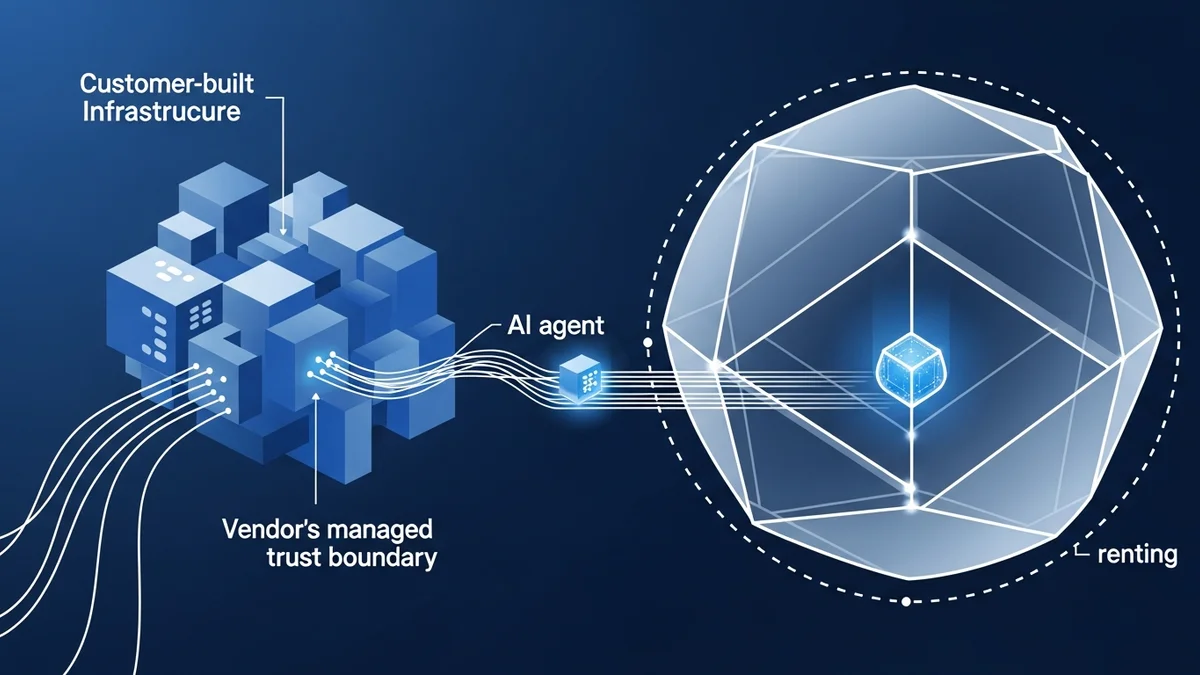
Before April 8, when Claude ran rm -rf or exfiltrated a secret through curl, it happened inside infrastructure you controlled. Your VPC, your logs, your incident runbook, your forensic trail.
After April 8, if you choose the managed path, it happens inside Anthropic’s runtime. Anthropic’s telemetry. Anthropic’s event store. Anthropic’s on-call.
That is not a worse place for it to happen. For many workloads it is a better place. But it is a different place, and the difference is the entire thing. The sandbox boundary just became a vendor trust boundary. Every audit question that used to end with “let me check our logs” now ends with “let me file a support ticket.”
This is the same pattern we documented in The Week Governance Became a Product Feature. Vendors are building governance primitives directly into their platforms. The positive reading is that governance is getting easier to adopt. The uncomfortable reading is that governance is getting easier to outsource. Those are the same sentence with different adverbs.
The Honest Case for Renting
We should say the thing that is true even when it is inconvenient for our consulting practice.
For internal, non-regulated, bursty workloads, Managed Agents is probably the right answer. Research agents exploring a codebase. Internal operations bots processing tickets. Prototyping something you will throw away in six weeks. Quick agents wrapped around a data pull.
In those cases, the productivity gain from not building your own loop, sandbox, compaction, checkpointing, tracing, and scoped permissions dominates the lock-in cost. Building that infrastructure yourself means hiring a team, and that team will produce a worse version of what Anthropic ships on day one. Rent it. Use the saved months to work on something that is actually your competitive advantage.
If that describes your workload, close this tab and go build.
The Honest Case Against Renting
For regulated production workloads, the honest answer is different, and it starts with one word: beta.
managed-agents-2026-04-01 is a date in an API header. There will be a managed-agents-2026-XX-XX. Breaking changes are explicitly anticipated. A bank cannot underwrite a production workflow on a contract the vendor can redefine between releases. A hospital cannot either. Neither can a law firm.
Then the unanswered list compounds. No published data residency means no EU deployment story yet. No harness-scoped BAA means no US healthcare story yet. No stated retention means no legal hold story yet. No SLA means no procurement story yet. No portability means exit costs accrue from day one. Each of these is addressable. None of them is addressed in the docs as of April 10.
For this segment, Bedrock or Vertex with the Messages API remains the defensible baseline. You keep the container. You keep the logs. You keep the egress rules. You keep the incident response. You also keep the work of building all of it, which is the point.
The Decision Is No Longer Technical
Here is the part that matters, and it extends the argument we made in Workload-Harness Fit.
The technical case for building your own harness just got weaker. Anthropic ships compaction, prompt caching, checkpointing, scoped permissions, and end-to-end tracing in the box. Your internal version will be behind on day one and further behind on day sixty.
The governance case for building your own harness just got stronger. Every primitive Anthropic ships is another thing the vendor owns, another thing a regulator will ask about, another thing an auditor will want to inspect, another thing your incident commander will not be able to see directly.
This means the CTO and the CISO will not agree on the answer. The CTO sees saved engineering months and a faster path to production. The CISO sees a new sub-processor in the critical path of every agent decision, operating on beta contracts with undisclosed retention. They are both right. They are evaluating different questions.
That disagreement is the work. It is not resolved by a feature comparison matrix. It is resolved by deciding where your governance boundary needs to live, writing that decision down, and then choosing the harness that fits inside the boundary you drew.
Call this “governed autonomy” if you want a label. The label is ours, not Anthropic’s. The question is not.
Four Questions Before You Rent the Harness
- Where does the sandbox boundary need to live? If regulatory posture requires agent execution inside your VPC, the rent option is off the table. Decide before you prototype, not after.
- Who is the system of record for agent behavior? If the event log in Anthropic’s cloud is your only audit trail, your audit trail is a support ticket away from being unavailable. If it is a copy of your own trail, you are paying to duplicate state.
- Is Anthropic a processor or a sub-processor? The contract shape is different, the DPA is different, and the customer notification obligations are different. Get the answer in writing before the pilot.
- What breaks when the beta header changes? Assume it will. Plan for the migration now, while the migration is still cheap.
None of these questions are new. What is new is that they have a concrete product to be asked against. Before April 8, “should we rent the harness” was a hypothetical. This week it is a purchase order waiting to be signed.
The harness became a commodity faster than most teams expected. Commodities do not compete on features. They compete on governance. The firms that decide where their governance boundary lives first will buy well. Everyone else will buy twice.
This analysis synthesizes Claude Managed Agents overview (Anthropic, April 2026), Claude Managed Agents Tools (Anthropic, April 2026), Anthropic Launches Claude Managed Agents to Speed Up AI Agent Development (SiliconANGLE, April 2026), Anthropic Rolls Out Claude Managed Agents (InfoWorld, April 2026), OpenAI Extends Responses API for Autonomous Agents (InfoQ, March 2026), and the Anthropic Trust Center (accessed April 2026).
Victorino Group helps CTO and CISO teams decide where the governance boundary lives before the build-vs-rent question reaches a purchase order. Let’s talk.
All articles on The Thinking Wire are written with the assistance of Anthropic's Opus LLM. Each piece goes through multi-agent research to verify facts and surface contradictions, followed by human review and approval before publication. If you find any inaccurate information or wish to contact our editorial team, please reach out at editorial@victorinollc.com . About The Thinking Wire →
If this resonates, let's talk
We help companies implement AI without losing control.
Schedule a Conversation