ChatGPT's March 4 Model Switch Cut Cited Domains by 20%. Move Your AEO Budget.
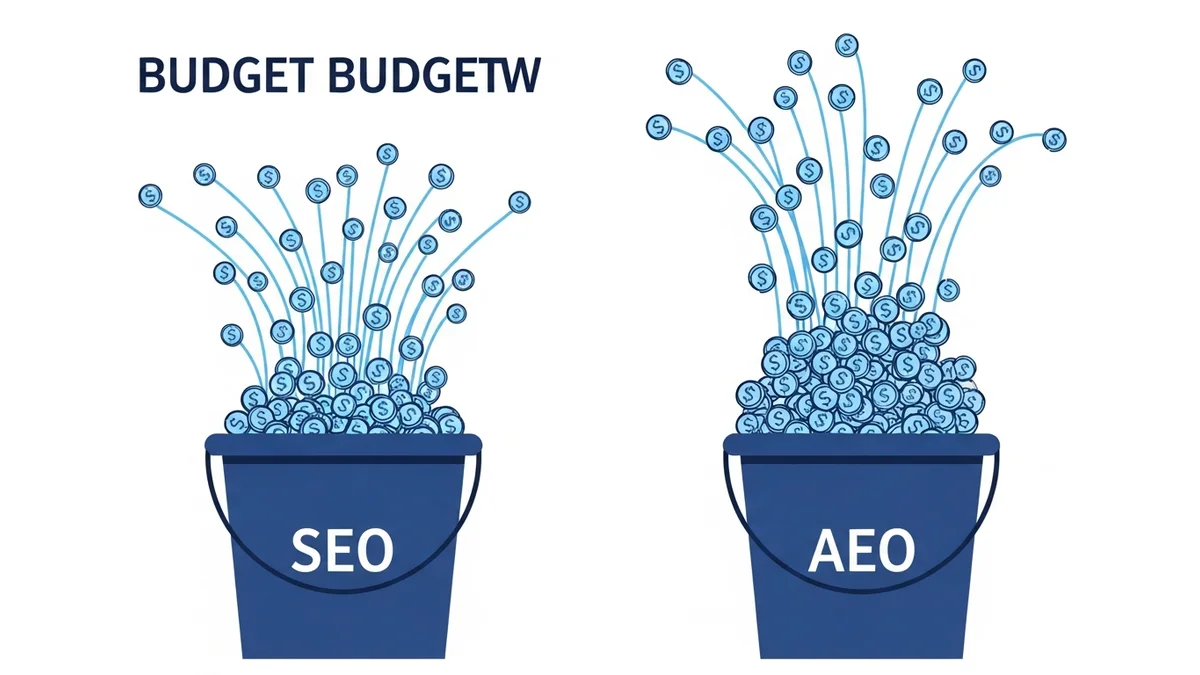
On March 4, 2026, OpenAI quietly switched the default model behind ChatGPT search from the GPT-4o/5.2 family to GPT-5.3 Instant. No press release. No version banner in the product. The user experience looked identical. What changed was invisible to the user and structural for anyone trying to win citations from the assistant.
RESONEO instrumented ChatGPT for fourteen weeks straight and published the results in Search Engine Land. The number that should reorganize your marketing budget: average unique cited domains per response dropped from 19 to 15. URLs per response dropped from 24 to 19. Both drops persisted across the entire post-March 4 window. That is more than a twenty percent reduction in citation surface area, executed on a single Wednesday by a model swap most marketing teams did not know happened.
This is the part of AEO that very few teams have priced in. Your visibility is not just a function of your content, your backlinks, or your structured data. It is a function of which ChatGPT model is the default this week. And the default changes without notice.
What the model switch actually changed
The technical detail matters because it tells you which dial you are not allowed to touch. RESONEO’s instrumentation traced the cut to two changes in the assistant’s web.run tool. First, the tool’s output format shifted from pipe-separated text to structured JSON, and the operations supported expanded from four to twelve. Second, the search behavior of the new default model is meaningfully shorter: GPT-5.3 Instant typically chains two to three search rounds per query, while GPT-5.4 (the deeper reasoning variant) chains five or more.
Fewer rounds means fewer fan-outs, which means fewer chances for your domain to be selected, retrieved, and cited. The drop from 19 cited domains to 15 is exactly what you would expect when the orchestrator runs a tighter retrieval loop.
Two more details from the instrumentation belong on the wall:
- More than ninety percent of weekly ChatGPT users are on the free plan, which means they get the lighter search experience by default. The shorter loop is the loop that matters for almost everyone you are trying to reach.
- The bot doing the actual page fetch is
ChatGPT-User, notOAI-SearchBot. If your robots, edge rules, or rate limits target the wrong user agent, you may have been excluding yourself from citations and not known it. Audit your access logs this week.
The combined picture: the assistant is faster, cheaper for OpenAI to serve, and citing fewer sources per answer. None of that is reversible from your side. You can publish the world’s most authoritative explainer; if the orchestrator only fans out to fifteen domains, the question is whether you are one of those fifteen.
The org-design response: AEO does not live in SEO
Eli Schwartz argued this week that the entire mental model most companies use for AEO is wrong. SEO is a product function: you ship pages, optimize structured data, build links, monitor rankings, iterate. AEO is a brand function: LLMs cite sources they have learned to trust, and trust comes from earned reputation, not from the technical hygiene of a single page.
His sharpest line: “Money can’t buy visibility in LLMs. It needs to be earned.” You cannot pay a vendor to insert your domain into a model’s training data or its retrieval preferences. You cannot run a campaign that buys citations the way you can buy AdWords impressions. The signal that gets you cited is the same signal that gets a journalist to call you for a quote: the assistant has read your name, in context, on enough independent surfaces, often enough, to treat you as a default reference.
That is brand work. PR work. Community work. Partnership work. Conference presence. Podcast guest spots. Substack mentions by people the model already trusts. Product Hunt launches. Reviews on platforms the model crawls. Co-authored research with credible institutions. The disciplines that produce earned reputation across third-party surfaces are not in the SEO team’s toolkit, are not on the SEO team’s calendar, and are not in the SEO team’s budget code.
Schwartz’s organizational claim follows directly: the AEO budget owner should be the brand team, not the SEO team. The SEO team should still own technical AEO hygiene (structured data, llms.txt, page accessibility for ChatGPT-User), because that is product work and they are the product team for organic. But the budget that moves citation share belongs with whoever owns the company’s third-party surface area.
If your AEO line item currently sits in the SEO P&L, you are funding the wrong function to move the metric.
The compound effect: model volatility plus brand-only signal
These two stories collide. RESONEO proved the assistant can drop your citations by twenty percent on a Wednesday. Schwartz proved you cannot get them back through technical optimization. The only durable hedge against model-version volatility is being mentioned often enough, on enough independent surfaces, that any plausible retrieval loop in any plausible model version still surfaces your name.
That is not an SEO sprint. That is a multi-quarter brand investment. Companies that treated AEO as a 2025 tactical project, plugged into the SEO roadmap, are about to discover that their citation share is brittle in exactly the way SEO rankings used to be brittle in 2011 when Google’s algorithm updated weekly. The fix then was building a brand strong enough that ranking volatility did not break your traffic. The fix now is building a brand strong enough that model volatility does not break your citations.
We have written before about the off-site signal as the AEO moat and about hard signals for AEO governance. The March 4 switch is the empirical proof that the off-site work was the right work. The companies still relying on on-page optimization to drive LLM visibility just lost twenty percent of their surface area without doing anything wrong.
Do this now
Block sixty minutes with your CMO, your head of brand, and your head of SEO. Walk three decisions:
One: move the AEO line item. If AEO budget is currently inside the SEO P&L, move it to brand or to a shared brand-and-comms pool. The owner should be whoever owns PR, partnerships, and community presence. The SEO team retains technical AEO hygiene only. This is a budget transfer, not a budget cut. The dollar amount should grow if your competitors are doing this; the function it funds should change.
Two: instrument cited-domain share, not just rankings. If you do not have a weekly snapshot of which domains the major assistants cite for your top twenty buyer queries, you are flying blind through model switches you cannot see. RESONEO ran a fourteen-week instrumentation. You need at least four weeks of baseline before the next default switch, and assume the next switch is within ninety days. Pick a tool, or build the snapshot in a spreadsheet, but start the timer today.
Three: audit ChatGPT-User access. Pull your access logs for the last thirty days. Confirm the user agent ChatGPT-User is not being rate-limited, blocked, or served a degraded response by your edge or your bot management. If you cannot find any ChatGPT-User hits, you are not in the citation pool because you are not reachable. That is not an AEO problem; that is an infrastructure self-inflicted wound.
The companies that will dominate LLM citations in 2027 are not the ones with the cleanest schema markup. They are the ones whose CMO read the Search Engine Land instrumentation in May 2026, accepted that the retrieval loop is now in OpenAI’s hands, and reorganized the budget around the only signal still under their own control. Earned reputation across third-party surfaces. Built by the brand team. Funded by the brand line. Measured weekly. Treated as a permanent capability, not a campaign.
The model switched on March 4. The org chart should switch this quarter.
This analysis synthesizes Inside ChatGPT Search: web.run, Fan-out Queries, AI Visibility (Search Engine Land, May 2026) and SEO Is a Product, AEO Is Brand (Product Led SEO, May 2026).
Victorino Group helps marketing leaders move AEO budget out of SEO and into the brand functions that actually move LLM citations. Let’s talk.
All articles on The Thinking Wire are written with the assistance of Anthropic's Opus LLM. Each piece goes through multi-agent research to verify facts and surface contradictions, followed by human review and approval before publication. If you find any inaccurate information or wish to contact our editorial team, please reach out at editorial@victorinollc.com . About The Thinking Wire →
If this resonates, let's talk
We help companies implement AI without losing control.
Schedule a Conversation