Contained Financial Harm vs. Active Military Conflict: The Appeals Court Frames AI Governance
This story has been building since February, when we first analyzed the Pentagon’s threat to designate Anthropic a supply chain risk. It escalated through a federal judge calling the designation punishment and a landmark First Amendment ruling blocking the ban. Now the D.C. Circuit Court of Appeals has added a new chapter, and the language it chose reveals something the previous rulings did not.
The court denied Anthropic’s emergency stay against the Pentagon’s supply chain risk designation. The split decisions now stand in tension: a San Francisco court says the ban is unconstitutional; a D.C. court says the Pentagon can proceed within DOD. Two federal courts, two opposite conclusions, one company caught between them.
But the ruling itself matters less than the framing.
The Sentence That Crystallizes Everything
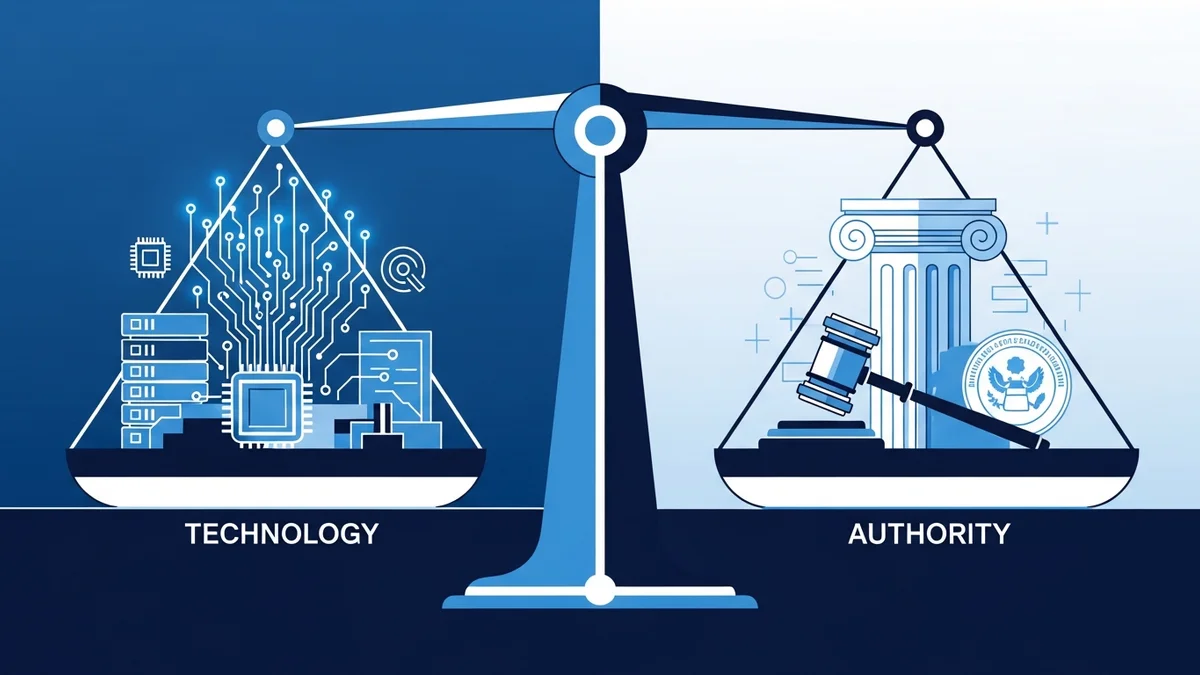
The D.C. appeals court wrote: “On one side is a relatively contained risk of financial harm to a single private company. On the other side is judicial management of how the Department of War secures vital AI technology during an active military conflict.”
Read that sentence twice. It does three things simultaneously.
It reduces Anthropic’s situation to “contained financial harm.” The company that lost hundreds of millions in contracts, faces projected billions in revenue damage, and became the first American entity ever subjected to a supply chain risk designation reserved for foreign adversaries. Contained.
It invokes “active military conflict.” The phrase does not specify which conflict. It does not need to. The words carry their own weight, and that weight tilts the scale before analysis begins.
It frames any judicial oversight as “management” of military operations. Not review. Not accountability. Management. As if a court asking whether the Pentagon followed its own rules is the same as a judge directing troop movements.
The Framing Is the Decision
Previous coverage of this saga focused on legal outcomes. Did the injunction hold? Was the designation lawful? Those questions still matter. But the D.C. court did something different. It chose a frame that makes the legal questions secondary.
Once you accept “contained financial harm vs. active military conflict,” the outcome is predetermined. No reasonable person weighs a company’s revenue against soldiers in the field and picks the company. The frame eliminates the need for analysis.
The problem is that this frame erases everything the San Francisco court found relevant. It erases that the supply chain designation was procedurally defective, with no Congressional notification and no evaluation of alternatives. It erases that the designation was prepared while negotiations were still active. It erases the First Amendment finding that using procurement sanctions to punish a company’s policy positions is unconstitutional.
None of those facts fit neatly into “company harm vs. military necessity.” So they disappear.
What “Contained” Actually Contains
Calling Anthropic’s harm “contained” requires ignoring the designation’s cascading effects. The supply chain risk mechanism forces every company doing business with the Pentagon to certify it does not rely on the designated entity. Claude is embedded across enterprise software stacks. The ripple effects extend far beyond one company’s balance sheet.
More importantly, the reputational damage of being placed in the same category as Huawei and Kaspersky is not “contained.” It is permanent. Financial losses can be recovered. Being labeled a national security threat by your own government carries a stigma that no court victory fully removes.
The “contained” framing also ignores the precedent. If the Pentagon can designate a domestic company a supply chain risk over a policy disagreement and a court calls the resulting harm “contained,” every technology vendor with governance commitments just received a signal. Your principles are a single-company problem. National security is everyone’s problem. Choose accordingly.
Two Courts, Two Realities
The split between San Francisco and D.C. creates genuine legal uncertainty. Judge Lin’s ruling in San Francisco treated the case as a First Amendment question. Is the government punishing a company for its speech? Her answer was clear: yes, and that is unconstitutional.
The D.C. court treated the case as a national security question. Can the military secure AI technology during wartime? Framed that way, any constraint on the Pentagon’s procurement authority becomes an obstacle to national defense.
Both framings are legally defensible. They are also irreconcilable. The case will eventually reach the Supreme Court, and the question it presents is not really about Anthropic at all. It is about which frame controls when governance principles collide with executive authority.
Todd Blanche, the acting Attorney General, stated the administration’s position plainly: “Military authority belongs to Commander-in-Chief, not a tech company.” This is the cleanest expression of one frame. The opposing frame, implied but never stated as directly: technology companies have a constitutional right to set limits on how their products are used, and the government cannot retaliate when those limits inconvenience it.
The “Department of War” Tell
One detail worth noting. The appeals court used the phrase “Department of War.” The Department of War was renamed the Department of Defense in 1947. Using the older name in 2026 is a rhetorical choice, not a legal one. “Department of War” invokes a more absolute authority than “Department of Defense.” War admits no qualifications. Defense permits debate about what constitutes a proportionate response.
Small language choices accumulate. “Contained financial harm.” “Active military conflict.” “Department of War.” Each word choice narrows the space for governance to operate.
What This Means for the Industry
The practical implications extend the analysis from our previous articles rather than replacing it.
The constitutional floor from the San Francisco ruling still holds, but it has a geographic limit. Within DOD procurement, the D.C. ruling allows the designation to proceed. For other federal agencies, the San Francisco injunction stands. Companies selling to the government now face jurisdiction-dependent governance risk. Same product, same policies, different legal treatment depending on which court has authority.
The framing war matters more than the legal war. Whoever controls the frame controls the outcome. “Company rights vs. government power” produces one result. “Financial harm vs. military necessity” produces another. Enterprise buyers evaluating AI vendors should watch which frame gains traction in the Supreme Court, because it will determine whether vendor governance commitments have constitutional protection or merely commercial value.
The six-month phase-out creates a countdown. Trump ordered federal agencies to phase out Anthropic within six months. The San Francisco injunction blocks enforcement for non-DOD agencies, but the clock is ticking for DOD. Companies that depend on Claude in defense applications need contingency plans. Companies watching from the sidelines need to ask whether their own governance commitments could trigger similar treatment.
The Question Gets Harder
Each chapter of this saga has sharpened the same question. In the original analysis, we asked who decides the acceptable risk threshold for AI in military contexts. In the court challenge, we saw the financial cost of answering “the developer decides.” In the First Amendment ruling, we found a constitutional basis for that answer.
Now the D.C. court offers a counter-frame. The developer’s harm is contained. The military’s need is active. Choose.
The honest answer is that both frames are incomplete. Anthropic’s harm is not contained. But the military’s need for reliable AI access during armed conflict is not trivial, either. A serious governance framework would address both concerns simultaneously. It would establish clear rules for AI deployment in military contexts, with oversight mechanisms that neither depend on a single company’s policy choices nor grant the executive branch unlimited authority to coerce vendors.
That framework does not exist. Until it does, the courts will keep choosing frames. And the frames will keep determining outcomes before the arguments begin.
This analysis synthesizes CNBC’s reporting on the D.C. appeals court ruling (April 2026), Judge Rita Lin’s preliminary injunction ruling in Anthropic v. Department of Defense (N.D. Cal., March 2026), and Axios’s coverage of the Pentagon-Anthropic dispute (February-March 2026).
Victorino Group helps enterprises build AI governance frameworks resilient to legal and political uncertainty. Let’s talk.
All articles on The Thinking Wire are written with the assistance of Anthropic's Opus LLM. Each piece goes through multi-agent research to verify facts and surface contradictions, followed by human review and approval before publication. If you find any inaccurate information or wish to contact our editorial team, please reach out at editorial@victorinollc.com . About The Thinking Wire →
If this resonates, let's talk
We help companies implement AI without losing control.
Schedule a Conversation