Your AI-Generated Code May Already Be Public Domain
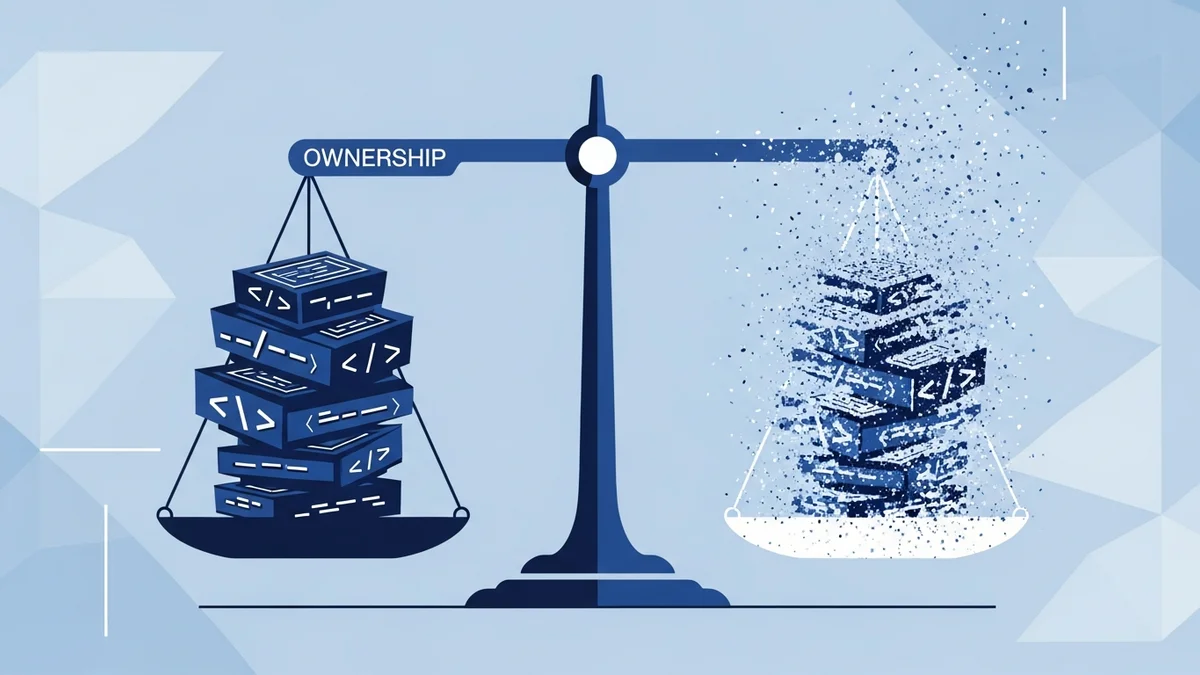
We’ve documented how AI coding agents break things operationally. Outages, quality decay, measurement distortion. But there is a governance deficit most engineering teams have not even considered: the code your agents write may not be yours to own.
On March 2, 2026, the U.S. Supreme Court declined to hear an appeal challenging the Copyright Office’s ruling that AI-generated output cannot be copyrighted. The ruling stands. Courts have upheld it at every level. And the implications for software built by AI agents are severe.
The Legal Reality
The U.S. Copyright Office has been consistent: copyright requires human authorship. When a human writes code with AI assistance (autocomplete, suggestions, copilot-style help), the human author retains copyright on the overall work. But when an AI agent generates code autonomously from a specification or prompt, the output falls outside copyright protection.
Courts have upheld this position. The Supreme Court’s refusal to intervene confirms it as settled law for now.
This is not a U.S.-only problem. The Berne Convention, which governs copyright across 181 countries, and the TRIPS Agreement, which binds World Trade Organization members, both require human authorship as the basis for copyright protection. Changing this would require renegotiating international treaties. That process takes decades, not quarters.
Joel Andrews, a twenty-year software engineer, put it plainly in his March 2026 analysis: “When you spend all that time and effort crafting the perfect specifications and then feed them into an AI model, the code that it spits out is, at best, part of the public domain.”
What “Public Domain” Means for Your Product
If your agents write your product, a competitor can copy that code freely. No infringement claim. No injunction. No damages. The code has no owner.
Consider the companies going all-in on AI-generated code. Spotify’s leadership has said their best developers “haven’t written a line of code since December.” Stripe and Notion are heavily invested. If a significant portion of their codebases is agent-generated, those portions may carry zero IP protection.
This is not hypothetical future risk. It is current legal exposure that most boards have not discussed.
The practical question is straightforward: what percentage of your codebase was written by AI agents with minimal human involvement? If you cannot answer that question, you cannot assess your IP exposure. And if the answer is “a growing share,” you have a problem that no engineering fix can solve.
The Governance Blind Spot
Most AI governance conversations focus on operational risk. Will the agent break production? Will it introduce security vulnerabilities? Will it accumulate technical debt? These are valid concerns. We’ve written about all of them.
But IP governance operates on a different timeline. Operational failures are loud and immediate. A thirteen-hour AWS outage gets an incident report. Copyright exposure is silent. It compounds invisibly until a competitor ships your feature using your own agent-generated code, and your legal team discovers they have no recourse.
The blind spot exists because IP governance and engineering governance report to different parts of the organization. General counsel thinks about patent portfolios and trade secrets. Engineering leadership thinks about velocity and reliability. Neither is asking: “Does our AI coding workflow produce copyrightable output?”
Someone should be.
The Economics Make It Worse
The copyright problem compounds with the economic instability of the AI tooling market. OpenAI remains, by Fortune’s November 2025 reporting, “wildly unprofitable.” The major AI providers are subsidizing usage to capture market share. When that subsidy ends, the economics of AI-generated code will shift.
Organizations that built their development workflow around cheap, fast agent-generated code will face a choice: pay dramatically more for the same output, or revert to human-written code for critical IP. Both options are expensive. Neither is pleasant.
The combination is toxic. You are building on tools whose pricing is artificially low, producing output that may have no IP protection, while the humans who could write copyrightable code are losing the practice of doing so. Joel Andrews calls this skill atrophy, and the data supports him. As we explored in The Four Failure Modes of Ungoverned AI Coding, agent dependency creates decay patterns that compound over time.
What Boards Should Be Asking
Three questions belong in the next board meeting for any company with significant AI code generation:
What percentage of our codebase is AI-generated? Not “AI-assisted” where a developer wrote the logic and used autocomplete. AI-generated, where an agent produced the code from a prompt or specification. If no one tracks this, that is the first problem.
Which components are core IP? Differentiated business logic deserves different treatment than boilerplate infrastructure code. Letting agents write your CRUD endpoints carries different risk than letting them write your recommendation engine or pricing algorithm.
What is our fallback if AI tooling costs triple? If your development velocity depends on tools priced below cost, your roadmap depends on someone else’s fundraising. That is a strategic risk, not a technical one.
A Framework for IP-Aware AI Coding
The solution is not to stop using AI coding agents. It is to govern their use with IP exposure in mind.
Classify code by IP sensitivity. Core business logic, proprietary algorithms, and competitive differentiators should have meaningful human authorship. Infrastructure, boilerplate, and commodity code can tolerate lower IP protection.
Track provenance. Know which code was written by humans, which was human-directed with AI assistance, and which was autonomously generated. This is not just good hygiene. It is the basis for any future IP claim.
Maintain human capability. The developers writing your most important code need to keep writing code. Skill atrophy in your core engineering team is an IP risk, not just an operational one. When the humans who understand your system can no longer modify it without an agent, you have lost something that no license agreement can restore.
Brief your legal team. If general counsel has not reviewed your AI coding practices through an IP lens, schedule that conversation. The intersection of copyright law and AI-generated code is evolving, and your organization’s exposure depends on decisions being made in engineering today.
The Uncomfortable Truth
The AI coding revolution is real. The productivity gains for certain tasks are genuine. But productivity without ownership is a strange kind of progress. You move faster while accumulating less.
When recursive trust problems meet copyright voids, the compounding effect is brutal. You are building on code you cannot verify, produced by tools you do not control, generating output you may not own. Each layer of abstraction adds convenience and removes protection.
The organizations that will navigate this well are the ones treating IP governance as seriously as operational governance. Not because the law might change in their favor. Because building a company on public domain code is a strategic choice that should be made deliberately, not discovered accidentally.
This analysis synthesizes Joel Andrews’s Some Uncomfortable Truths About AI Coding Agents (March 2026), the U.S. Copyright Office’s position on AI-generated works (2023-2026), and Fortune’s reporting on OpenAI’s financial position (November 2025).
Victorino Group helps organizations build AI governance that protects both operational stability and intellectual property. Let’s talk.
All articles on The Thinking Wire are written with the assistance of Anthropic's Opus LLM. Each piece goes through multi-agent research to verify facts and surface contradictions, followed by human review and approval before publication. If you find any inaccurate information or wish to contact our editorial team, please reach out at editorial@victorinollc.com . About The Thinking Wire →
If this resonates, let's talk
We help companies implement AI without losing control.
Schedule a Conversation