Sierra Hires Differently. Meta Cuts Differently. 95% of AI Pilots Still Fail.
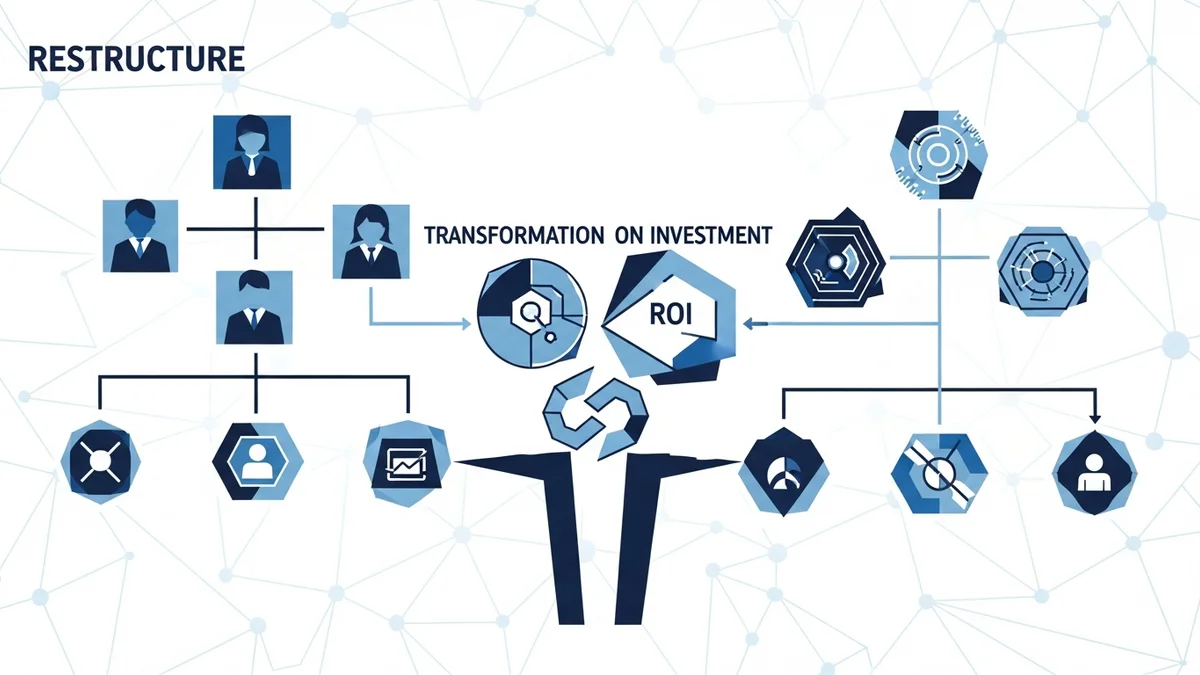
Three things happened in the same week, and most readers will treat them as separate stories.
Sierra published a careful essay describing how it now interviews engineers. Meta confirmed it will cut roughly 8,000 jobs starting May 20, 2026, framing the move as an AI focus. And Mihai Strusievici, founder of Axsion Digital Evolution, assembled the bluntest data block of the month in a CIO essay: 95% of AI pilots fail to produce P&L impact (MIT). Only 6% of firms attribute 5% or more of EBIT to AI (McKinsey). Roughly 60% of AI transformations deliver limited or no material value (BCG).
Read the headlines individually and they look like noise. Read them together and they describe a single decision most companies are getting wrong.
Sierra’s Quiet Reset
Sierra threw out the legacy interview. Two coding screens, an algorithms round, a system design loop, a culture-fit chat: all replaced. The new onsite is three sessions: Plan, Build, Review. The phone screen became system design. A debugging interview is in pilot.
The shift that matters is not the format. It is the assumption underneath.
Candidates have complete freedom during the build phase to use the AI tools and frameworks they choose. Sierra is not measuring whether engineers can stitch frameworks together from memory. It is measuring initiative, ownership, judgment, and whether someone can hold a system in their head while machines write the syntax.
Then comes the part most companies will skip. Sierra changed the debrief question. Interviewers no longer ask “should we hire this person?” They ask “where would this person thrive, and how do we support them?”
That is not a softer question. It is a harder one. It assumes the company already knows the shape of the work it needs done, the shape of the support it can offer, and the difference between someone who is generically strong and someone who is specifically right. Most companies cannot answer those three things. Sierra is forcing itself to.
There are no published outcome numbers yet. This is the most concrete public reset of the AI-era interview, not yet proven. Worth watching for that reason alone.
Meta’s Cut, Without the Story Music
The same week, CNBC reported that Meta will eliminate roughly 8,000 roles beginning May 20, citing efficiency and a sharpened focus on generative AI. Against a baseline of 78,865 employees, the math lands at about 10%.
In Meta’s AI-Native Structural Mandate, we examined the org-chart side of this restructure: renamed roles, flatter teams, identity encoded into hierarchy. The 8,000-person cut is the financial side. Same architecture, different page of the report.
The pattern is now visible across the industry. Companies announce workforce reductions, attach the AI explanation, and let the press do the rest. We pulled apart the incentive structure of that pattern in The AI Workforce Reckoning: the market often rewards the announcement, not the underlying capability. The Meta cut fits the playbook. Whether it produces durable economics is a different question, and one Meta itself has not yet answered.
The Math Nobody Is Putting on the Slide
Strusievici’s contribution is not original research. It is the triple-citation, lined up in one paragraph for the first time most readers have seen.
- MIT: 95% of AI pilots fail to generate measurable P&L impact at the pilot stage.
- McKinsey: only 6% of respondents attribute 5% or more of EBIT to AI.
- BCG: roughly 60% of AI transformation efforts deliver limited or no material value.
Three independent studies. Three different methodologies. The same shape of conclusion: most AI work does not show up where it would have to show up to justify the headlines.
Strusievici’s framing of why is the part to keep: AI amplifies structural friction rather than eliminates it. If your data ownership is unclear, AI makes the confusion faster. If your decision rights are tangled across functions, AI makes the tangle more expensive. If your governance was layered onto an org designed for an earlier era, AI exposes every seam.
This is the missing slide in most AI strategy decks. Companies are buying capability and then deploying it on top of architecture that was not built to absorb it.
Three Sides of the Same Restructure
Now line up the three stories.
Sierra changed how it picks people, on the assumption that the work itself has changed. Meta changed how many people it has, on the assumption that the work needs fewer of them. The MIT/McKinsey/BCG block tells us that neither move, by itself, produces ROI. The companies that show up in those failure rates are not the ones that did nothing. They are the ones that did one thing and called it a transformation.
Pick hiring redesign without governance redesign and you onboard sharper engineers into the same friction that ate the previous cohort.
Pick workforce reduction without hiring redesign and you keep the people who survived the cut, working in the same way they always worked, with fewer hands. Klarna’s reversal lives in this category. So does most of what Wall Street is currently celebrating.
Pick governance redesign without either of the others and you produce a beautiful operating model that no one is staffed or hired to execute.
The reason 40 Engineers, 1 PM: OpenAI’s Codex Team reads as a coherent story is that all three moves happened at once. They hired for a different shape of work. They sized the team for what AI now absorbs. And they encoded the governance into skills, sub-agents, and review pipelines that compound. That is not a 40:1 ratio. That is three decisions made together.
What This Means for the Next Quarter
Most companies will read this week’s news and pick one of the three moves. The hiring teams will champion Sierra. The CFOs will champion Meta. The strategy teams will champion the ROI math, usually as a reason to slow down.
The companies that come out of 2026 ahead will not be the ones that picked the boldest single move. They will be the ones that recognized hiring, structure, and governance as a single decision and made it once, deliberately, with the cost of each side priced in.
Sierra has not proved its bet. Meta has not proved its bet. The ROI numbers say most companies will not prove theirs either. The way out of the failure curve is not a better single move. It is the discipline to stop making single moves.
This analysis synthesizes Sierra’s The AI-Native Interview (April 2026), CNBC’s reporting on Meta’s 10% Workforce Cut (April 2026), and Mihai Strusievici’s CIO essay AI Doesn’t Create ROI. Organizations Do (April 2026).
Victorino Group helps enterprises redesign hiring, structure, and governance as a single AI-native decision. Let’s talk.
All articles on The Thinking Wire are written with the assistance of Anthropic's Opus LLM. Each piece goes through multi-agent research to verify facts and surface contradictions, followed by human review and approval before publication. If you find any inaccurate information or wish to contact our editorial team, please reach out at editorial@victorinollc.com . About The Thinking Wire →
If this resonates, let's talk
We help companies implement AI without losing control.
Schedule a Conversation