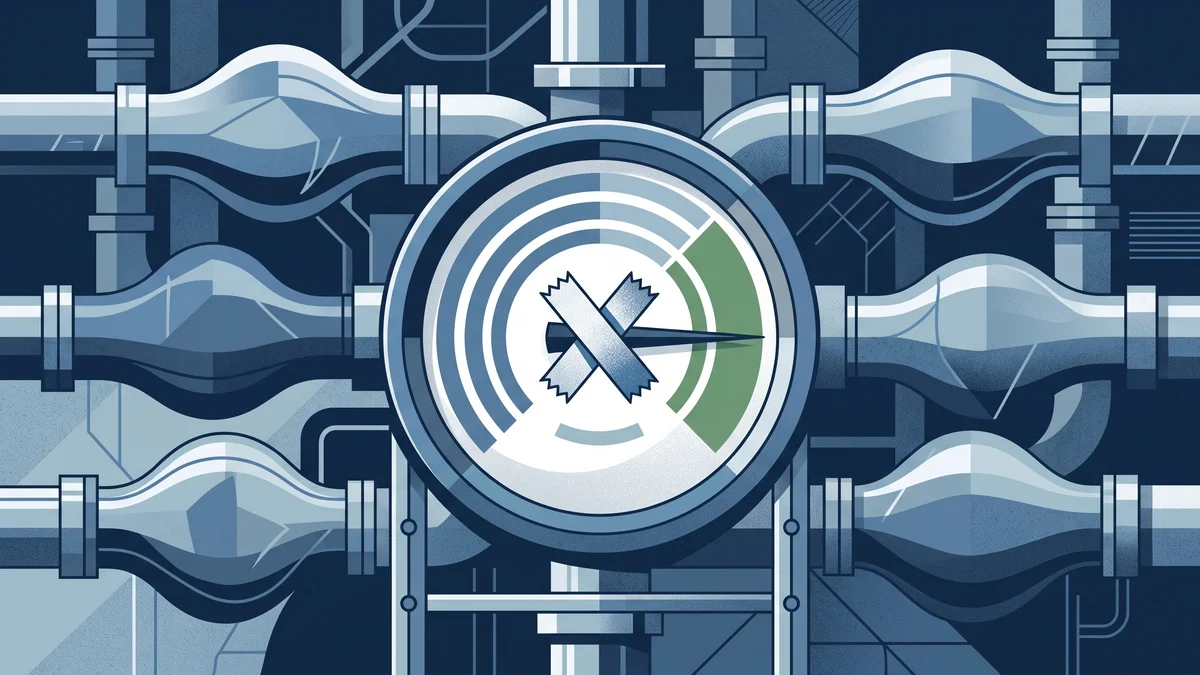
Ashley Rolfmore describes a company paying for an AI tool that covers for a process the company never finished building. Her line for it: “You’re paying someone else’s AI to compensate for the bits of yours that aren’t working yet.” The case is anonymised and there is no measured data behind it. It still names something I rarely see an operating review ask.
A capacity crisis used to be informative. The support queue overflowed, sales stopped getting answers, the one engineer who understood the billing code became a bottleneck for everyone else. That pain forced a question: what does this company need to build, hire, or stop doing? The crisis was the signal. Answering it was how the company grew up.
AI removes the pain without answering the question. A workaround that once cost a hire now costs a subscription and an afternoon of prompting. The queue gets drained, the answers get drafted, the bottleneck engineer gets a summariser. The process underneath stays exactly as it was. The signal that would have forced the change has been muted.
What cheap workarounds hide
Rolfmore frames the shift as a company moving “from producer of capability to consumer of capability.” Read literally, that sounds like ordinary outsourcing. The problem is which capabilities get consumed. The ones a company rents to cover a broken internal process are the ones it needed to own, because those were the ones the crisis was pointing at.
Her title frames this as AI stopping startups from “completing puberty”: the growth phase where a company builds the operating habits it will live with. The argument travels well beyond startups. It applies to any team that has replaced a hard conversation with a tool.
David Pereira makes the same point from the management side. His ten-item map compares 2022 and 2026 across requirements, backlogs, reports, consensus, sign-off, meetings, saying no, bridging communication, opinion-based prioritisation, and features over value. Every pathology on the list survived. What changed is the production cost. “AI can write fifty well-crafted backlog items before you finish your coffee.” The backlog that once exposed a team’s lack of focus by being too long to maintain is now effortlessly maintained. It looks like discipline. It is the old pathology with better formatting.
Pereira adds two categories that were absent from his 2022 list: “Shiny sh*t” and “Tool obsession.” Both describe the failure Rolfmore sees, observed from the product room instead of the ops room.
The reporting loop nobody reads
The blind spot Pereira names is what happens to reporting once both ends of it are automated. Pereira’s phrasing: “Two machines exchange information while nobody learns anything.” Picture the chain. One agent drafts the status report from the ticket system. Another summarises it for the steering committee. The committee’s assistant drafts the response. Every artifact is well-written, on time, and unread by anyone who could act on it.
Before automation, a report nobody read eventually died, because writing it was a cost someone would refuse to keep paying. That refusal was information. Now the cost of writing it is close to zero, so the loop never dies and the absence of readers never surfaces.
The same logic applies to Rolfmore’s question about who went quiet. A complaint from support or sales was a channel. If the complaints stopped after an AI tool arrived, one of two things happened: the problem got solved, or the complainer found a private workaround and stopped escalating. Only the first is good news, and from the outside they look identical. We argued in Growth Is Now a Trust Problem that growth now depends on trust more than on channel performance. The complaint channel from the people closest to the customer is a trust channel, and this essay’s claim is that it deserves the same protection.
Six questions before any dashboard
Rolfmore’s response is an audit, and the audit is what turns cost visibility into a decision. We showed in the cost meter as a quality control that seeing spend changes behaviour. This is the next step: what to do with what you see.
Her six questions, condensed:
- What does the AI spend profile look like?
- What work is it taking off people?
- Who reviews the newly automated workflows, and for what?
- What is the AI making invisible?
- Who used to complain and went quiet, and what silent workaround appeared?
- Is feedback from support and sales still flowing back to the roadmap?
The first two are the questions a finance review would normally ask. Questions three through six are the ones that find the muted signal. Question four in particular has no line on any dashboard, because a dashboard can only show what someone decided to measure, and the thing being made invisible was never measured.
Pereira’s test sits one level up, at strategy. When an AI-generated plan lands on the table, he asks: “Which options did you consider? What gives you confidence? Why now?” A plan drafted by a model answers none of them unless a person stands behind it. We covered a rubric for judging agent output earlier this year. Pereira’s three questions are the version for the document that decides what the agents work on in the first place.
Four verdicts, one per use
The audit produces a list of AI uses that are compensating for something. Rolfmore’s rule is that each one gets one of four verdicts. As I read the four options:
Eliminate. The process the AI is covering for should not exist. The workaround was hiding a decision to stop doing the work altogether.
Productise. The compensation revealed a capability the company should own. Build it, hire for it, or buy it properly.
Operationalise as a bounded service. The AI use is legitimate and needs an owner, a review step, and a boundary. This is where question three from the audit lands.
Accept as a conscious trade-off. The company keeps renting the capability and writes down why. The word doing the work is conscious.
The value of the rule is that it blocks a fifth, unwritten verdict: keep paying and stop thinking about it. That is what the muted signal produces by default.
We wrote in the AI-native org and its ROI problem about programmes that fail to show a return. This essay is about a subtler outcome: the programme that shows a return on paper because it made a broken process cheap to run, and in doing so removed the pressure that would have fixed it.
Do this now
Pick the three largest lines in your AI spend. For each one, answer Rolfmore’s fourth question in one sentence: what is this making invisible? If you cannot answer, that line is compensating for something you have not yet named.
Then find one person in support or sales who used to escalate problems and has gone quiet since the tools arrived. Ask what changed. The answer is either a solved problem or a private workaround, and you need to know which.
Finally, take the most recent strategy document an AI helped draft and put Pereira’s three questions to its author. Which options were considered. What gives you confidence. Why now. Someone who can answer owns the strategy. Someone who cannot has forwarded a model’s output with a signature attached.
Run the audit on a calendar, every quarter, with the four verdicts written down. It replaces the signal the crisis used to send, and unlike the crisis, it arrives before the damage.
This analysis synthesizes AI Is Stopping Startups From Completing Puberty (Ashley Rolfmore, September 2026) and Bullshit Management Didn’t Die. It Got Automated (David Pereira, Untrapping Product Teams, September 2026).
Victorino Group helps operating teams audit what their AI spend is compensating for and decide, per use, whether to eliminate, productise, bound, or accept it. Let’s talk.
All articles on The Thinking Wire are written with the assistance of Anthropic's Opus LLM. Each piece goes through multi-agent research to verify facts and surface contradictions, followed by human review and approval before publication. If you find any inaccurate information or wish to contact our editorial team, please reach out at editorial@victorinollc.com . About The Thinking Wire →
If this resonates, let's talk
We help companies implement AI without losing control.
Schedule a Conversation