When the Product Is the Workflow: Figma, Freelancers, and the SaaS Disruption Curve
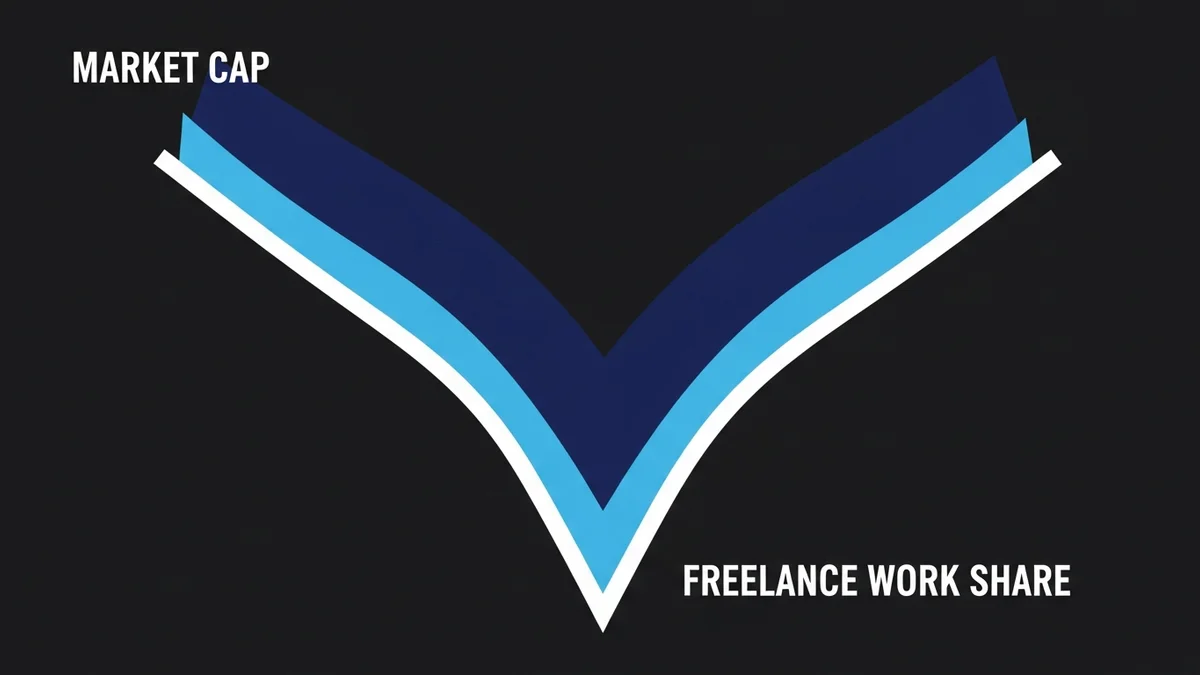
Two reports landed in the same week of May 2026, from opposite ends of the design supply chain. HackerNoon covered Figma’s stock performance since its August 2025 IPO, citing publicly discussed estimates that the company has lost roughly 85% of its market value. We And The Color published platform data showing freelance graphic design work shrank 17% in the first eight months after ChatGPT’s launch, with entry-level project share falling from 15% to below 9% of total volume.
The headlines look like two different stories. They are one story told from two sides.
The vendor selling the workflow tool is bleeding capital. The labor that performs the same workflow is bleeding work. Both are getting compressed by the same force, which is generative AI converting workflow steps into single prompts. When the product is the workflow, the workflow becoming free is a category event, not a feature update.
The Same Force, Two Casualties
A design freelancer who built a logo, a banner set, and three social variants used to charge a few hundred dollars and take a week. That work flowed through Figma, Illustrator, or Photoshop. The freelancer paid for the tool. The client paid for the freelancer. The vendor sat at the top of a long, expensive supply chain.
A founder running the same workflow today opens Midjourney or a generative tool inside a chat interface, generates the logo, iterates by typing, exports the file, and pays around twenty dollars a month for unlimited generations. The freelancer was disintermediated. The professional design tool was bypassed entirely.
We And The Color’s data shows where the compression bites first. Entry-level freelance projects fell from 15% of platform volume to below 9% within eight months. Mid-tier work shrank 17% in the same window. Only the top of the pyramid (strategic brand systems, complex multi-surface work, defensible craft) is holding its rates. The middle is hollowing out.
Figma’s reported market reaction tells the same story from the supply side. According to HackerNoon’s coverage, the company has lost approximately 85% of its public-market value since IPO. We were unable to independently verify the figure through primary market sources before publishing, so treat the number as directional rather than confirmed. The direction is what matters. A category-defining design tool, freshly public, is being repriced by a market that suspects its core workflow is being absorbed into general-purpose models.
The market is asking a sharp question. If a founder can ship a brand without opening Figma, how big is the addressable market for Figma? If a marketing team can produce a campaign without hiring a freelancer, how big is the addressable workforce for design as a service? The same answer cuts both ways.
Product as Workflow Is a Risk Class
Most SaaS valuations rest on a hidden assumption. The tool encodes a workflow that humans cannot easily replicate without it. Figma encoded collaborative design. Salesforce encoded the sales pipeline. Workday encoded HR processes. The encoding was the moat.
Generative AI breaks the encoding. When a model can take a natural-language brief and produce the same artifact the workflow used to produce, the tool stops being indispensable. It becomes one option among many, including the option of not using a dedicated tool at all.
This is not theoretical. It is happening to design today, to copywriting in parallel, and is reaching analytics and BI next. The pattern is consistent. Categories where the product equals the workflow get compressed first. Categories where the product equals the system of record (Stripe, NetSuite, Snowflake’s storage layer) are more durable because the data has gravity that the workflow does not.
A working classification for any SaaS portfolio:
High disruption risk. The vendor’s value lives in the act of doing work. Design tools, copy editors, image editors, BI dashboards, low-end content marketing platforms. AI can generate the output without the tool.
Medium disruption risk. The vendor encodes both workflow and data, but the data is not deeply proprietary. Project management, CRM lite, helpdesk. AI can replace the workflow steps but the data lock-in slows the bleed.
Lower disruption risk. The vendor owns the system of record, regulatory boundary, or hard integration surface. Payments, financial systems, identity, infrastructure. AI changes how users interact with the system, not the system itself.
Figma sits in the first category. So do thousands of point-solution SaaS products that built their value on encoding a single workflow well. The repricing happening to Figma’s stock is the leading indicator. The freelance market data is the trailing indicator. Same event, different sensors.
What the Layered Effect Looks Like
When the product is the workflow, three things happen in sequence.
First, the commodity layer collapses. Entry-level work disappears because a twenty-dollar subscription can produce work that used to require a junior practitioner with a thousand-dollar software license. The We And The Color numbers (entry-level project share falling by roughly 40% as a proportion of platform volume) is exactly this layer collapsing.
Second, the mid-tier compresses. Freelancers who survived the entry-level wipeout move up the value chain, competing for shrinking mid-tier work against more senior practitioners. Margins compress, project counts drop, the survivors run faster to stand still. The 17% volume drop is this compression.
Third, the top tier holds, but the floor underneath it disappears. Strategic, brand-defining, high-judgment work continues to command premium rates. The catch is that the apprenticeship pipeline that produced senior practitioners runs through the entry-level work that just got eliminated. The top tier holds today and erodes over the next five years as no new seniors enter the field.
This is the same pattern any SaaS leader should expect in their category once AI compresses their workflow. The product reprices because customers can avoid it. The labor that uses the product reprices because clients can avoid them. The training pipeline that feeds the top of the market reprices because the early-career work that funded it no longer exists.
What Procurement and Product Leaders Should Do Now
The Figma and freelancer signals are useful precisely because they are not subtle. They give product leaders, CFOs, and procurement teams permission to ask harder questions about their stack before the repricing hits.
Three questions to put on the table this quarter.
Which of our SaaS contracts encode a workflow that AI can now produce directly? Walk through the renewal list. Mark each vendor by what they actually deliver. If the answer is “they help our team do X,” and a general-purpose AI tool can now do X with a prompt, that contract is in the high-risk category. Negotiate accordingly.
Which internal roles are organized around producing workflow outputs that AI now produces? This is the freelance question turned inward. Roles that exist to operate a tool to produce a deliverable are exposed to the same compression as the freelancers in the data. The work is not going away, but its shape is changing. Plan the transition before it becomes a layoff.
Which of our own products sell a workflow that AI is absorbing? If you sell SaaS, this is the survival question. Figma reportedly losing 85% of its market value in nine months is a warning every founder should take personally. The companies that survive are the ones that move from selling workflow to selling judgment, governance, or system-of-record value. The ones that double down on encoding workflow more cleverly are racing toward the same cliff.
The two reports from this week are not separate stories. They are the same disruption curve seen from the vendor side and the labor side. Anyone whose business sits on top of a workflow that the new tools can absorb should treat this as a planning signal, not a sector anomaly.
Product is workflow is now a risk classification. Apply it to your stack before the market applies it to you.
This analysis synthesizes Figma’s Collapse Should Terrify SaaS Leaders (HackerNoon, May 2026) and Freelance Designers Can’t Compete With a $20/Month AI Subscription (We And The Color, May 2026).
Victorino Group helps enterprises classify SaaS disruption risk and reposition workflow-bound products before the market does it for them. Let’s talk.
All articles on The Thinking Wire are written with the assistance of Anthropic's Opus LLM. Each piece goes through multi-agent research to verify facts and surface contradictions, followed by human review and approval before publication. If you find any inaccurate information or wish to contact our editorial team, please reach out at editorial@victorinollc.com . About The Thinking Wire →
If this resonates, let's talk
We help companies implement AI without losing control.
Schedule a Conversation