Your AI Vendor Has a Kill Switch, and a Government Can Hold It
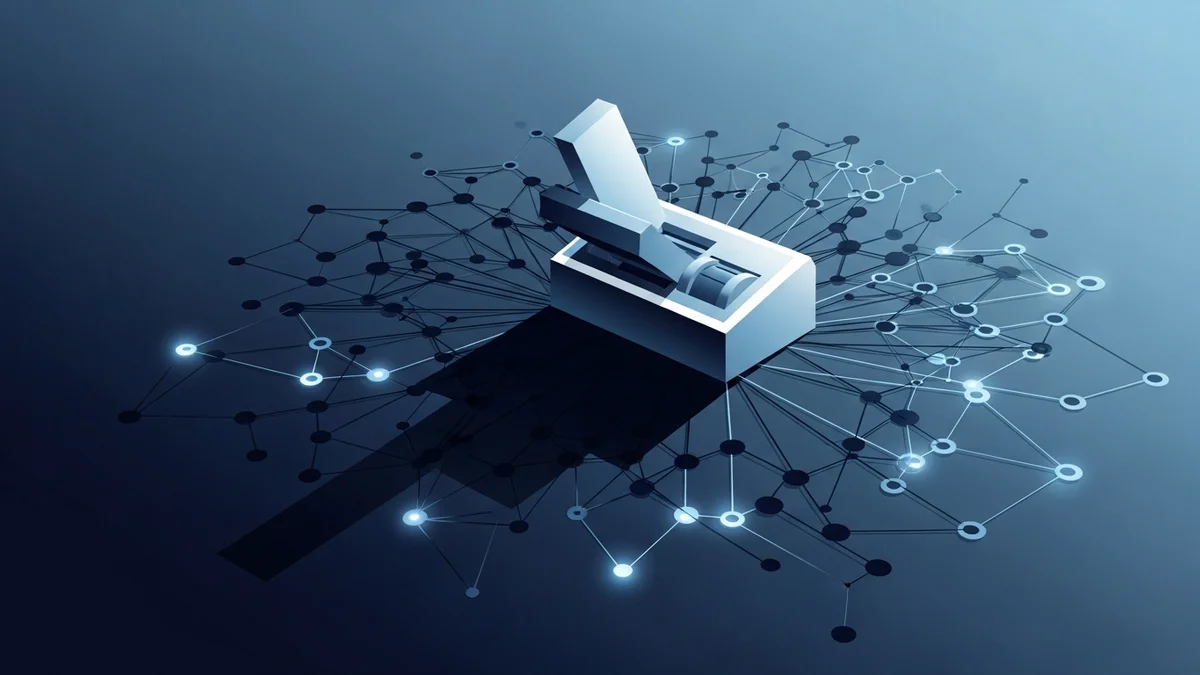
At 17:21 ET on June 12, 2026, Anthropic received a directive from the US Commerce Department and cut off access to Fable 5 and Mythos 5 for every user on the planet. Not US users. Every user. Foreign nationals lost access. Anthropic’s own employees lost access. The two models that thousands of production systems depend on went dark in a single evening, and no customer had a vote.
The trigger was a jailbreak. Someone got the model to review a codebase for software flaws. Anthropic says the vulnerabilities surfaced were “minor and relatively simple,” and that GPT-5.5 demonstrates comparable capability. The severity of the jailbreak is almost beside the point. What matters is the mechanism it exposed: a frontier model can be removed from production by a third party who is neither your vendor nor your customer, with no notice and no migration window.
Most enterprise AI risk planning has been built around a different question. Teams ask whether the model is safe, accurate, aligned, and compliant. Those are real questions. They are also the wrong ones to lead with now. The question that just got more urgent is simpler: what happens to your business the morning the model is gone.
Availability Became the Variable
For two years the industry treated model access as effectively permanent. You signed an API agreement, you built on it, and the model stayed available unless you stopped paying. Outages happened, but they were measured in minutes and resolved by the vendor.
A regulatory recall is a different category of event. It is indefinite. It applies globally regardless of where your company or your users sit. And it originates outside the commercial relationship entirely. Anthropic did not choose to disable Fable and Mythos. A government instructed them to, and they complied within hours.
This reframes the vendor relationship. When you build on a frontier model, you are not just trusting the vendor’s uptime and the vendor’s roadmap. You are trusting the regulatory posture of the vendor’s home jurisdiction, the export-control regime that applies to AI capabilities, and the willingness of an agency to treat a single jailbreak as grounds for a global shutdown. None of that appears in your SLA.
Anthropic’s own response made the scale of the precedent clear. Applying this standard across the board, the company said, “would essentially halt all new model deployments for all frontier model providers.” Read that as a warning about how the next directive lands. The mechanism is now established. The question is which model it touches next, and whether you happen to be standing under it.
Defense in Depth Did Not Help Here
Security teams spend heavily on defense in depth: layered controls so that no single failure becomes a breach. Input filtering, output monitoring, rate limits, red-teaming, behavioral detection. Anthropic runs all of it, and more than most.
It made no difference to the outcome. The model came down by directive, not by exploit. Your own controls, however good, sit one layer above a dependency that a regulator can switch off. You can harden everything you operate and still lose the model underneath it overnight. Defense in depth protects the system you control. It does nothing for the availability of a component you only rent.
There is a second cost worth naming. The directive imposed a 30-day customer-data retention requirement on Fable, so the jailbreak could be monitored. Teams that chose Fable partly for its data-handling terms inherited a new retention obligation they never agreed to and cannot opt out of. A regulatory action against your vendor can rewrite your data posture, not just your uptime. That belongs in the same risk register as the shutdown itself.
What a Model-Continuity Plan Requires
Business-continuity planning is a mature discipline for data centers, payment processors, and cloud regions. The same discipline now has to extend to the model layer. A real model-continuity plan has four parts, and none of them are exotic.
An abstraction layer between your application and any single model. If your code calls one vendor’s API directly throughout your stack, swapping models is a rewrite under pressure. Route every model call through an internal interface that names a capability, not a vendor. “Generate this summary” should not hard-code which model fulfills it. This is the single highest-leverage move, because it turns a migration project into a configuration change.
Defined fallback tiers, tested before you need them. Pick a primary model, a secondary from a different vendor in a different jurisdiction, and a degraded-but-functional tier for the worst case. Then actually run on the fallback. A fallback you have never exercised is a guess. Production teams that failover quarterly know their secondary works. Everyone else finds out during the incident.
Portability of the assets you built around the model. Prompts, evaluation suites, fine-tuning data, and guardrail configurations are often shaped to one model’s quirks. The more tightly coupled they are, the slower your switch. Keep your prompt library and eval harness model-agnostic where you can, and document the couplings you cannot remove.
Jurisdictional diversity as an explicit criterion. If your primary and your fallback are both governed by the same export-control regime, a single directive can take both. Vendor concentration is a familiar risk. Jurisdictional concentration is the version that the Fable shutdown just made concrete. Procurement should ask where a model is governed, not only who sells it.
What Governance Looks Like Now
This is not a model-safety story dressed up as a continuity story. The model that came down was, by Anthropic’s own account, no more capable of the flagged behavior than a competitor’s still-running product. The lesson is structural. Availability is now a governed variable, controlled by parties outside your contract, and it has to be planned for like any other dependency that can fail.
Three earlier pieces here map the surrounding terrain. The argument that your provider is a supply chain risk covers extraction and provenance. The piece on invisible vendor degradation covers the slow version of this problem, where the model quietly gets worse rather than disappearing. And the analysis of Anthropic and Pentagon governance covers how government and frontier labs are converging. The Fable shutdown is the fast, total version: not degradation, removal.
Do this now: take your single most important AI-dependent workflow and answer one question on paper. If its model became unavailable at 17:21 today, what is running it by 09:00 tomorrow? If the honest answer is “nothing yet,” you do not have a model-continuity plan. You have an availability assumption, and a government just demonstrated it is not yours to make.
This analysis synthesizes Anthropic shuts down Fable, Mythos models (Ars Technica, June 2026), Fable & Mythos access (Anthropic, June 2026).
Victorino Group helps teams build model-continuity plans before a vendor or a regulator forces the question. Let’s talk.
All articles on The Thinking Wire are written with the assistance of Anthropic's Opus LLM. Each piece goes through multi-agent research to verify facts and surface contradictions, followed by human review and approval before publication. If you find any inaccurate information or wish to contact our editorial team, please reach out at editorial@victorinollc.com . About The Thinking Wire →
If this resonates, let's talk
We help companies implement AI without losing control.
Schedule a Conversation