HBR Finally Named It: 'Every 30 Minutes Someone Creates Something I Have to Look At'
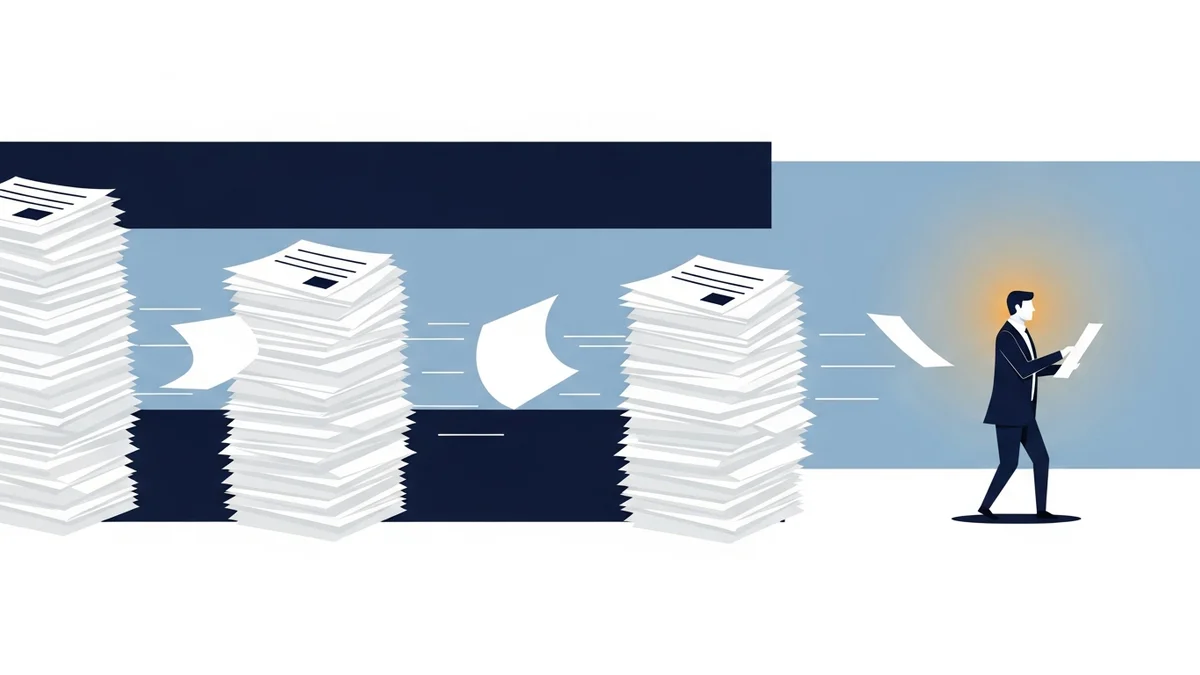
A manager interviewed by Harvard Business Review put words on something engineering leaders have been muttering for a year: “Every 30 minutes, someone creates something I have to look at.” Liz Fosslien and Mollie West Duffy published that sentence on May 25, 2026, inside a piece titled Managers Are Struggling to Keep Up with the AI Productivity Boom. The management trade press has finally caught up to the operational reality.
The reflex inside HBR’s framing is to coach the manager. Clearer direction. Focus attention on what matters. Faster feedback loops without micromanaging. All true. All insufficient. What the article describes is not a coaching problem. It is a governance problem with a coaching wrapper, and the difference matters because coaching scales with the manager and governance scales with the system.
What Actually Broke
The output of an AI-accelerated team is not a faster version of the previous output. It is a different artifact, produced at a different cadence, demanding a different kind of attention from the person at the top of the queue.
Before agents and copilots, a manager of eight engineers absorbed maybe ten review-worthy artifacts per day. Pull requests, design proposals, status updates, one or two escalations. The mental model behind classical management practice assumes that volume. One-on-ones, weekly syncs, quarterly reviews, ad hoc judgment calls. The whole apparatus runs on the assumption that most of what the team produces between touchpoints does not need the manager.
That assumption is gone. When each individual contributor ships three to five times what they used to, the queue at the manager’s desk does not grow three to five times. It grows worse than linearly, because each artifact arrives at a moment when the previous one has not been fully processed, and the cost of context-switching compounds. The manager who used to be the bottleneck for direction becomes the bottleneck for verification, integration, and prioritization. All three at once.
That is the operational fact behind the HBR quote. The manager is not slow. The manager is correctly recognizing that the job description quietly changed and nobody renegotiated it.
Three Things Break First
When a team accelerates and the management layer does not redesign, three specific things break before anything else. Naming them is the first step in fixing them.
Queue depth. The number of artifacts waiting on the manager’s attention at any given moment. Pre-AI, this number bounced between zero and four. Post-acceleration, it bounces between fifteen and forty. There is no theoretical maximum because the team has no mechanism to know they have already overshot the manager’s processing rate. They are not being rude. They are doing what they were told to do, faster than the system can absorb the consequences.
Feedback latency. The time between an artifact being produced and the producer getting useful signal back. Pre-AI, this hovered around a day. Post-acceleration, with the queue deep and the manager triaging, it stretches to three days, five days, sometimes a full week. The producer keeps producing in the absence of signal, building on assumptions that have not been validated. By the time feedback arrives, the producer has shipped four more things on top of the unreviewed one. Reversing course is now expensive.
Attention allocation. Which artifacts the manager chooses to read closely, which to skim, which to skip. Pre-AI, this was implicit and survivable because the queue was small enough that even random selection worked most of the time. Post-acceleration, attention is the scarcest resource in the system and it is being spent without an explicit policy. The manager defaults to recency, or to whoever pinged loudest, or to whatever is on top of the screen. None of those correlate with what actually matters to the business.
Read the HBR framing back against those three and the recommendations land differently. Clearer direction is queue depth governance: fewer artifacts compete for review because the team knows in advance what counts. Faster feedback loops without micromanaging is feedback latency engineering: the loop closes through structure, not through the manager being available more hours. Focus attention on what matters is attention allocation, made explicit instead of vibes-based.
Why This Is Governance, Not Coaching
The coaching frame says: this manager needs to get better at the new pace. Better at prioritization, faster at written feedback, more disciplined about deep work blocks.
The governance frame says something different. The system has changed. The constraints have shifted. The role description has not been rewritten to match. No amount of individual heroics will close that distance, because the next manager hired into the same structure will hit the same wall in the same week.
We saw the same shape in The Mexican Standoff Inside AI Teams: the team locks up not because individuals are failing but because nobody has the authority to declare who decides what. We saw it from a different angle in The Two-Clock CEO: scale-stage CEOs running two incompatible operating cadences on a single calendar. And we saw it inside the PM function in AI Agents for Product Managers: the PM role expands faster than the org chart admits, and individual ingenuity papers over structural debt until the structure breaks.
The HBR manager is the same pattern at a different layer. The fix is not to make the manager work harder against an unrenegotiated job description. The fix is to renegotiate it, in writing, with explicit governance for the three things that break first.
What Governance Looks Like in Practice
Queue depth governance. Publish a maximum. State out loud how many open artifacts a manager will hold at once, and what happens when the queue exceeds it. Options that actually work: a designated peer-review tier for anything below a defined criticality threshold, a hard cutoff where new artifacts route to a reviewer pool instead of the manager, a weekly queue audit where stale items are killed rather than carried. The principle: the queue is a resource with a ceiling, not an inbox with infinite capacity.
Feedback latency engineering. Set a target time-to-feedback for each artifact class, and instrument it. Twenty-four hours for code review at a certain criticality, forty-eight for design proposals, same-week for written strategy memos. When the metric slips, the response is structural: more reviewers, smaller artifacts, async feedback templates that lower the cost of a useful response. Not “the manager should respond faster.” That is coaching. Structural change is governance.
Attention allocation, made explicit. Decide in advance which categories of artifact the manager reads closely versus skims versus delegates. Write it down. Share it with the team so they know what kind of attention to expect when they produce a given artifact. The act of writing it forces the prioritization that the manager was previously doing implicitly under pressure. The act of sharing it removes the social cost of not reading everything.
None of this is exotic. It is the same kind of governance discipline we already apply to incident response, to access control, to financial approvals. The novelty is applying it to managerial attention as a resource that can be designed, budgeted, and protected.
Do This Now
If you manage managers, this week: pick one manager and one team. Sit with them for an hour. Count the queue. Measure the average feedback latency over the last two weeks. Ask the manager to list, in writing, which artifact categories they currently read closely versus skim versus skip. Bring that artifact to the next leadership meeting.
You will not need to argue for governance after that. The numbers will argue for themselves. The reason HBR could finally publish the quote is that the math has become impossible to hide. The reason it is your job, not the manager’s, to fix it is that the manager cannot govern the system they are operating inside.
The team got faster. The role description did not. The work of the next two quarters is to close that distance deliberately, with explicit levers on queue depth, feedback latency, and attention allocation. Otherwise the productive team becomes the unmanageable team, and you lose the manager along with the throughput gain.
This analysis synthesizes Managers Are Struggling to Keep Up with the AI Productivity Boom by Liz Fosslien and Mollie West Duffy (Harvard Business Review, May 2026).
Victorino Group helps leadership teams replace AI-era management ad-hoc heroics with explicit governance for queue depth, feedback latency, and attention allocation. Let’s talk.
All articles on The Thinking Wire are written with the assistance of Anthropic's Opus LLM. Each piece goes through multi-agent research to verify facts and surface contradictions, followed by human review and approval before publication. If you find any inaccurate information or wish to contact our editorial team, please reach out at editorial@victorinollc.com . About The Thinking Wire →
If this resonates, let's talk
We help companies implement AI without losing control.
Schedule a Conversation