Cost Per Lead Just Broke a 5-Year Trend. The Job Now Is Measuring a System You No Longer Steer.
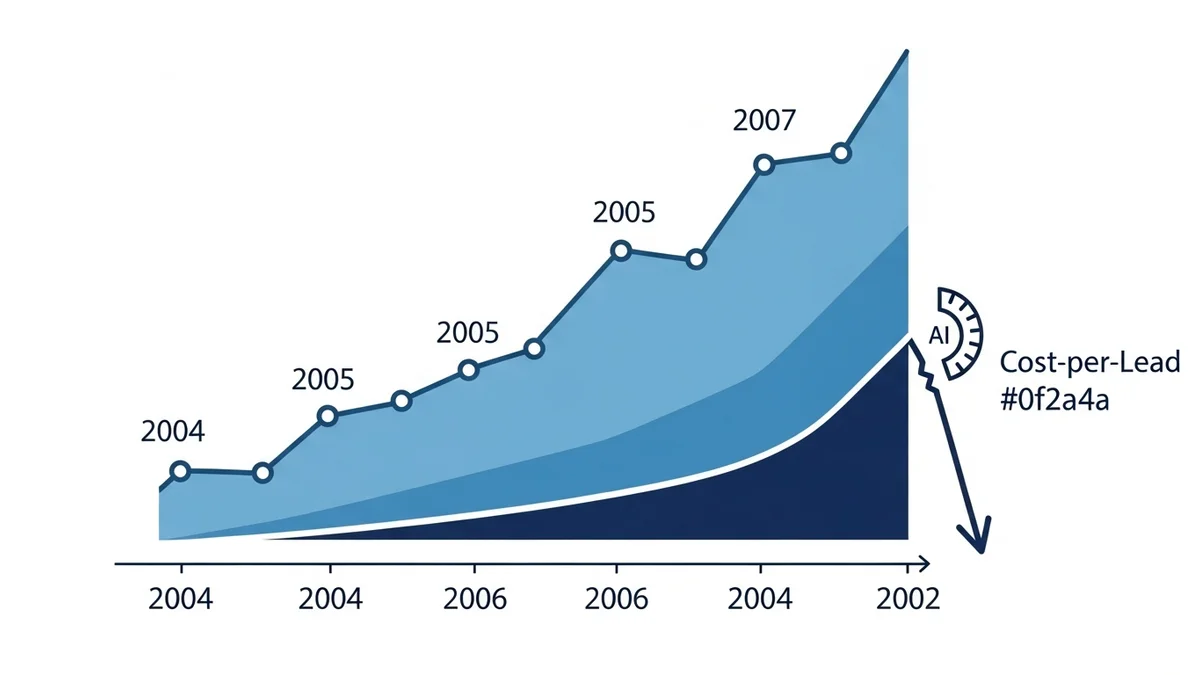
For five years the line went up. Cost per lead in Google Ads, measured every spring by WordStream across thousands of US search campaigns, climbed in 2022, climbed in 2023, climbed in 2024, climbed in 2025. The standing assumption was that paid search was getting more expensive forever, and the marketing team’s job was to slow the bleed.
Then the 2026 edition arrived. Cost per lead fell to $66.69. First decline in five years. The same sample now reports a median conversion rate of 8.18%, improving across 87% of industries. Cost per click held steady at $5.42, click-through rate at 6.64%.
The dataset is real. 13,474 US search campaigns, April 2025 through March 2026, with a 52-campaign minimum per subcategory. Median figures, not means, so a handful of giant accounts cannot drag the curve. This is the most-cited benchmark in performance marketing, run for ten years by the same team, and it just broke its own trend.
WordStream’s own explanation, written by Senior Content Marketing Specialist Susie Marino, names the cause in the first paragraphs: Performance Max and AI Max. Google’s AI-driven bid and creative systems are now doing the work that used to be a paid search manager’s calendar of weekly optimizations.
That is the headline. The real story sits one layer deeper.
The system improved. The operator did not.
For the last decade, the standard advertiser job was a feedback loop: pull a report, find the underperforming keyword or audience, change the bid or the creative, observe the next week’s numbers, repeat. The skill was operating the controls.
Performance Max and AI Max replace most of those controls with a black box that decides where to place the bid, which audience to chase, which creative variant to serve. The advertiser supplies inputs (budget, conversion goals, asset groups, audience signals) and the system supplies outcomes. The intermediate steps are not exposed for human override.
This is the part that should reset how marketing leaders think about their job. The five-year CPL trend did not break because operators got better. It broke because the operator changed. A statistical learning system now runs the auction strategy, and on the published numbers it runs it better than the median human did.
We covered an adjacent pattern in the pinhole view of AI value: organizations that measure AI’s contribution through one narrow lens (usually headcount) miss the system-level shift. Marketing has the opposite problem now. The system-level shift is undeniable on the benchmark line. The narrow operational lens (which keyword, which bid, which match type) is becoming irrelevant.
What “supplement, don’t replace” actually concedes
WordStream’s own published guidance is striking once you read it as a governance posture rather than a tactical tip. The phrase repeated through the report is “supplement, don’t replace.” Run Performance Max and AI Max alongside manual campaigns. Keep the manual campaigns alive as a control surface.
Read it again. The recommended posture from the most authoritative benchmark in the category is: let the AI run the spend, but do not dismantle the manual machinery, because you need something to compare against.
That is a governance posture, not an optimization tip. It says, in effect: you can no longer trust the inside of the system, so you must preserve an external reference point to know whether the system is still working. The manual campaign becomes the benchmark, the control group, the way to detect drift.
This is the same logic that mature ML operations teams apply to production models. You hold out data. You keep an older version running in shadow. You instrument the system to detect when its decisions diverge from the reference. The marketing equivalent is now arriving by necessity, not by design choice.
The shift is uneven, and that is the signal
Looking inside the benchmark, the CPL movements are not uniform. Travel CPL dropped 39.35%. Beauty and Personal Care dropped 34.95%. Automotive categories went up, attributed to tariff-driven cost pressure that no bidding algorithm can neutralize. Conversion rate gains skewed toward Beauty and Personal Care (up 32.34%) and Personal Services (up 26.69%).
The pattern is not “AI made everything cheaper.” The pattern is “AI redistributed where efficiency landed.” Categories with abundant first-party signal, clear conversion events, and elastic demand benefited most. Categories with macroeconomic headwinds or weaker conversion infrastructure did not.
This matters for governance because the system’s improvements are now industry-conditional in a way the previous decade’s CPC inflation was not. When the cost of clicks rose steadily across the board, the operating posture was uniform: bid smarter, write better copy. When AI bidding produces a 39% drop in one vertical and a price increase in another, the operating posture has to become diagnostic. The marketing leader’s job is to explain why their vertical landed where it landed on a benchmark they did not directly influence.
We argued in governance and AI adoption mandates that top-down “use the AI” orders produce malicious compliance when leaders cannot model what the system is doing. The paid search version of that risk is here now. A CMO who tells the team to “lean into Performance Max” without an instrumented view of what the system is and is not doing is delegating the budget to a process they cannot defend in a board meeting.
The new shape of the marketing operating model
Three changes follow from this, and they are already overdue in most teams.
Stop staffing for the old loop. A team built around weekly bid adjustments, keyword expansions, and audience tweaks is operating a control surface the platform has largely removed. The labor that produced the previous decade’s incremental gains is being absorbed by the platform. The labor that produces the next decade’s gains is governance work: holding out manual campaigns as reference, building incrementality tests, instrumenting first-party conversion signals well enough that AI bidding has clean inputs.
Treat the published benchmark as your control, not your target. WordStream’s $66.69 CPL is the median across 13,474 campaigns. It is not a goal. It is a reference point. If your CPL is meaningfully above it and your category moved with the trend, the question is structural: signal quality, conversion infrastructure, asset group composition. If your CPL is below it, the question is sustainability: is the AI system finding cheap inventory that will not last, or is it finding durable efficiency?
Govern the inputs, because the outputs are no longer steerable. When the bid algorithm is opaque, the only durable control is the quality of what you feed it. Conversion event definition. First-party data hygiene. Asset group diversity. Audience signal precision. These are the new performance levers, and they live upstream of the platform, inside the marketing team’s own systems.
Do this now
This week, pull your last 12 months of paid search performance and lay it next to the WordStream 2026 medians for your industry. If your CPL trajectory does not roughly match the benchmark’s industry-level movement, you have a diagnosis to do: either your conversion signal is degraded, your campaign structure is fighting the platform, or your competitive set diverges from the benchmark in ways you need to name explicitly. The five-year inflation story is over. The story that replaces it is whether you can explain your numbers when the system, not you, produced them.
This analysis synthesizes Google Ads Benchmarks 2026: New Data for 23 Industries (WordStream / LocaliQ, May 2026).
Victorino Group helps marketing leaders govern AI-driven paid media as a measurement discipline, not an automation experiment. Let’s talk.
All articles on The Thinking Wire are written with the assistance of Anthropic's Opus LLM. Each piece goes through multi-agent research to verify facts and surface contradictions, followed by human review and approval before publication. If you find any inaccurate information or wish to contact our editorial team, please reach out at editorial@victorinollc.com . About The Thinking Wire →
If this resonates, let's talk
We help companies implement AI without losing control.
Schedule a Conversation