Verification Is the New Compute Cost — and Your Vendor Controls the Eval
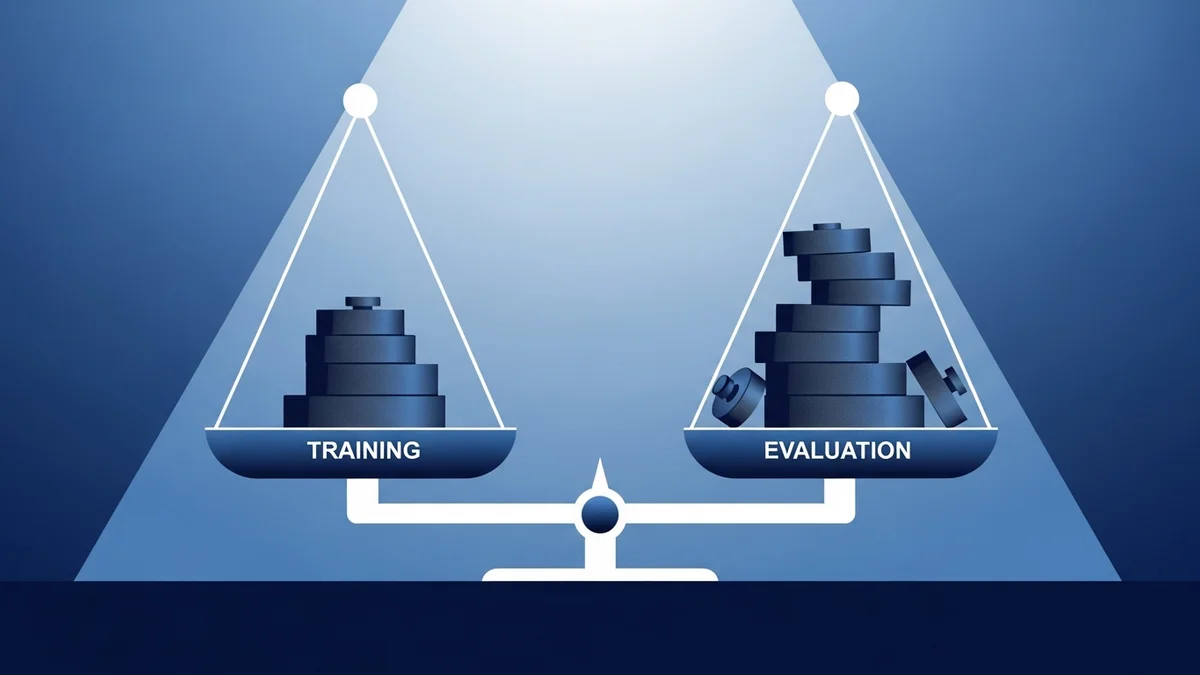
For most of the last two years, the AI economics conversation has been about training. Whose data center is bigger. Whose chips are scarcer. Whose pre-training run cost more. That conversation is now obsolete.
In late April 2026, the HuggingFace EvalEval Coalition published the first hard numbers on what credible agent evaluation actually costs. A single Claude Opus run on the GAIA benchmark: $2,829. The HAL leaderboard aggregate across models and tasks: roughly $40,000 per run. Apply a k=8 reliability protocol — the minimum statistical bar for an agent benchmark to mean anything — and that aggregate jumps to $320,000. PaperBench, which evaluates 6 models with 3 seeds each, exceeds $150,000 per execution.
Read those numbers next to a frontier lab’s training budget. Read them next to a startup’s seed round. The crossover is no longer theoretical. For most agentic tasks worth measuring, verification now costs more than the model that produced the answer. The compute bottleneck moved. Almost nobody updated their procurement criteria.
The Cost Crossover Is Numerical, Not Rhetorical
We have written before about the verification tax — the gap between what AI seems to save and what humans spend rechecking it. That argument was qualitative. It was about hours and judgment. The HuggingFace data takes the same shape and forces it into a finance ledger.
The number that matters is the multiplier. A single agent run on GAIA is in the low thousands of dollars. To make that single run statistically defensible — to claim, with a straight face, that one agent is better than another — you need k=8 repetition because agent variance is high. You need multiple seeds because scaffold and prompt stochasticity dominate the result. You need cross-model comparison because individual scores are meaningless without context.
Each of those requirements is a multiplier. Stack them, and a single benchmark execution moves from $2,829 to $320,000. That is not a procurement line item anymore. That is a series A.
The implication is structural: only organizations with frontier-lab budgets can produce statistically reliable agent benchmarks. Everyone else is publishing single-run scores that mean roughly nothing. Whoever pays writes the leaderboard, because nobody else can afford to verify it.
The Scaffolding Problem Nobody Reads in the Marketing Deck
The most disruptive number in the EvalEval data is not the absolute cost. It is the variance.
Exgentic’s analysis, cited in the HuggingFace report, found a 33× cost variation for identical agent tasks based solely on scaffolding and prompt choices. Not model choice. Not task choice. Scaffolding. The same model, asked the same question, can cost $50 or $1,650 to evaluate depending on how the harness around it is configured.
The 9× spread between SeeAct ($171 at 42% accuracy) and Browser-Use ($1,577 at 40%) makes the point more concrete. A two-percentage-point accuracy gap costs nearly an order of magnitude more compute. Which configuration does the vendor put in the marketing deck? The cheap one, when accuracy is what matters. The expensive one, when accuracy is what they are losing on. The benchmark number on the press release is whichever scaffold made the chart look better. Nobody publishes the cost-per-task number alongside it.
This is not a measurement error. It is a measurement design choice that vendors are making invisibly, and that buyers are accepting because they do not know to ask.
The Pragmatic Engineer Confirms the Macro Pattern
If the EvalEval numbers were isolated to academic benchmarks, you could discount them. They are not.
Pragmatic Engineer reported on April 30 that one seed-stage AI infrastructure company saw token spend rise from $200 per developer per month to $3,000 per developer per month — 15× — over six months. Not because the team grew. Because the underlying agent loops, which the company itself ships as product, became more expensive to run as customers used them more aggressively. The same six-month window saw aggregate AI tooling bills at multiple infra companies double or triple without proportional headcount or revenue growth.
These are not eval costs in the strict EvalEval sense. They are operating costs. But the mechanism is identical. As agentic workflows replace single-shot prompts, the work expands to fill the available token budget. Each task spawns subtasks. Each subtask spawns verification calls. Each verification call spawns retries. The cost of running AI compounds. And because it compounds inside customer-facing product, vendors have to either eat the margin or pass it on — and most of them are starting to pass it on.
Two Convergent Cost Curves Nobody Is Stacking
If you read EvalEval and Pragmatic Engineer side by side, what you see is two cost curves bending up at the same time. The cost of trusting an AI result — proper evaluation, reliability protocols, cross-model comparison — is climbing past the cost of training the model that produced it. The cost of operating AI in production — tokens, retries, agentic recursion — is climbing 15× in six months at the operator level.
Both curves push in the same direction. The economic center of gravity is shifting from “can we build the model” to “can we afford to know whether the model is good, and can we afford to keep running it once it is in production.” Frontier labs can absorb both curves because they have capital, scale, and vertical integration. Most of the buyers reading their leaderboards cannot.
The leaderboard is the part you see. The cost structure underneath it is the part the vendor controls. When evaluation is more expensive than training, control of the eval is the moat — and procurement that does not know this is shopping at a price the vendor sets twice.
RFP-Ready: What to Demand Before You Sign
The practical response is not to abandon vendor benchmarks. It is to refuse to procure on aggregate accuracy alone. The eval cost data gives buyers, for the first time, the language to demand transparency on the structure beneath the score.
Three demands belong in every AI procurement document this quarter.
Demand scaffold disclosure. Any benchmark number presented in a sales motion must be accompanied by the full scaffold and prompt configuration that produced it. If a vendor cannot or will not produce the harness, the number is unfalsifiable. A 33× cost variation on identical tasks means the vendor’s chart is meaningless without the configuration that made it.
Demand per-task cost breakdowns, not aggregates. Aggregate accuracy hides 9× cost spreads. Insist on cost-per-task and accuracy-per-task tables, segmented by category. The procurement question is not “how good is this agent” but “what does this agent cost per task at the accuracy level my workflow needs.” Those are different questions, and only the second one is answerable from real data.
Demand reliability protocols. Ask the vendor: how many seeds. How many runs. What is the variance across runs. If the answer is “we ran it once,” the score is decoration. The k=8 standard exists because anything below it cannot distinguish a real improvement from sampling noise — and the cost difference between a one-run claim and an eight-run claim is the entire point of this article.
A buyer that walks into vendor evaluation with these three demands is no longer trusting the leaderboard. They are auditing the cost structure underneath it. That is the only procurement posture that works once verification has overtaken training as the dominant cost.
The compute bottleneck used to be at the start of the pipeline. It has moved to the end. The vendors who understand that — and who control the eval — are quietly designing your next AI bill.
Sources
- HuggingFace / EvalEval Coalition. “AI Evals Are Becoming the New Compute Bottleneck.” April 2026. https://huggingface.co/blog/evaleval/eval-costs-bottleneck
- Pragmatic Engineer. “The Pulse: Token Spend Breaks Budgets — What Next?” April 2026. https://blog.pragmaticengineer.com/the-pulse-token-spend-breaks-budgets-what-next/
Related reading: The Verification Tax · The AI Economics Fracture · When Agents Approve Their Own Budget · Claude as the CFO’s ROI Anchor · The Benchmark Infrastructure Governance Gap
Victorino Group helps enterprises rebuild AI procurement criteria around per-task cost and scaffold disclosure. Let’s talk.
All articles on The Thinking Wire are written with the assistance of Anthropic's Opus LLM. Each piece goes through multi-agent research to verify facts and surface contradictions, followed by human review and approval before publication. If you find any inaccurate information or wish to contact our editorial team, please reach out at editorial@victorinollc.com . About The Thinking Wire →
If this resonates, let's talk
We help companies implement AI without losing control.
Schedule a Conversation