The Double-Blind Eval Arrived: Contamination Is Now an Infrastructure Problem
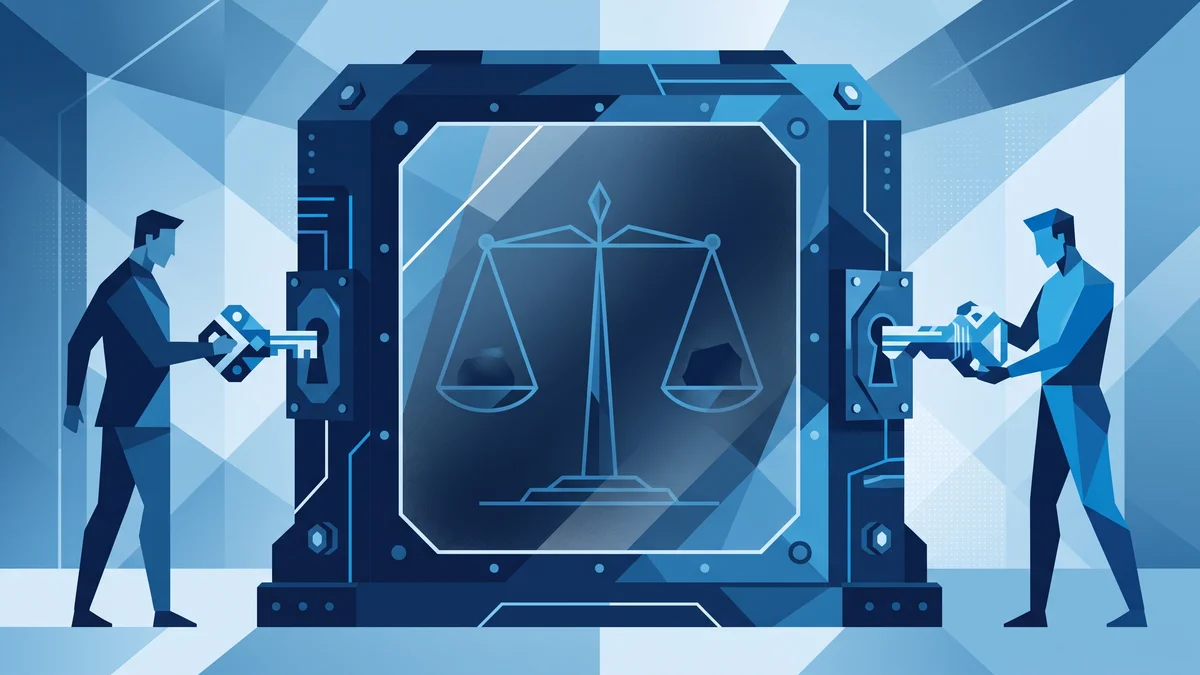
On August 27, 2026, Google DeepMind’s Responsibility & Safety team (byline: Isaac, Messing, Lum) announced a pilot of what they call the world’s first double-blind AI evaluation of a proprietary model. The evaluators never see the model’s weights. The lab never sees the test questions. A confidential-computing enclave, with cryptographic attestation, enforces both blindfolds at once.
When we wrote about benchmark contamination as a governance problem, the essay ended on an open question: the benchmark is contaminated, now what? This pilot is a first credible answer arriving, and it arrives as infrastructure: a property of the execution environment, enforced rather than promised.
What DeepMind actually built
The mechanism runs on Confidential Space within Google Cloud Confidential Computing. Evaluator prompts enter an encrypted, attested enclave. The proprietary model runs inside that same enclave. Neither party accesses the other’s sensitive data: the evaluator’s test set stays hidden from the lab, and the lab’s model stays hidden from the evaluator. Attestation, as the announcement describes it, gives each side cryptographic evidence about the enclave rather than a promise about process.
The pilot ran on Gemini Flash Lite, a small model. The partners were the Singapore AI Safety Institute, OpenMined, AVERI, and MLCommons. And the announcement is methodology-only: no quantitative results were published. Those three facts define both the significance and the limits of what happened, and this essay will hold on to all three.
DeepMind’s own framing of the problem is worth quoting. If a model has already seen the test questions, the announcement says, “the results can only be trusted to an extent”, and it names the problem outright: benchmark contamination. That concession, from the lab that builds the models being tested, grants the premise behind long-running skepticism of public scores. Public benchmark scores measure a mixture of capability and exposure, and from outside the lab there is no way to decompose the mixture from the score alone.
From trust problem to infrastructure problem
Until now, third-party evaluations of frontier models rested on process promises. The lab promises it filtered the benchmark out of training data. The evaluator promises it kept the test set secret. Both promises are unverifiable by the other side, so every published score carries an asterisk: trust us.
The double-blind design replaces both promises with a property of the execution environment. The lab cannot have trained on questions it structurally cannot read. The evaluator cannot leak or reverse-engineer weights it structurally cannot access. Contamination of this evaluation stops being something a lab could do and get caught at. It becomes something the infrastructure does not permit.
That shift matters for the same reason it mattered in our argument that the eval environment is production: evaluation infrastructure deserves the same engineering seriousness as the systems being evaluated. An eval whose integrity depends on everyone behaving is a production system with no access controls. An eval whose integrity is enforced by attestation is a system you can reason about.
There is a familiar precedent for this move. Certificate transparency made CA misbehavior detectable by construction, and reproducible builds made tampering visible without asking maintainers to be more careful. Mature security engineering keeps converting “trust the counterparty” into “verify the mechanism”. Model evaluation is late to that conversion, and this pilot is the first public performance of it I have seen.
The honest limits
Three caveats, and they are not small.
First, this is a pilot on one small model. Gemini Flash Lite is not a frontier system, and a methodology proven at small scale is not automatically viable for the largest models, where inference cost, enclave capacity, and latency all get harder. The announcement published no quantitative results at all. Until numbers from a double-blind run appear and survive scrutiny, this is an architecture, not an evidence base.
Second, the independence question. Google evaluated Google’s own model, inside Google’s own cloud, on Google’s own confidential-computing product. The independence of the result does not come from organizational separation, because there is none. It comes from two other places: the external partners who participated in the pilot, and the attestation itself, which is checkable by parties outside Google. That is a real form of independence, but it is a narrower one than “an unrelated auditor ran this on neutral infrastructure”, and buyers should keep the distinction in view. A skeptic can reasonably ask what an equivalent pilot looks like on a non-Google cloud, and the announcement does not answer that.
Third, double-blind evaluation removes one class of contamination: the lab seeing this evaluator’s test set. It does nothing about test-like data that already saturates public training corpora, and it does not verify what went into training. It narrows the trust surface; it does not eliminate it.
What enterprise buyers should do with this
Here is where the pilot stops being a research story and becomes a procurement story.
Every enterprise buying access to a proprietary model today evaluates it in one of two weak positions. Either you rely on the vendor’s published benchmarks, which carry the contamination asterisk, or you run your own evaluation by sending your test prompts to the vendor’s API, which hands the vendor your test set and can quietly contaminate every future round. Your second annual vendor evaluation is scored against a model whose training pipeline may have absorbed your first.
The double-blind template dissolves that dilemma, and it does so on named infrastructure: the pilot ran on Confidential Space within Google Cloud Confidential Computing, with cryptographic attestation. What was missing was a demonstrated protocol for using such an environment to evaluate a proprietary model, and that protocol is what DeepMind published.
So the question to put in your next model procurement cycle is concrete: would you submit this model to a double-blind evaluation? Since the tooling is still a pilot, the useful version of the question is contractual and forward-looking. Ask the vendor whether they will commit, in the agreement, to supporting attested, double-blind evaluation of the deployed model version as the tooling matures, with an evaluator of your choosing. The answer tells you something even before any eval runs. A vendor whose benchmark claims are real has structural reasons to say yes. A vendor who hesitates is telling you which asterisks to take seriously.
For regulated buyers the stakes are higher again. Audit-without-disclosure is the exact shape that model audits in finance and healthcare need: the auditor must test the real production model, the vendor cannot expose weights, and neither party can take the other’s word for it. This pilot demonstrates in public that the shape is buildable.
Do this now
Add one clause to your model-vendor evaluation template this quarter: a commitment to attested third-party evaluation, naming double-blind execution in a confidential-computing environment as the target mechanism, with a review date rather than an immediate obligation. It costs the vendor nothing today, which is exactly why a refusal is informative. In parallel, stop sending your full proprietary test set to vendor APIs during bake-offs. Hold back a sealed subset, because until double-blind tooling reaches you, the only test set you can trust is the one no vendor has ever seen.
Contamination was a trust problem for as long as no infrastructure existed to remove the trust. That excuse now has an expiration date.
This analysis synthesizes Piloting the world’s first double-blind AI evaluations (Google DeepMind, August 2026).
Victorino Group helps enterprises build model evaluation and vendor-audit programs that do not depend on taking the vendor’s word. Let us talk.
All articles on The Thinking Wire are written with the assistance of Anthropic's Opus LLM. Each piece goes through multi-agent research to verify facts and surface contradictions, followed by human review and approval before publication. If you find any inaccurate information or wish to contact our editorial team, please reach out at editorial@victorinollc.com . About The Thinking Wire →
If this resonates, let's talk
We help companies implement AI without losing control.
Schedule a Conversation