Field Notes: What Sysco, Cathay Pacific, and The Hartford Said About AI ROI
Post 4 of 5 from my Cloud Next 2026 field notes. This one is the panel I almost didn’t go to. Three enterprise leaders, three industries, the inevitable host with talking points. I went anyway because the conversations that happen on these panels — when leaders are willing to be honest in front of 500 peers — are sometimes the most useful hour of the entire conference. This one was.
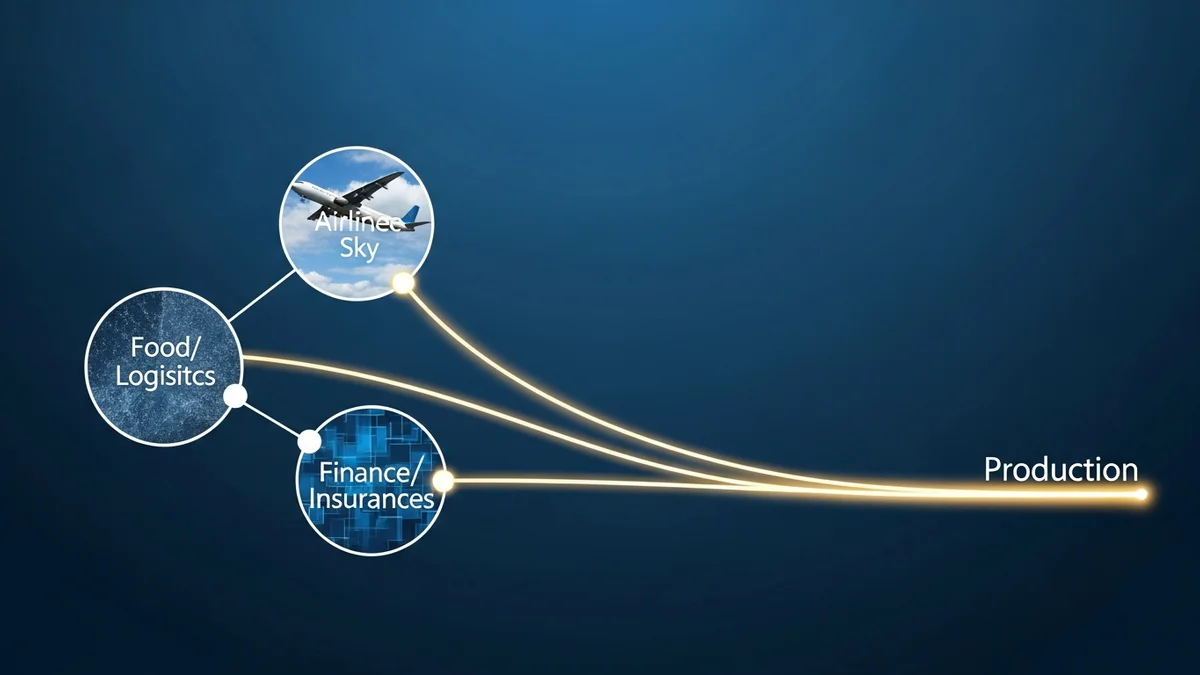
The setup was simple. Google moderated. The host opened with a survey of 3,500 leaders across 24 countries on the ROI of AI, then handed the floor to the panelists. Laura from Sysco, who designs global data strategy and AI workloads for the food distributor. The product and engineering lead at Cathay Pacific, who runs human-facing and conversational AI experiences for the airline. Jeff from The Hartford, who runs Data, AI, and Operations for a 200-year-old insurer. Three industries that could not be more different: food logistics, aviation, insurance.
What unified them was the arc they each described, almost word-for-word: 2024 was the year of two hundred pilots. 2025 was the year of moving a few of them into production. 2026 is the year of realizing actual business value.
I have heard this arc before, in private rooms. I had not heard it said out loud, on a stage, by three enterprises at once.
What Each One Said
Laura at Sysco talked about a top-down AI-first mandate and a three-pillar foundation: data modernization, near-real-time data movement, and analytics matured into automated alerts that trigger action rather than just charts. The use case she anchored everything around was not glamorous. It was automating the Sunday weekly planning ritual that district sales managers run before each week starts — the kind of work that is high-volume, repetitive, and tied directly back to P&L. She walked the panel through how that one workflow connects to revenue and cost. The point landed because she was not selling a moonshot. She was selling a Sunday afternoon.
The Cathay Pacific lead was running a chatbot that today handles more than fifty thousand conversations a month, with roughly half deflected from human agents. The frame was almost boringly clear: the two business levers are cost optimization and context. Context, in their definition, is whether the customer is a first-time flyer or a frequent flyer with a missed connection at 2am. Same model, different context, different outcome. Generational engagement was called out as a strategic priority — younger flyers want self-serve answers, older ones want a human on the line, and the system has to know which is which without asking.
Jeff at The Hartford framed the entire effort as evolutionary, not revolutionary. He launched an internal AI Academy. Engagement scores in the high nineties. The detail that stuck with me: they rolled out enterprise change-management discipline before they scaled the technology. A 200-year-old insurer treating culture as the deployment surface, not the obstacle.
The closing round was the part I wrote down word-for-word. Each panelist gave one piece of advice. “Break away from your dashboard — if you only look at the past, your AI is incremental.” “Enjoy the ride.” “Start with the customer, go back, figure out how to create value.”
Three Patterns That Came Through
If you take everything that was said and strip the industry-specific texture, three patterns sit underneath all three companies.
Top-down mandate is what unsticks AI projects. None of these three companies described a bottom-up grassroots adoption story. Each one described a clear executive directive that gave teams permission and pressure at the same time. The pilots that died in 2024 were the ones that lacked that cover. The pilots that moved to production in 2025 had it.
The use cases that work are still high-volume, repetitive tasks tied to clear cost or revenue impact. Sysco’s Sunday planning. Cathay Pacific’s deflected chats. The Hartford’s claims and operational workflows. Nobody on stage talked about an autonomous agent rewriting their business. They talked about removing the most expensive minutes from the most expensive workflows, and they showed the math.
Culture and change management is where most rollouts get stuck — not technology. Every panelist circled back to this. Jeff was the most explicit, but Laura and the Cathay lead said it in their own way. The technology works. The deployment problem is human. The teams that built training, internal academies, and visible executive sponsorship moved. The teams that bought tools without doing the people work did not.
What Was New, And What Wasn’t
I have to be honest with you. None of those three patterns are new. Top-down mandate as the unstick mechanism, repetitive high-volume work as the right wedge, change management as the actual bottleneck — these are the lessons of every enterprise transformation since ERP. Anyone who lived through cloud migration, ERP rollouts, or the first wave of analytics platforms has heard all of this before.
What was new — and what made the panel worth the hour — was the willingness to admit publicly that the everyone-is-shipping-agentic narrative does not match what is actually happening inside large organizations. Three named enterprises stood up in front of five hundred peers and said the quiet part out loud: pilots are not production. The drift from experimentation toward tangible outcomes is the actual maturity curve, and it takes years.
That kind of honesty is rare. It is also the most useful signal a buyer or an operator can take from a conference like this.
My Add: The Discipline They Had to Learn the Hard Way
Here is the part that connects this panel to the work we do.
The arc each of these three companies walked — from two hundred pilots, to a few in production, to actual business value — is the same arc Victorino coaches our clients through deliberately. We call it alpha → review → production. The names are not magic. The discipline is.
In alpha, an AI workflow runs alongside the existing process. Outputs are inspected. Nothing is automated. The point is to learn whether the system actually works on real inputs, in the real environment, with the real edge cases. Most pilots die here, and that is fine. The cost of dying in alpha is small.
In review, the workflow runs in production but every output is reviewed by a human before it is acted on. This is the floor most enterprises skip. They go from “the demo worked” to “let’s automate the loop,” and they discover three months later that 6% of the outputs were wrong in ways the humans never caught because the humans had stopped looking. The review phase is where the real cost-benefit math gets calibrated. It is also where the change management gets done — the humans see the system’s behavior over enough cycles to trust or distrust it on real evidence, not on a vendor pitch.
In production, the workflow is automated end-to-end and the humans move to monitoring exceptions rather than reviewing every output. This is where ROI shows up in the P&L. It is also the phase that most enterprises treat as the starting line. It is the finish line.
What Sysco, Cathay Pacific, and The Hartford described on stage is the same three-stage arc, lived in the wild, without anyone calling it that. They learned it the hard way. The honest framing in 2026 is that there is no shortcut. The teams that win are the ones who treat alpha → review → production as discipline, not paperwork.
I left the room thinking the most useful thing I could do was not predict the next breakthrough. It was help more clients walk the arc on purpose, instead of stumbling into it after two hundred pilots and a budget review.
That is what this work has always been. Cloud Next 2026 just made it easier to point at.
This analysis synthesizes the Google Cloud Next 2026 panel on AI ROI (Google Cloud, April 2026), Google Cloud Next blog (Google Cloud, April 2026), and the author’s in-person notes.
Victorino Group helps enterprises move AI from pilot to production with the discipline mature operators learn the hard way. Let’s talk.
All articles on The Thinking Wire are written with the assistance of Anthropic's Opus LLM. Each piece goes through multi-agent research to verify facts and surface contradictions, followed by human review and approval before publication. If you find any inaccurate information or wish to contact our editorial team, please reach out at editorial@victorinollc.com . About The Thinking Wire →
If this resonates, let's talk
We help companies implement AI without losing control.
Schedule a Conversation