Claude Design Shipped. Linear's CEO Fired Back. Both Are Right.
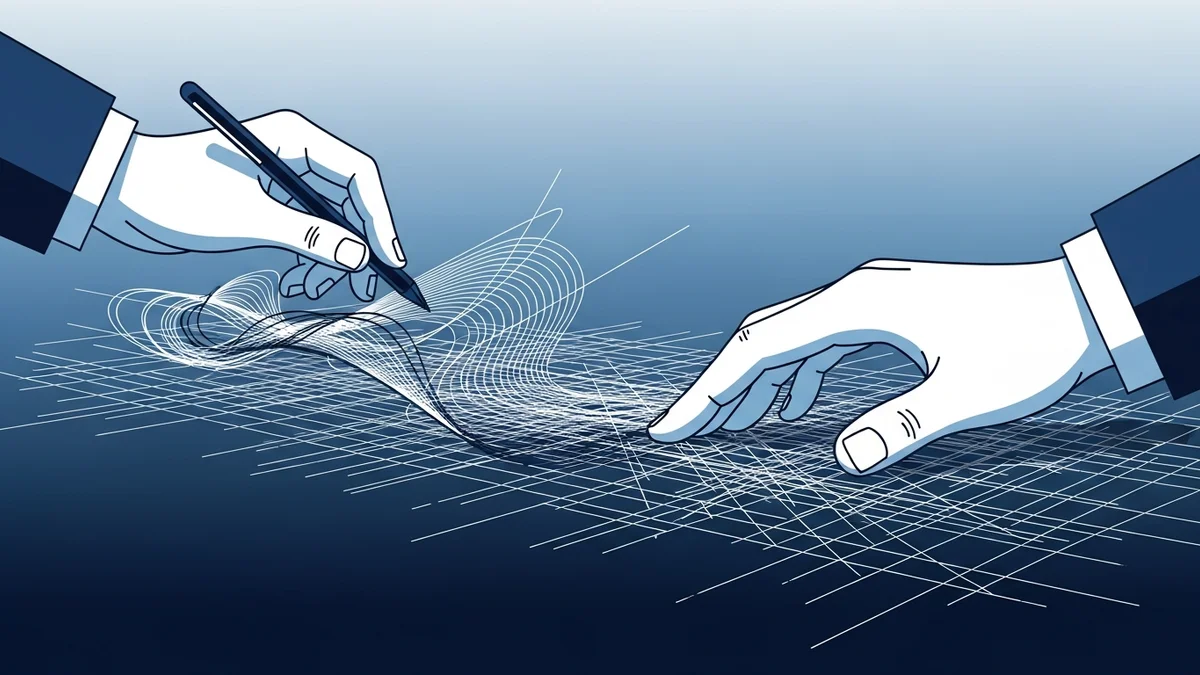
On Thursday, April 17, Anthropic shipped Claude Design. By Friday, April 18, Karri Saarinen, the CEO of Linear, had published his rebuttal. The title said everything: “Output Isn’t Design.”
Forty-eight hours. Ship on day one, cultural pushback on day two. Engineering lived through this with Copilot, Cursor, and agents. Now design is living through it in public.
This is the governance-beyond-engineering moment for design. And both sides of the fight are correct.
What Anthropic Actually Shipped
Claude Design runs on Opus 4.7 and produces end-to-end design work: pages, components, flows. It reads a design system and builds within it. Anthropic’s headline metric is blunt. Pages that took 20-plus prompts in other tools now take two. The launch partners are Canva, Datadog, and Brilliant.
That is a vendor-reported number. Treat it as direction, not a benchmark. But the direction is significant. Twenty prompts represent deliberation. Two prompts represent a transaction. The gap between them is where most of a designer’s actual thinking used to live.
Sam Henri Gold, writing the day after the launch, spotted the deeper move. Claude Design reads code, not Figma primitives. The source of truth for product UI is shifting from a proprietary canvas to an open artifact that any LLM can ingest. Whoever reads code as the primary object wins the governance surface for AI-generated design.
That is a significant claim. We agree with most of it while noting the obvious caveat: Figma has absorbed every previous shift (plugins, Dev Mode, code export, MCP). Writing the company off twice in one essay is premature. But the direction of travel is real.
What Saarinen Actually Said
Saarinen’s response landed less than 24 hours later. The line that will outlive the news cycle:
“Our industry keeps confusing the appearance of design with design itself.”
He grounded the argument in Christopher Alexander’s 1964 Notes on the Synthesis of Form. Alexander’s distinction is between form (what gets produced) and fit (whether the form resolves the underlying problem). Saarinen’s paraphrase: the hard part of design is understanding the problem well enough to know what should exist at all, and how.
Disclose the incentive. Linear competes in the space of tools that turn intent into shipped product. A world where a chat assistant produces 90% of the UI is not Linear’s strongest world. Saarinen is not a neutral observer. He is also not wrong.
The argument works because it points at a real thing. Claude Design produces form. It does not, by itself, produce fit. Fit requires context the model does not have: who the user is, what they are trying to accomplish, what constraints the business has already absorbed, what the brand has decided not to be.
The Three-Layer Frame
We argued in February that AI output quality is a governance problem, not a design problem. We argued in March that design systems were becoming constraint layers for autonomous software. This week, both arguments arrived at the same intersection, and a sharper frame became possible.
Design, under AI, operates on three layers:
The constraint layer. This is the design system. Tokens, components, variants, accessibility rules, motion primitives. It is what the agent can build with. Claude Design reads your constraints. Figma’s MCP beta writes within them. The constraint layer is where governance becomes architecture, because an agent cannot use a component that does not exist.
The fit layer. This is product context. The customer problem. The pricing tier this page has to convert. The regulatory language the footer has to carry. The tenth-user discovery that shaped the empty state. An LLM can guess at fit from patterns in its training data. It cannot reason about fit from first principles because it does not have the principles. Fit is what the product team knows and the model does not.
The taste layer. This is judgment. Which of three valid options is the right one for this brand, this quarter, this audience. Taste is not a lookup. It is the accumulated preference of people who have had their output compared to the market for years. Taste is what Saarinen is actually defending.
When Anthropic says Claude Design collapses 20 prompts into two, it is describing the constraint layer compressing. That is a real productivity gain. When Saarinen says output is not design, he is describing the fit and taste layers, and noting that compressing the constraint layer does not address them.
Both are describing the same system. They are just standing at different layers.
Governance Enforces Fit
This is where the governance framing does work that neither side’s framing does alone.
In engineering, we spent the last 24 months learning that AI coding assistants produce plausible code that fails against context. The fix was not to reject the tool. The fix was to build the context: specs, test suites, review agents, CI gates, architectural constraints encoded in the repo itself. Governance infrastructure is what made AI-generated code trustworthy at scale.
Design needs the same infrastructure. The difference is that the constraint layer already exists. Design systems have been treated as governance infrastructure by the teams that take them seriously. What has been missing is the fit layer, codified. Most organizations have no artifact that captures the product context an AI tool would need to produce design that actually resolves a problem.
Claude Design forces the question. If an agent can produce a landing page in two prompts, and the page is technically compliant with the design system, but the page fails to do what landing pages at your company are supposed to do, where was the failure? The failure was at the fit layer, which nobody had made machine-readable.
Governance-for-design means the fit layer becomes as explicit as the constraint layer. Product principles versioned and reviewed. Customer jobs documented and referenced. Conversion hypotheses written down before the generation, not rationalized after. Brand positions that reject options, not just prefer them. None of this is new to good design teams. What is new is that the agent needs it in the context window, not in a deck.
The Audit Trail Problem
Here is the uncomfortable corollary. Twenty prompts were, functionally, a deliberation log. You could see the designer stress-testing the problem. Two prompts do not leave that record.
This is the same audit-trail problem engineering hit a year ago. An AI that generates a passing test suite in ten seconds gives you no visibility into which cases were considered and rejected. The speedup removes the artifact that quality review relied on. The fix was to add structured review at the output, because the process no longer produced a natural log.
Design teams governing AI-generated output will need the same thing. Some kind of structured critique at the artifact, because the generation no longer produces one. Reviewer agents. Design critiques scheduled as part of the workflow, not optional. Fit-layer checks written as explicit prompts. The deliberation moves from the production step to the review step. It does not disappear.
Why This Matters Beyond Design
We have been tracking the governance-beyond-engineering arc for two quarters. Marketing had the moment when autonomous campaigns started shipping. Legal had the moment when agents entered regulated workflows. Design just had its public moment, in 48 hours, with the biggest design CEO in the industry drawing the line.
Every function will have this moment. The pattern is consistent. A vendor ships a credible production tool. A practitioner with standing publishes the principled objection. The surface argument looks like a fight about the tool. The actual argument is always the same: when AI produces form, what governs fit?
The teams that answer that question first in their domain will define the standard for their domain. The teams that treat the fight as a culture war will lose the decade.
Saarinen is right that output is not design. Anthropic is right that Claude Design compresses the constraint layer. The missing piece, for every function AI is about to reach, is the governance infrastructure that keeps form and fit honest to each other.
Design had its moment this week. Your function is next.
This analysis synthesizes Anthropic’s Introducing Claude Design (April 2026), Karri Saarinen’s “Output Isn’t Design” (April 2026), and Sam Henri Gold’s Thoughts on Claude Design (April 18, 2026).
Victorino Group helps teams make the governance layer for design visible and measurable. Let’s talk.
All articles on The Thinking Wire are written with the assistance of Anthropic's Opus LLM. Each piece goes through multi-agent research to verify facts and surface contradictions, followed by human review and approval before publication. If you find any inaccurate information or wish to contact our editorial team, please reach out at editorial@victorinollc.com . About The Thinking Wire →
If this resonates, let's talk
We help companies implement AI without losing control.
Schedule a Conversation