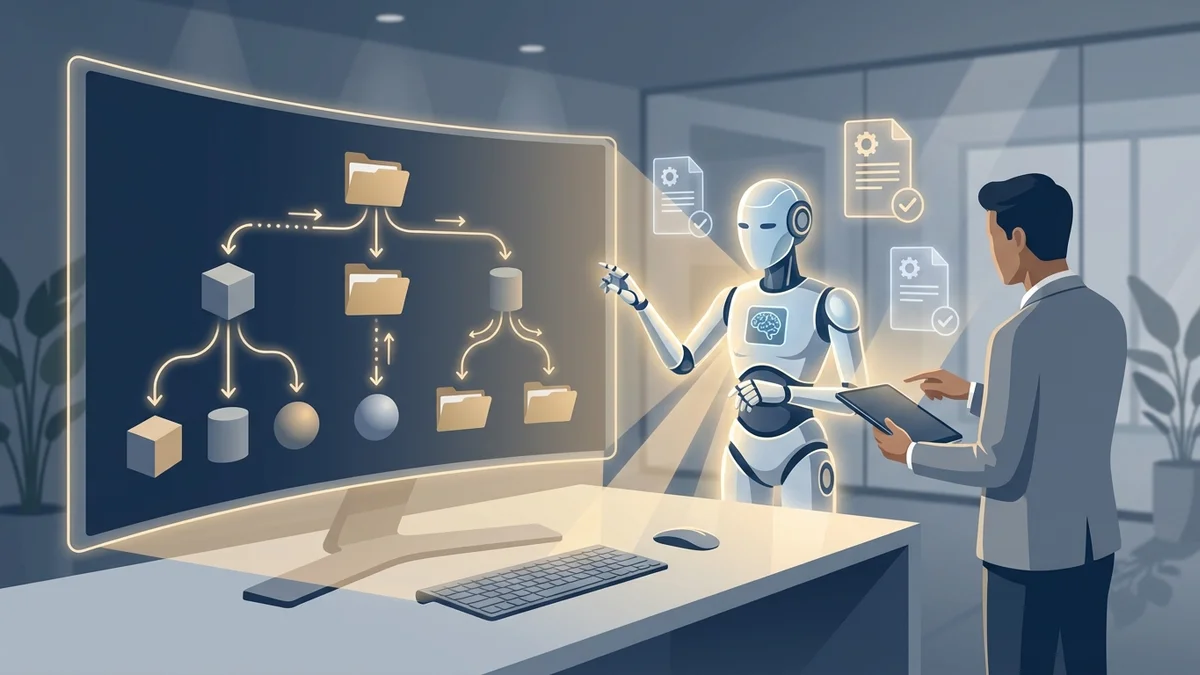
On January 12, 2026, Anthropic released Claude Cowork. The official description: “Claude Code for the rest of your work.” The implicit promise: agentic automation for non-programmers.
Here’s what nobody tells you: users were already hacking Claude Code for non-coding tasks. Vacation research. Email cleanup. File organization. Subscription cancellations. Boris Cherny, an Anthropic engineer, admitted it publicly.
Cowork isn’t an invention. It’s recognition that demand for agents already existed — and was being served by a tool not designed for it.
What It Is and How It Works
Claude Cowork is an assistant that executes real tasks on your computer files. It doesn’t generate suggestions. It doesn’t create templates. It acts.
The workflow:
- You describe the task in natural language.
- Claude creates a structured plan.
- Files are mounted in an isolated environment via Apple virtualization.
- Claude reads, edits, and creates files as needed.
- Can search and extract web data with Claude in Chrome.
- Validates results and asks for clarification if necessary.
- Delivers completed task.
The differentiator: you can queue multiple tasks. Claude works in parallel. Like leaving messages for a coworker.
Architecture: Security Isn’t Optional
I discovered something examining file paths: Claude Cowork doesn’t run in containers. It uses the Apple Virtualization Framework (VZVirtualMachine) — full virtualization.
Files are mounted in isolated paths like /sessions/zealous-bold-ramanujan/mnt/. Each session gets a unique identifier. Claude can’t “wander” the system.
The sandbox isn’t optional like in Claude Code. It’s mandatory. Total isolation by design.
Claude Code vs Cowork:
| Claude Code | Claude Cowork | |
|---|---|---|
| Sandbox | Optional | Mandatory |
| Interface | CLI (Terminal) | GUI (App) |
| Audience | Developers | Everyone |
| Setup | Technical | Ready to use |
Interesting fact: Cowork was developed in approximately 10 days using Claude Code itself.
Real Use Cases
Simon Willison, a well-known developer, tested it with his collection of blog post drafts.
Instruction given: “Look at my drafts from the last three months, check which ones have already been published on my site via search, and suggest the ones closest to being ready.”
What Claude did:
- Ran
findand located 46 files. - Performed 44 individual site searches.
- Cross-referenced drafts with published posts.
- Generated list ranked by readiness.
Simon requested a bonus: “Make an artifact with animated encouragements to motivate me to publish.”
Claude created an interactive HTML page with confetti animations and motivational messages.
Result: “That’s a good response. Found exactly what I needed to see.”
Applications for American Companies
Through client conversations, I identified specific opportunities for the US context:
Financial Compliance:
- Processing expense reports from receipt images.
- Extracting data from 1099 forms for analysis.
- Reconciling financial documents across systems.
- Organizing files by tax year/entity.
Legal Management:
- Organizing case files by docket number/court.
- Batch contract analysis.
- Compiling documentation for regulatory audits.
- Generating compliance reports.
Financial Operations:
- Processing bank statements.
- Cash flow analysis from documents.
- Automatic expense categorization.
- Data consolidation from multiple sources.
HR and Administration:
- Initial resume screening.
- Analysis of pay stubs and employment documents.
- Employee documentation organization.
- Headcount report generation.
Security: What Works and What Still Worries
Implemented protections:
- Mandatory sandbox via full VM.
- Explicit permissions — you choose folders and connectors.
- WebFetch with filtering — web content is summarized before processing, mitigating prompt injection.
- Action confirmation — Claude asks for approval before significant actions.
Real risks:
Prompt Injection: Attackers can alter Claude’s behavior through malicious content in files or websites. Anthropic has defenses. Offers no absolute guarantees.
Destructive Actions: Claude can delete files if instructed. The recommendation: “clear and unequivocal” instructions.
Anthropic itself admits: “Agent safety — the task of protecting Claude’s real actions — is still an active area of development in the industry.”
My recommendation: Avoid giving access to sensitive files like financial documents. Monitor suspicious actions. Treat Cowork like you’d treat a talented but unsupervised intern — capable, but needs boundaries.
Availability and Pricing
Current status: Research Preview.
- Platform: macOS (Claude Desktop app).
- Price: Claude Max subscription — $100 or $200/month.
- Region: United States initially.
- Other plans: Waitlist available.
Expected roadmap (unofficial, based on signals):
- Q1-Q2: Windows/Linux expansion and cross-device sync.
- Q2-Q3: Enterprise version with SLA and corporate support.
- Q3-Q4: Native integrations with Slack, Teams, and corporate APIs.
- 2027+: Multi-agent orchestration and visual workflow builders.
Expectation: Google and OpenAI should release similar products soon. This is a race for general-purpose agents.
What We Learned
1. AI that acts, not just chats: Cowork executes real tasks. Turns instructions into concrete actions.
2. Claude Code democratization: Same capabilities. Accessible to users without technical knowledge.
3. Security by design: Mandatory sandbox via real virtualization. Claude only accesses what you authorize.
4. Risks still exist: Prompt injection and destructive actions are real risks. Precautions are necessary.
5. American opportunities: Financial processing, legal management, and compliance are promising areas.
6. Limited access for now: macOS + Claude Max. Windows and Enterprise coming soon.
Conclusion
Claude Cowork isn’t revolutionary. It’s the democratization of something that already worked for developers.
The question isn’t “does this work?” It’s: “are you ready to delegate execution to a machine?”
If the answer is yes, productivity gains are real. If the answer is no, wait for the Enterprise version with SLA and corporate support.
But don’t wait too long. The window for experimentation is open. In six months, agents will be commodity. The competitive advantage will belong to those who learned to use them first.
Victorino Group implements agentic automation with integrated governance for companies that can’t afford to fail. If you want to explore how to apply Cowork to your processes, let’s talk.
All articles on The Thinking Wire are written with the assistance of Anthropic's Opus LLM. Each piece goes through multi-agent research to verify facts and surface contradictions, followed by human review and approval before publication. If you find any inaccurate information or wish to contact our editorial team, please reach out at editorial@victorinollc.com . About The Thinking Wire →
If this resonates, let's talk
We help companies implement AI without losing control.
Schedule a Conversation