Next Insurance Kept Its Sprints and Its Board. It Changed Who Writes Every Artifact.
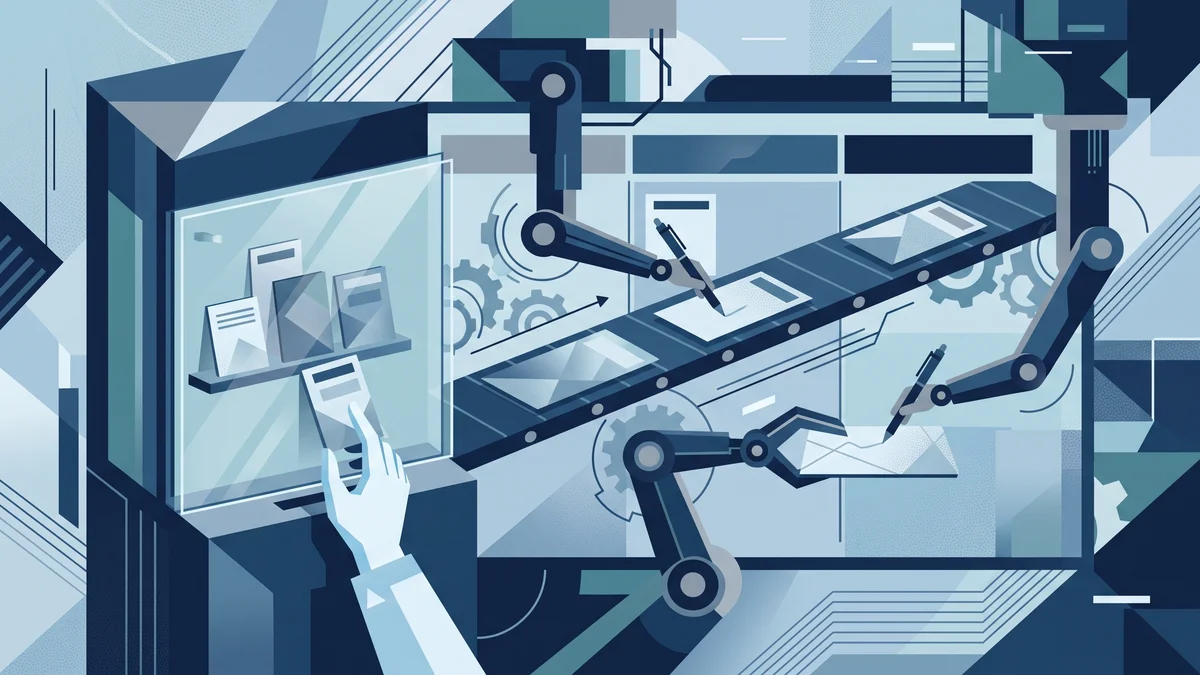
An insurer of about two hundred people has spent three or four months putting an agentic development lifecycle into production. Per Yuval Yeret’s account of a conversation with Shay Mandel, who leads product and AI enablement at Next Insurance, the company kept its quarterly planning, kept its sprints, and kept its board. What changed is who writes the artifacts. PRDs, designs, code, reviews: agents produce them, driven by skills the company maintains, and a short list of decisions stays with people.
The rollout is running in a few squads so far. It is a single case, reported second-hand, and I treat it that way. It earns eight minutes because it is the clearest sequencing decision I have seen written down: change authorship first, hold the process still, and let the process tell you when it needs to change.
Two variables, one experiment
Everything in an agentic rollout invites a redesign. Sprints look slow when an agent drafts a PRD faster than the sprint can absorb. Standups look pointless when a pipeline updates the board. The ceremony list asks to be rewritten.
Next Insurance left it alone. Same cadence, same board, same planning rhythm. My reading of why: experimental hygiene. If you change who produces the artifacts and how the team coordinates in the same quarter, a drop in delivery has two candidate causes and you cannot separate them. Hold the process still and the only variable moving is authorship. When something breaks, you know where to look.
The process will change eventually, and the trigger is observable: the moment the board stops telling you where the work is. In the escalation boundary is the artifact the handoff between agent and human was a written document. Here the handoff is a Kanban state, and the state feeds the same flow metrics the team already reads. When a column no longer describes what the agents are doing, that column is the first thing to redesign. Until then the board is doing its job, which is to keep the flow visible while authorship changes underneath it.
The five decisions that stay human
The most useful thing in Yeret’s write-up is a list. Five decisions stay with people at Next Insurance:
- Priorities and feature selection.
- PRD approval.
- Technical design review before any code is written.
- A human look at the pull request after the agent review has said OK.
- The manual switch on A/B results.
Agents draft everything else. Look at where the five sit. Each is a gate on a transition, and each is the point where a wrong answer is expensive to reverse. Choosing the wrong feature is measured in quarters. Approving a wrong PRD is measured in sprints. A wrong design costs the code written on top of it. A wrong merge costs a rollback. A wrong A/B call costs a customer-facing outcome. The human in every entry approves or switches; drafting has left the list entirely.
We have argued that specs are governance artifacts. This case is what that looks like in a company with a published list. The list is short enough to fit on a slide and specific enough to audit. Ask an engineering leader which decisions in their agentic pipeline still require a person and, in my conversations, the usual answer is a feeling. Next Insurance can hand you five lines.
Sixty percent is the plan
Mandel’s expectation-setting is unusual for how explicit it is: “the initial version will probably be sixty percent accurate or seventy. And we’ll probably get to ninety percent or ninety-five. And the extra five percent is why we need a human in the loop.”
Three things follow. The first version is planned to be wrong about a third of the time. The last five percent is the design justification for the human gates. And the list of five decisions is sized to that five percent: a company that expects agents to be right nineteen times in twenty puts people where the twentieth answer would hurt most.
Review by exception was a proposal when we wrote it: a machine reads everything, a person reads what the machine flags. Yeret’s account names a skill for PRD review by engineering. Set it next to the second human decision, PRD approval, and the shape is the one we described, running in production at an insurer. An agent produces the review. A person owns the approval.
One user per skill is a failure mode
The account names an anti-pattern seen at other companies: “every skill is used by maybe one or two users.” The answer it gives: “everyone should improve the brain that we have in the company.”
If agents write the artifacts, the skills that drive them are the company’s process in executable form. A skill with one or two users is a private process. Twenty of those and you have twenty ways to write a PRD, each drifting alone. Skill sprawl is process sprawl with a version-control system attached.
The remedy the account describes is organisational: skills are shared assets, and everyone improves them. The concrete form I would give that: one repository, many contributors, review on changes. A company that lets every squad keep its own prompts has made the authorship change and thrown away the governance it was supposed to buy.
Product and engineering are behind
One sequencing detail cuts against the usual story. At Next Insurance, claims, support and the customer-facing side adopted AI about a year ago. Product and engineering are, in the account’s words, “actually behind.”
Engineering teams tend to assume they lead because they built the tooling. My reading of this case: the functions that moved first had artifacts with clear owners and clear accuracy thresholds. Engineering carries a denser chain of handoffs (PRD, design, code, review, release), and it took longer to decide which human decisions to keep. We wrote about what agent-written code does to product management. The Next Insurance list is one answer: a person keeps priorities and PRD approval, and gives up the drafting.
Knowing you need the tool is the hard part
Benedict Evans, writing the same month, frames the problem from outside the company. “The hard part is knowing that you need a tool for this in the first place, and then knowing what the tool should do.” A tool that touches “50 or 500 people across five different departments, three different systems of record, and four different regulatory regimes” “has to be a purchase, and a decision, and an 18-month sales process.”
Evans is explaining why enterprise transformation is slow. The Next Insurance list is an answer to his second question, what the tool should do. Once a company knows which decisions stay human, the agentic lifecycle has a specification: everything else. Before that list exists, “adopt AI in engineering” is a wish with a budget.
Evans also says roughly half of pilots fail, and adds that this is normal and is the point of a pilot. That figure is his estimate, offered without a source, and I cite it as his opinion. It does fit the Mandel model. A pilot that expects sixty percent accuracy and plans the human gates around the shortfall is built to survive being wrong often. A pilot that expects ninety-five percent on day one is built to be cancelled.
Do this now
Write your list before you change anything else.
- Pull the artifact inventory for one squad: PRDs, designs, pull requests, test plans, release notes, board updates. Mark who writes each one today.
- For each transition between artifacts, decide whether a person approves, reviews, or is absent. Next Insurance has five entries. Yours may have four or seven. The count matters less than the fact that it is written and can be audited.
- Hold the ceremonies still for the duration. Same sprint length, same board, same planning. Watch the board. The day it stops telling you where the work is, you have your first process change, and you will know why you are making it.
- Put the skills in one place, with an owner per skill and a change log. A skill with one user goes on a list for adoption or removal.
- Write the accuracy expectation down. Sixty to seventy now, ninety to ninety-five later. The residual is the reason the list in step 2 exists.
Authorship first, process second, and a written list of what stays human in between.
This analysis synthesizes Don’t Redesign Your Process Yet. Change Who Writes the Artifacts (Scrum.org, author Yuval Yeret, case from Shay Mandel of Next Insurance, September 2026) and AI, Tools, and Transformation (Benedict Evans, September 2026).
Victorino Group helps engineering organizations decide which decisions stay human before agents take over the artifacts. Let’s talk.
All articles on The Thinking Wire are written with the assistance of Anthropic's Opus LLM. Each piece goes through multi-agent research to verify facts and surface contradictions, followed by human review and approval before publication. If you find any inaccurate information or wish to contact our editorial team, please reach out at editorial@victorinollc.com . About The Thinking Wire →
If this resonates, let's talk
We help companies implement AI without losing control.
Schedule a Conversation