Archestra Just Shipped Governance for the Conversation Channel
Open source spent the last decade defending the commit channel. Dependabot watches dependencies. CodeQL scans diffs. Sigstore signs releases. Maintainers built an entire stack around the assumption that the dangerous payload arrives as code, gets reviewed, then merges or does not.
In April 2026, Archestra (CTO Ildar Iskhakov) published an incident report that quietly redefined the perimeter. The dangerous payload, in their case, never tried to merge. It tried to talk. One $900 bounty issue accumulated 253 bot comments. One support issue in the x.ai repo drew 27 mostly-untested pull requests. A single team member spent half a day each week deleting spam from the discussion thread. The defenders were watching the gate to the codebase. The siege was happening at the marketplace.
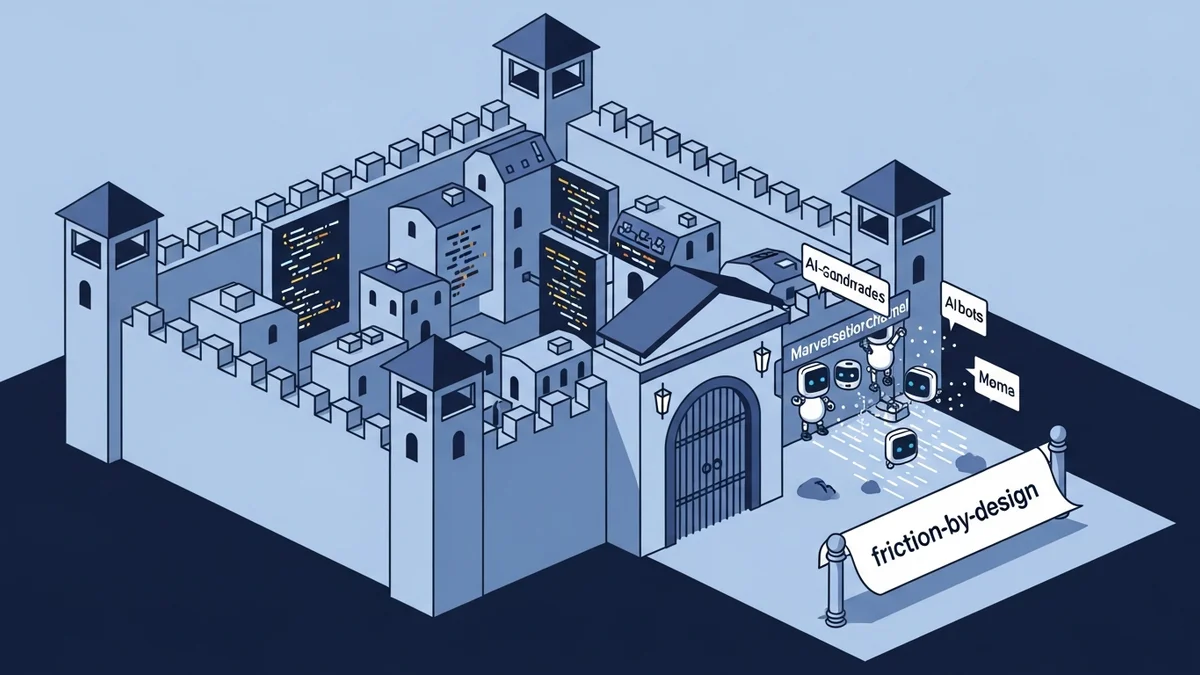
Archestra’s response was not another scanner. It was a contributor-side onboarding gate that exploits an obscure GitHub setting (“limit to prior contributors”) to make AI-generated noise structurally unable to participate in conversations. That mechanism is the news. The fact that they had to build it is the story.
The Channel Maintainers Forgot
Every governed system has channels. In an open-source project, three matter: the commit channel (what enters the codebase), the release channel (what ships to users), and the conversation channel (issues, discussions, PR threads, code review comments). The first two have a decade of tooling behind them. The third was treated as social infrastructure, governed by Code of Conduct documents and the assumption that participation cost time, which acted as a natural filter on bad actors.
That assumption is dead. When an AI agent can post a “thoughtful implementation plan” in two seconds, the participation cost collapses to zero on the producer side and rises sharply on the receiver side. Every comment a maintainer reads has the same human cost as before. The asymmetry that broke code review under AI-assisted PRs, as we covered in The Collina Paradox, is now breaking the discussion thread.
The economics are the same. Production is cheap. Review is expensive. Conversation is review.
What Archestra Actually Shipped
The mechanism is worth understanding because it is more clever than it looks.
GitHub has long offered a repository setting that restricts who can comment to “prior contributors.” The setting was designed for established projects with stable contributor pools. It is a blunt instrument: turn it on and new humans cannot say hello either. For most projects that is unacceptable, so the setting sits unused.
Archestra found the loophole. They built a GitHub Action that runs an onboarding flow: a CAPTCHA, a short set of ethical AI usage rules to accept, basic identity checks. Once a real human completes the flow, the Action does something elegant. It creates an empty Git commit attributed to that user via Git’s author-override mechanism, using GitHub’s standard username@users.noreply.github.com address. The commit lands in the repository. GitHub registers the user as a prior contributor. The conversation channel opens.
A human who wants to participate spends two minutes on the onboarding. An AI agent firing off comments at scale either fails the CAPTCHA, refuses the ethical clause, or, more likely, was never built to navigate an onboarding flow at all because the cost of participation was assumed to be zero.
Friction by design. Not a scanner. Not a reputation score. A gate.
Why the Previous Attempt Failed
Archestra had tried the obvious thing first. They deployed London-Cat, a reputation bot that watched for spam patterns and flagged suspicious accounts. It worked the way most defensive automation works: detect, score, throttle. Against the volume of AI-generated participation, it did not hold. Reputation systems assume a slow ramp where bad actors accumulate signal over time. AI-generated noise does not ramp. It arrives at scale, from accounts with no history, and either overwhelms the classifier or trains it into uselessness.
This is the recurring pattern in AI-era governance. Defenses built around behavioral analysis assume a defender’s economy of effort that no longer exists. The attacker spends nothing. The defender spends everything. The Archestra pivot, from detection to access control, mirrors what happened with email two decades ago: spam filters helped, but the structural fix was reputation-bound sending domains, DKIM signing, and SPF records. Identity at the gate beat content analysis at the inbox.
What This Is Not
Archestra has been careful about the framing, and we should be too. This is not a security tool. The onboarding gate does not analyze code. It does not detect malicious payloads. It does not stop a determined adversary who is willing to spend two minutes on a CAPTCHA. As we covered in Clinejection: The Supply Chain Attack Pattern, real supply-chain attacks operate through different vectors and require different defenses.
What this gate does is restore the cost asymmetry that the conversation channel was implicitly designed around. It does not make participation impossible. It makes participation cost something. That cost filters out the kind of high-volume, low-effort AI noise that is currently consuming maintainer attention. It does not filter out a thoughtful human with a slow morning.
The distinction matters because the wrong framing leads to the wrong tools. Treating the conversation channel as a security perimeter invites scanners, classifiers, and ML defenses that will lose the same arms race London-Cat lost. Treating it as an access-controlled commons invites onboarding gates, identity verification, and friction calibrated to the kind of participation the project wants.
The Governance Surface Map Just Got Bigger
If you are running an open-source project or any platform with user-generated content, your governance surface map needs a third entry. The commit channel has Dependabot and CodeQL. The release channel has signing and provenance. The conversation channel has, until now, nothing operational. Archestra just shipped the first credible primitive for that layer.
The implication is broader than open source. Every system that accepts conversational input from external participants, support tickets, community forums, issue trackers, marketplace reviews, contractor messaging platforms, faces the same economics. Production cost has collapsed for the participant who deploys an agent. Review cost has not changed for the platform operator who reads the output. The systems that survive will be the ones that rebuild the cost asymmetry at the access layer, not the analysis layer.
As we explored in AI Offense Rewrites Open Source, the attacker-defender economics inverted when AI made offense cheap. Archestra’s onboarding gate is one of the first defensive moves that accepts the inversion and works with it instead of against it. It does not try to win an analysis war it cannot win. It changes the game to one where the defender can still set the price of entry.
Do This Now
If you run a repository, a community, or any system with a conversation channel:
Audit the channel. Count the AI-generated participation you are absorbing per week and convert it to maintainer hours. If the number is non-trivial, you have a budget problem that is currently invisible because the cost is paid by individuals, not the project. The first compounding move is to make that cost visible at the project level.
Then ask the access question. Who needs to participate in conversation, and what is the minimum credible friction that filters automated participation without filtering humans? GitHub’s “prior contributors” setting is a starting point. Archestra’s onboarding-gate pattern is a more sophisticated answer. The right answer for your project may be different, but the design principle is the same: move the defense from content analysis to access control before the analysis arms race breaks your maintainers.
The Victorino team works with open-source maintainers and platform operators on exactly this kind of governance surface design. The commit channel is well-defended. The conversation channel is where the next year of work lives.
This analysis synthesizes Let’s Talk About AI Slop (Archestra.AI, April 2026).
Victorino Group helps open-source maintainers and platform teams design conversation-channel governance, not just code-channel defense. Let’s talk.
All articles on The Thinking Wire are written with the assistance of Anthropic's Opus LLM. Each piece goes through multi-agent research to verify facts and surface contradictions, followed by human review and approval before publication. If you find any inaccurate information or wish to contact our editorial team, please reach out at editorial@victorinollc.com . About The Thinking Wire →
If this resonates, let's talk
We help companies implement AI without losing control.
Schedule a Conversation