Daniel Epstein, Partner Tech Strategist at Microsoft, published a piece in May 2026 arguing that agent development needs Agile. Not prompt engineering. Not better models. Agile. Issues with acceptance criteria. Review gates. Persistent instruction files. Spec-first backlogs. Microsoft even shipped a template repository to operationalize the position.
Read alongside the PFF case study from the same month, the argument seems to short-circuit. PFF deleted standups, sprint planning, refinement, retrospectives, and the product manager role. Two engineers with agents outshipped a team of ten. So which is it: does Agile survive the agent era, or does it not?
Both, because Agile was never one thing.
Agile Was Two Things All Along
Read any 2001 Agile Manifesto retrospective and you find a single label covering two very different machines wired together.
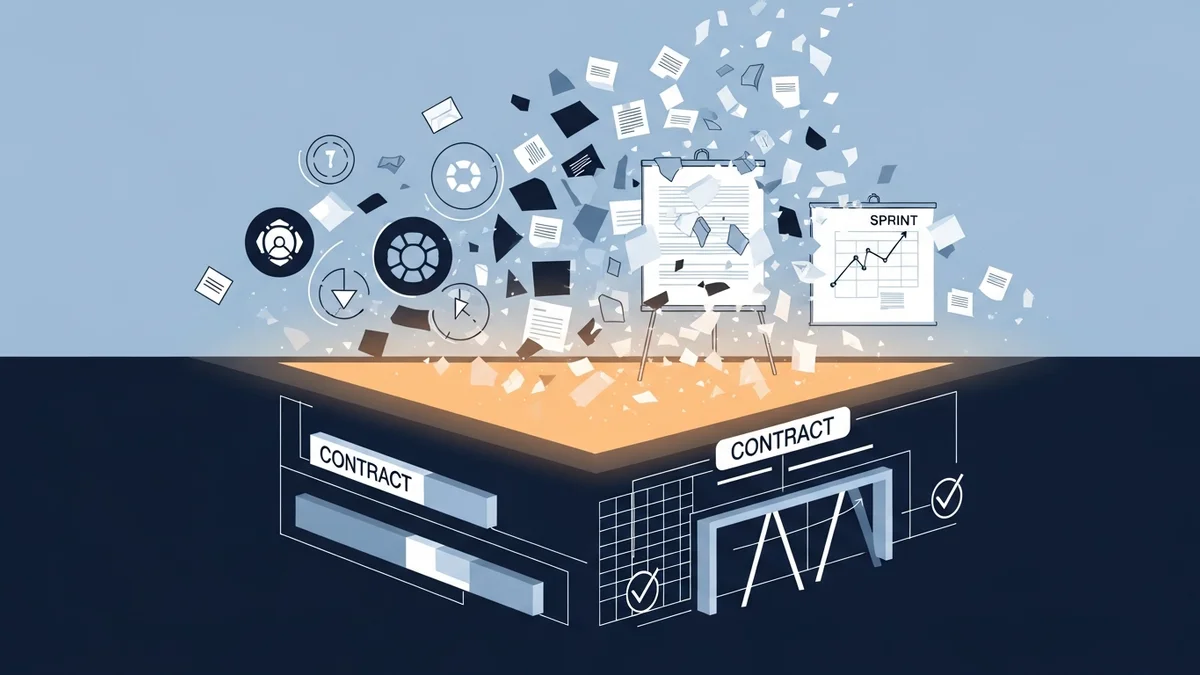
The first is the coordination stack. Standups, sprint planning, refinement, retrospectives, demo days, capacity charts. Every artifact in this layer answers a question about humans: when are you free, what is blocking you, how much work can a person hold in their head over fourteen days, how do we keep the team from burning out. The coordination stack is ergonomics. It optimizes scarce, slow, opinionated human attention so a small group of engineers can ship coherent software without colliding.
The second is the contract stack. Issues with acceptance criteria, definition of done, design documents, API contracts, test specifications, review checklists, persistent instruction files. Every artifact in this layer answers a question about the work itself: what does this change actually mean, how do we know when it is correct, what cannot break, what must be true after the merge. The contract stack is specification. It encodes intent precisely enough that someone else, including a future version of yourself, can execute against it without ambiguity.
For twenty years the two stacks looked like one because they ran inside the same ceremony. The standup updated the coordination stack and surfaced gaps in the contract stack at the same time. The retrospective improved coordination and tightened contracts in the same meeting. Disentangling them was unnecessary. The agents made it necessary.
Why Agents Collapse the Coordination Stack
Engineer hours stopped being the scarce resource.
That single sentence is the whole story. We covered the operational evidence in a recent piece on PFF and the org inversion. Mike Spitz, CTO of Pro Football Focus, ran a three-month experiment in early 2026 where two engineers plus agents went up against ten engineers without them. The two-engineer team shipped 25 times more deploys, 10 times more weighted ticket complexity, and lifted CSAT from a 7.5 baseline to 8.6. Along the way they deleted the PM role, sprint planning, daily standups, refinement, and retrospectives. The half-hour huddle every other day was all that survived.
This is what happens when the resource a ceremony was protecting becomes abundant. Standups optimize a constraint, namely human typing speed coordinated across calendars, that no longer binds when an agent fleet runs in parallel. The coordination stack does not break in some dramatic way. It simply stops paying its rent. The ceremonies turn into theater, and the leaders who keep running them on inertia are paying salaries to maintain rituals that protected a constraint that has moved.
Why Agents Amplify the Contract Stack
The opposite is true for the second stack.
Epstein puts it directly: “This is not a model problem; it is a process problem. Upgrading the model does not fix missing acceptance criteria.” His Minthe project surfaced the failure mode at a fidelity that prompt enthusiasts rarely confront. Multiple agents running in parallel drifted from one another. Behavior diverged from spec. The codebase looked correct in isolation and incoherent in aggregate. The only stable source of truth that survived the chaos was the GitHub issue tracker, where the acceptance criteria were explicit enough to anchor every agent back to a single definition of done.
The reason is structural. A human engineer with a vague ticket asks a question, pulls the PM into a hallway, or just makes a judgment call grounded in years of context about the product. An agent with a vague ticket invents an answer. It has no shared context outside the artifact in front of it. The artifact is the contract. If the contract is loose, the agent fills the slack with plausible-sounding nonsense that compiles, passes its own tests, and ships a regression.
Epstein’s other line, the one worth printing on a poster: “If you are catching architectural violations during final review rather than during story execution, your governance is too late.” That is the contract stack stated as governance. The acceptance criteria, the architectural constraints, the persistent instruction files in the repo, the review gates between Plan, Issue, Implement, Review, Merge, and Docs in the Microsoft template repository. Every one of those artifacts moves architectural intent forward from “final review” to “story execution,” where the agent can actually obey it.
The contract stack used to be a quiet supporting cast. Now it is the only thing holding the work together.
The Move: Promote the Contract Layer, Not Add Ceremonies Back
The mistake most leaders are about to make is to read Epstein, panic at the coherence problems Minthe surfaced, and bolt the coordination stack back on top of an agent fleet. Daily standups with agents. Sprint planning with agents. Retrospectives where someone presents agent metrics. This is wasted motion. The coordination stack solves a constraint that is gone. Reinstating it does not help the agents and does not help the humans.
The right move is the opposite. Promote the contract stack to first-class operational status. Treat acceptance criteria with the seriousness a previous generation reserved for sprint planning. Make persistent instruction files versioned artifacts that ship through pull requests like code. Move architectural constraints out of tribal knowledge and into machine-readable rules that gate execution, not review. The phase diagram Microsoft ships in the template, Plan to Issue to Implement to Review to Merge to Docs, is not a workflow you adopt because it looks tidy. It is a workflow you adopt because each transition is a point where contract validation can be enforced before drift compounds.
Said another way: Agile did not survive the agent era. The contract half of Agile survived, and it now carries the load the coordination half used to share.
This Generalizes Past Engineering
The same decomposition shows up everywhere the operating model starts including agents.
Marketing teams are discovering that the campaign brief is the new contract. Where a junior marketer once filled in the blanks with brand instinct, an agent fills them with whatever the brief allows. A loose brief produces a campaign that is technically on-spec and off-brand. The marketing brief used to be a starting point for human conversation. It is becoming a binding artifact, the kind that warrants the same review gates engineers apply to architectural decisions.
Legal teams are running the same play. The matter intake form, the deal memo, the redline guidance document. These used to be context for a human associate. They are becoming the contract that governs what an agent is allowed to draft, redline, or escalate. Firms that invest in tightening intake artifacts are pulling ahead. Firms that treat intake as administrative overhead are watching agent output drift into liability.
Design teams are next, and the contract artifact there is the design system itself. A design system used to be a guide. It is becoming the rule layer that an agent on the canvas must respect. The teams treating their design system as a versioned contract are about to look very different from the teams treating it as documentation.
The line through all three is the same line we drew through engineering. The brief is the contract. The contract is the governance surface. The agent is the executor. Promote the contract layer or accept the drift.
Do This Now
Pick one workstream that already has agents in it. Engineering is fine. Marketing campaigns, legal intake, or design system enforcement work equally well.
In the next sprint or week, do exactly one thing: take the artifact that the agent treats as its source of truth, whether that is a ticket, a brief, a matter intake form, or a design system token file, and rewrite it with full acceptance criteria. Not just “what should happen” but “what cannot happen,” “what must still be true after the work is done,” and “what counts as evidence.” Then make every agent run gate against that artifact before merging, shipping, or filing.
You will discover within a week which of your contracts were loose enough that the agent was filling slack with invention. That discovery is worth more than another quarter of debate about whether Agile is alive. The contract stack is what you keep. Everything else is up for renegotiation.
This analysis synthesizes Agentic-Agile: Why Agent Development Needs Agile (Not Just Prompts) (Microsoft Developer Blog, May 2026) and the agentic-agile-template (Microsoft, May 2026).
Victorino Group helps operating teams promote the contract layer of AI work without recreating ceremonies that no longer pay rent. Let’s talk.
All articles on The Thinking Wire are written with the assistance of Anthropic's Opus LLM. Each piece goes through multi-agent research to verify facts and surface contradictions, followed by human review and approval before publication. If you find any inaccurate information or wish to contact our editorial team, please reach out at editorial@victorinollc.com . About The Thinking Wire →
If this resonates, let's talk
We help companies implement AI without losing control.
Schedule a Conversation